🔎 Pareto Efficiency
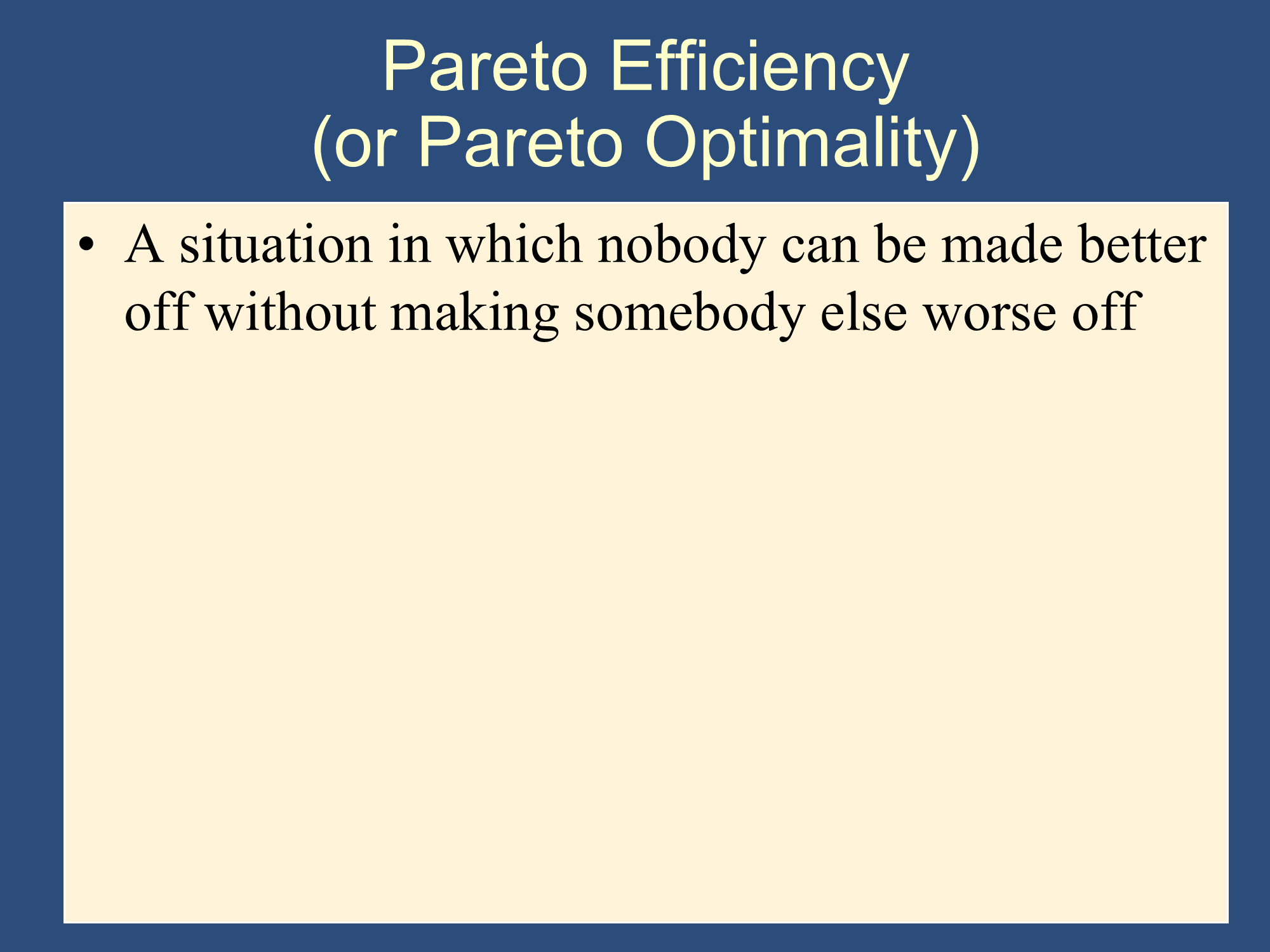
Pareto efficiency is a way of measuring how goods are distributed within a group of people. Simplifying slightly, a distribution of goods is Pareto Efficient if there is no way to redistribute the goods without making someone unhappy, but while making at least one person happier.
Pareto Efficiency doesn’t help us analyze situations if there is only a single good. Therefore, let’s consider a situation where there are two different goods. In particular, suppose there are two goods, oranges and bananas, and suppose that there are only two people, Bruce and I. Suppose both of us enjoy both fruits, but I prefer bananas and Bruce prefers oranges.
Situation 1: wrong fruit (Pareto inefficient)
Section titled “Situation 1: wrong fruit (Pareto inefficient)”First, let’s consider a situation in which I have an orange and he has a banana. According to our assumptions, we would both be better off if we traded. On a simple intuitive level, we can clearly see that this would not be an efficient way to distribute the goods in this society.
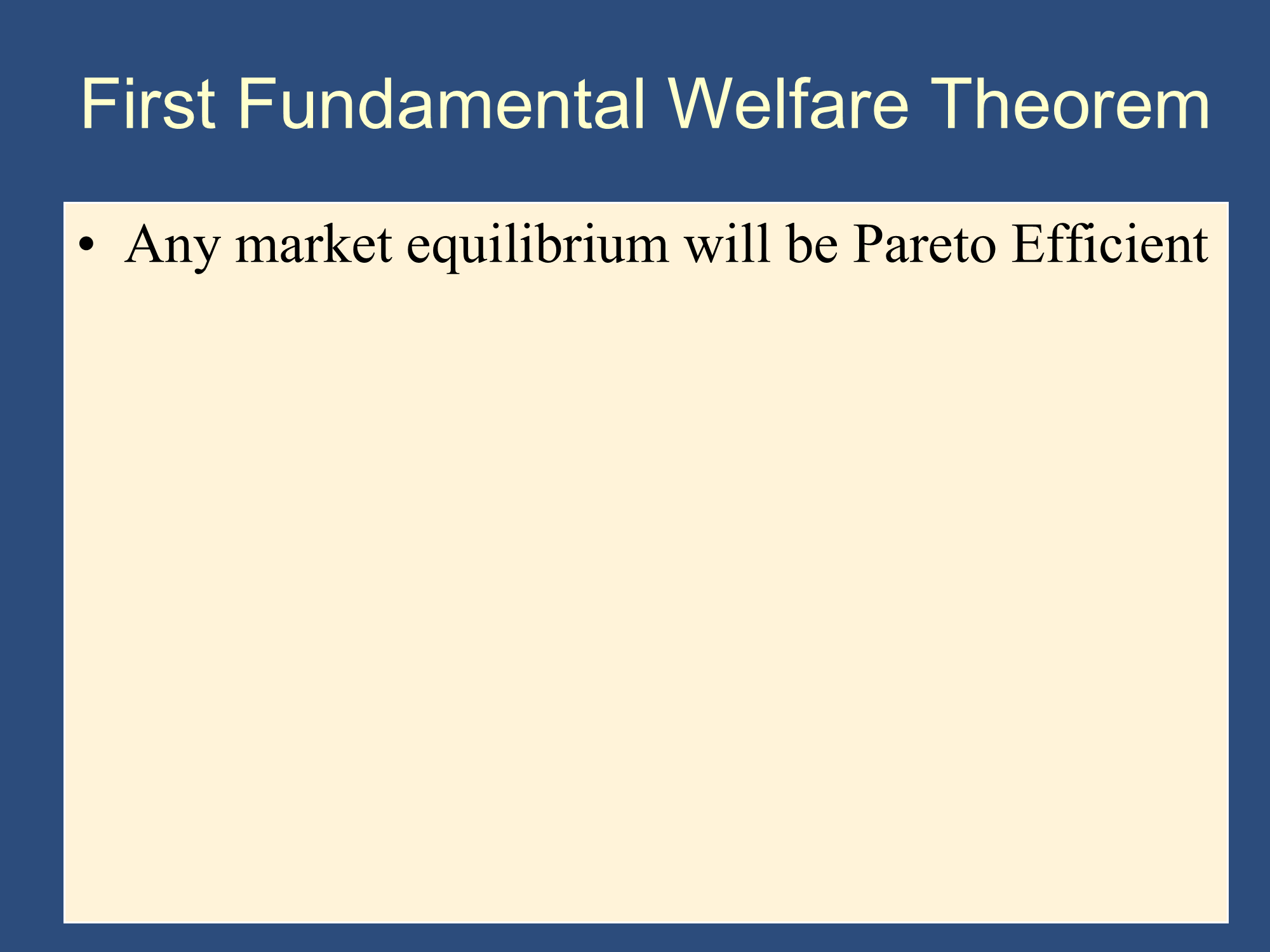
Turning to the concept of Pareto optimality, in this example, both Bruce and I would be happier if the goods were redistributed. Therefore there is no way to redistribute the goods without making someone unhappy, but while making at least one person happier. By definition, this situation is Pareto inefficient. We like that Pareto efficiency identifies this situation as inefficient, because it is clearly inefficient.
Situation 2: Bruce has everything (Pareto efficient)
Section titled “Situation 2: Bruce has everything (Pareto efficient)”In contrast, suppose Bruce has both the banana and the orange and I have nothing.
Would this be Pareto efficient? Strangely enough, it is. This is because Pareto efficiency doesn’t ask whether a distribution of goods is fair. It only asks whether a distribution of goods could be improved by redistributing the same goods.
Let’s check the Pareto efficiency of this distribution of goods. Can you think of a way of redistributing the goods that makes one person happier without making anyone less happy?
Well, any redistribution of the same goods will mean that Bruce has less fruit. If we assume that his desire for his own consumption outweighs his suppor
From our textbook:
16.2 Efficiency in Exchange
Section titled “16.2 Efficiency in Exchange”We begin [by looking at] the behavior of two consumers who can trade either of two goods between themselves. (The analysis also applies to trade between two countries.) Suppose the two goods are initially allocated so that both consumers can make themselves better off by trading with each other. In this case, the initial allocation of goods is economically inefficient.
In a Pareto efficient allocation of goods, no one can be made better off without making someone else worse off.
- Pareto efficient allocation - Allocation of goods in which no one can be made better off unless someone else is made worse off.
The term Pareto efficiency is named after the Italian economist Vilfredo Pareto, who developed the concept of efficiency in exchange. Notice, however, that Pareto efficiency is not the same as economic efficiency as we defined it in Chapter 9. With Pareto efficiency, we know that there is no way to improve the well-being of both individuals (if we improve one, it will be at the expense of the other), but we cannot be assured that this arrangement will maximize the joint welfare of both individuals.
Note that there is an equity implication of Pareto efficiency. It may be possible to reallocate the goods in a way that increases the total well-being of the two individuals, but leaves one individual worse off. If we can reallocate goods so that one individual is just slightly worse off but the other individual is much, much better off, wouldn’t that be a good thing to do, even though it is not Pareto efficient? There is no simple answer to that question. Some readers might say yes, it would be a good thing to do, and other readers might say no, it wouldn’t be fair. Your own answer to this question will depend on what you think is or is not equitable.
Feedback? Email munger.e1010@gmail.com 📧. Be sure to mention the page you are responding to.