👨🏫 Notes on E-1000 Lecture 5
How to calculate Marginal Opportunity Costs (MOCs)
Section titled “How to calculate Marginal Opportunity Costs (MOCs)”✏️ Given the following information, calculate the Marginal Opportunity Costs (MOCs)
| Laptops per worker year | Motorcycles per worker year | |
|---|---|---|
| China | 9 | 3 |
| US | 10 | 5 |
✔ There are four Marginal Opportunity Costs (MOCs) to calculate. We calculate all four using a similar process (please read all four examples from top to bottom)
To calculate the MOC of a laptop in China
Section titled “To calculate the MOC of a laptop in China”In China, in 1 year, one worker can produce either 9 laptops or 3 motorcycles. In terms of the resources spent:
- 1 worker-year = 9 laptops = 3 motorcycles
We can divide everything by 9 to calculate the MOC of 1 laptop in China:
- 1/9 worker-year = 1 laptop = ⅓ motorcycles
This means that in 1/9th of a year, a worker in China can either make 1 laptop or of a motorcycle.
If they decide to make one more laptop, it takes 1/9th year, so they can make ⅓ fewer motorcycles.
Therefore, in China, the MOC of 1 laptop in China is ⅓ of a motorcycle.
To calculate the MOC of a motorcycle in China
Section titled “To calculate the MOC of a motorcycle in China”We return to our original resources spent equation:
- 1 worker-year = 9 laptops = 3 motorcycles
We divide everything by 3 to calculate the MOC of 1 motorcycle in China:
- ⅓ worker-year = 3 laptops = 1 motorcycle
This means that in ⅓rd of a year, a worker in China can either make 3 laptops or 1 motorcycle. Therefore, to produce another motorcycle, they must reallocate productive capacity that could have built three laptops.
In other words, in China, the MOC of 1 motorcycle is 3 laptops.
To calculate the MOC of a laptop in the US
Section titled “To calculate the MOC of a laptop in the US”Returning to the table at the very start of this problem, in the US, the resources spent are as follows:
- 1 worker-year = 10 laptops = 5 motorcycles
If we divide everything by 10, it will tell us what can be made in 1/10th of a worker-year. Because 10 laptops can be made in a year, this will tell us what 1 laptop is equivalent to:
- 1/10 worker-year = 1 laptops = ½ motorcycle
Therefore, in the US, the MOC of 1 laptop is ½ motorcycle.
Likewise, starting with the original formula, if we divide everything by 5, it will tell us what can be made in ⅕th of a worker-year. Because 5 motorcycles can be made in a year, this will tell us what 1 motorcycle is equivalent to:
- ⅕ worker-year = 2 laptops = 1 motorcycle
Therefore, in the US, the MOC of 1 motorcycle is 2 laptops.
The MOC of a motorcycle in the US
Section titled “The MOC of a motorcycle in the US”Above, we have explained each step of the calculation very carefully. Now we strip the process down to its bare essentials:
- 1 worker-year = 10 laptops = 5 motorcycles
- ⅕ worker-year = 2 laptops = 1 motorcycles ← dividing everything by 5
- MOC of 1 motorcycle is 2 laptops
We can now copy everything into the table:
| MOC of Laptop | MOC of Motorcycle | |
|---|---|---|
| China | ⅓ MC | 3 Laptops |
| US | ½ MC | 2 Laptops |
✏️In the US, without trade, if they want one more laptop, what must they give up? What must they give up if they want one more motorcycle?
✔ To get more laptops, the US must reallocate labor away from motorcycles and toward laptops. To get one more laptop, without trade, the US must give up half a motorcycle. To get one more motorcycle without trading, they must give up 2 laptops.
Shortcuts to calculate MOCs
Section titled “Shortcuts to calculate MOCs”United States:
| What to write | Why you write it |
|---|---|
| 10 laptops = 5 motorcycles | Copy from the table (it’s given in the problem). |
| 1 laptop = 5/10 MC = ½ MC | Divide both sides by number of laptops (for 1/10th of a year) |
| MOC of 1 laptop is ½ MC | With the same work-time, a worker could make 1 laptop or .5 MC |
| MOC of 1 MC is 2 laptops | Take reciprocal (ie flip the fraction) |
✏️ Fill in the following table for China:
| What to write | Why you write it |
|---|---|
| Copy from the table (it’s given in the problem). | |
| Divide both sides by ___ (for 1/___th of a year) | |
| __________________________ | With the same work-time, a worker could make 1 MC or _____ |
| __________________________ | Take reciprocal (ie flip the fraction) |
✔ Click here to view answer
| What to write | Why you write it |
|---|---|
| 9 laptops = 3 motorcycles | Copy from the table (it’s given in the problem). |
| 1 laptops = ⅓ motorcycle | Divide both sides by 9 (for 1/9th of a year) |
| MOC of 1 laptop is ⅓ MC | With the same work-time, a worker could make 1 laptop or ⅓ MC |
| MOC of 1 MC is 3 laptops | Take reciprocal (ie flip the fraction) |
Perhaps you can find even more shortcuts, but I urge you to not go straight to the shortcuts until you fully understand the original process and why the shortcut works. Economics is far more about the thought process than any rote calculations.
Absolute and Comparative Advantage
Section titled “Absolute and Comparative Advantage”Absolute and Comparative advantage are defined and explained in the problem below.
✏️ Given the following data, which country has the absolute advantage in each good? Which country has the comparative advantage in each good? Who should export each good?
| Laptops per worker year | Motorcycles per worker year | |
|---|---|---|
| China | 9 | 3 |
| US | 10 | 5 |
| MOC of Laptop | MOC of Motorcycle | |
|---|---|---|
| China | ⅓ MC | 3 Laptops |
| US | ½ MC | 2 Laptops |
✔
Absolute Advantage
Section titled “Absolute Advantage”Absolute Advantage is defined as higher productivity. It means the ability to produce more of the good while using the same amount of resources. Using the “per worker year” table on the left, we see that a worker in the US can produce 10 laptops in a year. A worker in China can produce 9 laptops. Therefore, the US has an absolute advantage in producing laptops.
Summary:
Laptops per worker year | Motorcycles per worker year | |
|---|---|---|
| China | 9 | 3 |
| U S | 10 | 5 |
10 laptops > 9 laptops, so US has an absolute advantage in Laptops
5 MC > 3 MC, so US has an absolute advantage in Motorcycles
Comparative Advantage
Section titled “Comparative Advantage”Comparative Advantage means having a lower MOC. By looking at the “MOC of Laptop” column, we see that China has a lower MOC of laptops (only ⅓ of an MC instead of ½ of an MC) and that the US has the lower MOC of motorcycles (only 2 laptops instead of 3 laptops). Therefore China has a comparative advantage in laptops and the US has the comparative advantage in motorcycles.
🧠Intuition: To see why MOCs determine comparative advantage and trade flows, return to the definition of MOC. The MOC of a motorcycle is how many laptops you give up when you decide to make a motorcycle instead of those laptops (because the same worker can’t make both, you must choose).
When a worker makes a motorcycle in China, it takes them a certain amount of time (above, we calculated this to be ⅓ year). In that same amount of time, the worker could have made 3 laptops (above, we calculated that in China, ⅓ worker-year = 1 motorcycle = 3 laptops). Therefore, to make a motorcycle, they must give up 3 laptops. In contrast, in the US, ⅕ worker-year = 1 motorcycle = 2 laptops, so we give up only 2 laptops to make a motorcycle. Because the US has a lower MOC, it gives up fewer laptops to make a motorcycle and should be making and exporting motorcycles. In other words, it has a comparative advantage in motorcycles.
Summary:
MOC of Laptop | MOC of Motorcycle | |
|---|---|---|
| China | ⅓ Motorcycle | 3 Laptops |
| US | ½ Motorcycle | 2 Laptops |
- 2 Laptops < 3 Laptops ⇨ The US has a comparative advantage in motorcycles because it gives up fewer laptops to make a motorcycle.
- ⅓ motorcycle < ½ motorcycle ⇨ China has a comparative advantage in laptops because it gives up fewer motorcycles to make a laptop.
Terms of Trade
Section titled “Terms of Trade”How trade works:
- Based on comparative advantage, you decide what you are productive at and what the other country is more productive at.
- You put more resources toward the good you have a comparative advantage in. You buy the other good and pay with the good you are more productive in.
For example:
- The US specializes in motorcycles. It buys laptops from China and pays with motorcycles.
- China specializes in laptops. It buys motorcycles from the US and pays with laptops.
Definition: Terms of trade = how many units of the exported good must be offered in exchange for each unit of the imported good
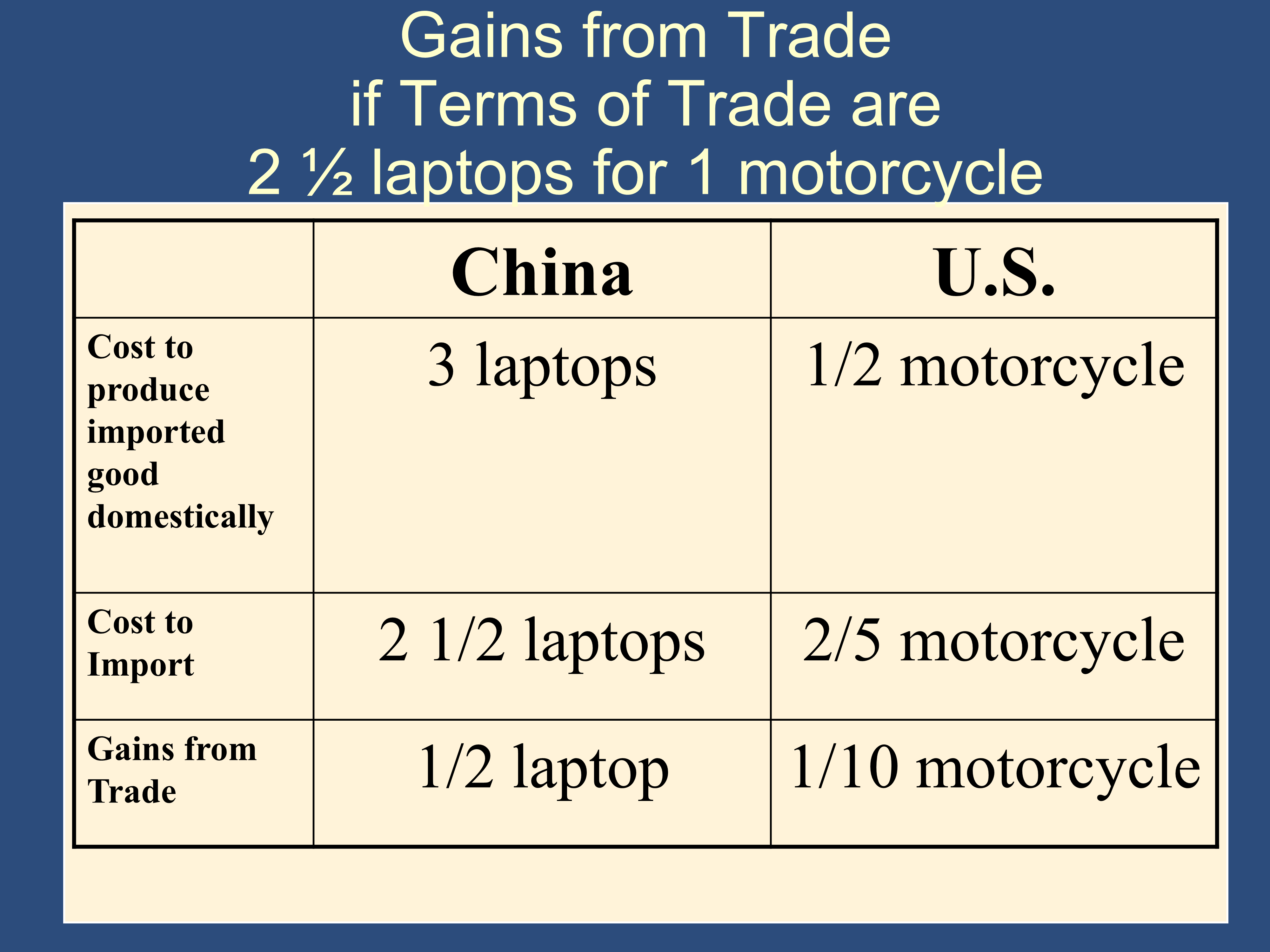
For example: Terms of trade = 2 ½ laptops per motorcycle = ⅖ motorcycle per laptop.
Something is acceptable to a country if it could make the country better off by specializing and trading (rather than just making the good domestically). Ie it is acceptable if it leads to “gains from trade.”
✏️Suppose China exports laptops to the US in return for motorcycles. 1 MC is traded for 1 laptop. Will these Terms of Trade (ToT) be acceptable to both countries?
| MOC of Laptop | MOC of Motorcycle | |
|---|---|---|
| China | ⅓ Motorcycle | 3 Laptops |
| US | ½ Motorcycle | 2 Laptops |
✔🙋♂️ someone will reject this…
China will accept these terms of trade. China exports laptops and wants motorcycles. Without trade, if they want a motorcycle, their MOC says that they need to give up give up 3 laptops. However, with trade, to get a MC, they only need to give up 1 laptop. Much cheaper!! 👍 Rather than making their own motorcycles, they will want to import US motorcycles.
The US will reject these terms of trade. US exports MC. It wants laptops in return. Will these ToT be acceptable to the US? The US is making MC. If it wants laptops, instead of making a MC, it can make _2_ laptops. (MOC of MC =2 laptops). With trade, instead of getting 2 laptops, it only gets 1 laptop. It will reject these terms of trade!!! 👎
Can we come up with a rule? (click to reveal the answers)
For China to be happy 👍, the price of a motorcycle must be
less than 3 laptops (without trade, to get a MC, they must give up 3 laptops. Trade must be better than this. They should give up less than 3 laptops.)
For the US to be happy 👍, the price of a motorcycle must be
more than 2 laptops (without trade, if they give up a MC, they get 2 laptops. Trade must be better than this. They must get more than 2 laptops instead of a motorcycle.)
For the US to trade, the value of a MC must be .
For China to trade, the value of MC must be .
The value of a motorcycle must be between 2 and 3 laptops:
Therefore, any Terms of Trade where a motorcycle is worth between 2 and 3 laptops will work for both parties.
There could be many, many possible terms of trade. Our techniques can only tell us which terms of trade are acceptable to both countries. We can’t figure out which terms of trade “are best” or “will happen.” All we can figure out is which possible terms of trade “might happen” because they are acceptable to both countries.
Terms of Trade and Reciprocals
✏️If the terms of trade say a motorcycle is worth 2.5 laptops (ie 5/2 laptops), what is a laptop worth?
✔Just flip the fraction (ie take the reciprocal). 1 laptop is worth ⅖ of a motorcycle. You can also do this with algebra:
- In terms of value: 1 motorcycle = 5/2 laptops
- Divide both sides by 5/2: ⅖ motorcycle = 1 laptop
Shortcut
Section titled “Shortcut”For terms of trade to be mutually acceptable, they must be between the two MOCs. For example, in the following table:
- The value of a motorcycle must be between 2 and 3 laptops.
- The value of a laptop must be between ⅓ and ½ motorcycle.
| MOC of Laptop | MOC of Motorcycle | |
|---|---|---|
| China | ⅓ Motorcycle | 3 Laptops |
| US | ½ Motorcycle | 2 Laptops |
To calculate the terms of trade, make it between the MOCs of the two countries. For example, 1 Motorcycle must be traded for between 2 and 3 laptops. 1 Laptop must be traded for between ½ and ⅓ motorcycles.
What if the MOCs look like this:
| MOC of Laptop | MOC of Motorcycle | |
|---|---|---|
| China | ⅓ Motorcycle | 3 Laptops |
| US | ⅓ Motorcycle | 3 Laptops |
There is no comparative advantage and no reason to trade. The gains from trade come from the differences in the MOCs. If the MOCs are identical, there is no point to trade. If the MOCs are very close, then the gains from trade may not be larger than the transportation costs, so, practically, there may be no point in trade.
99% of the time, one country will have the comparative advantage in laptops and the other country will have the comparative advantage in motorcycles. 1% the MOC of a laptop will be the same for both countries. If the MOC of a laptop is the same in both countries, then neither country will have a comparative advantage, and there is no point of trade.
Gains from Trade
Section titled “Gains from Trade”Gains From Trade if Terms of Trade are 2.5 Laptops for 1 Motorcycle
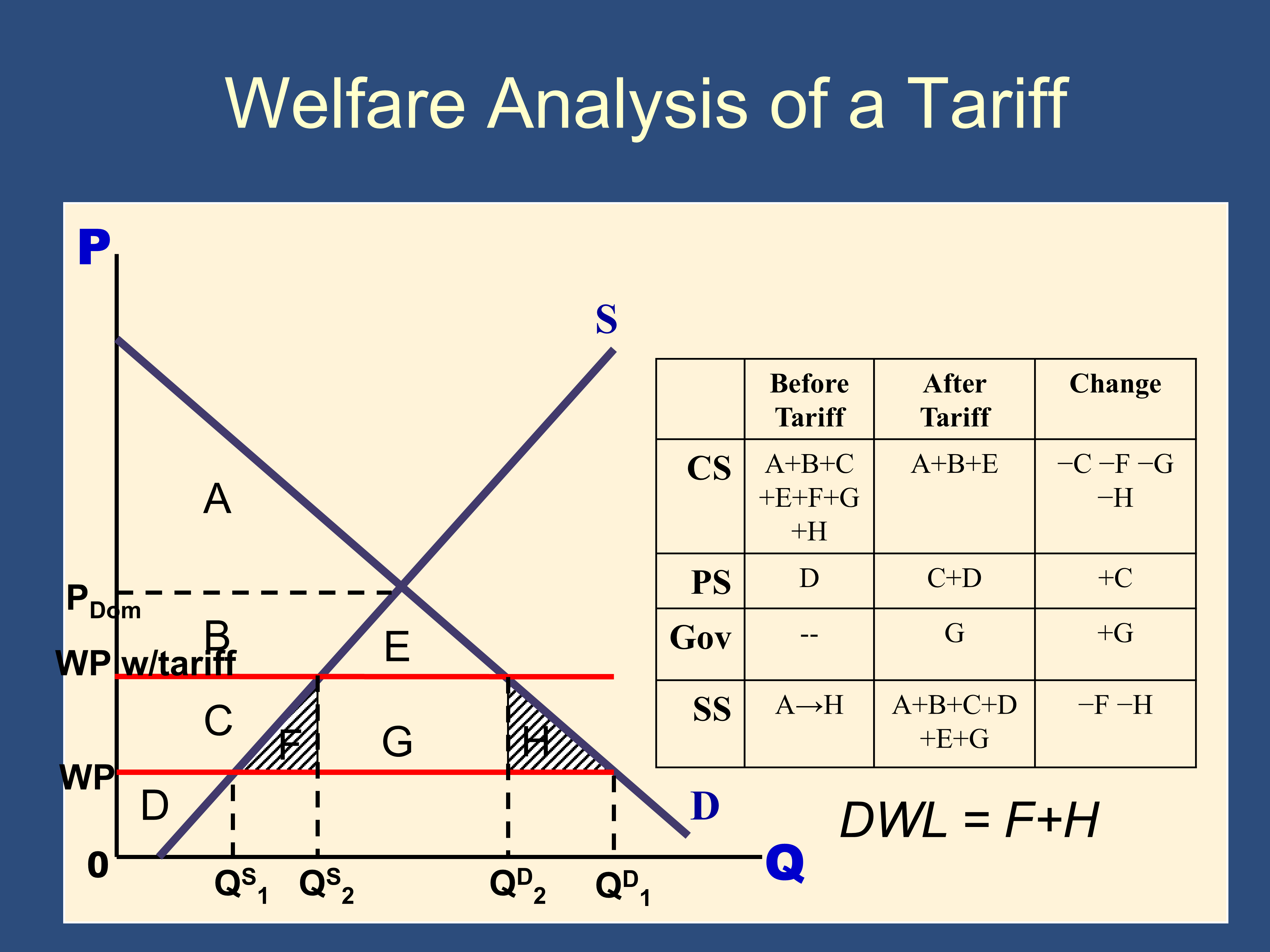
Welfare Analysis of Trade
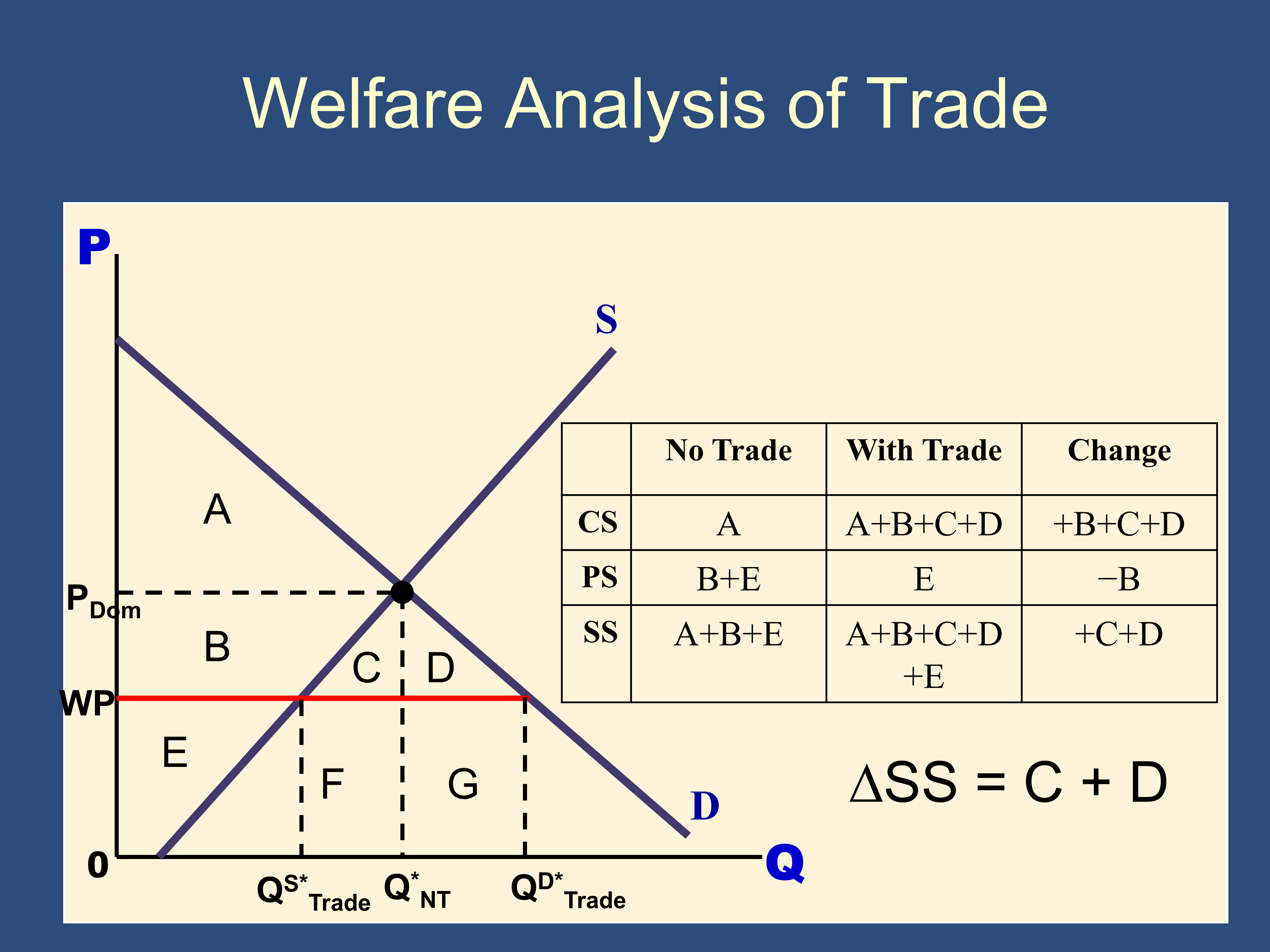
Section titled “Welfare Analysis of Trade”
Feedback? Email munger.e1010@gmail.com 📧. Be sure to mention the page you are responding to.