✏️ Formula Example
✏️
What is profit?
✔ Click here to view answer
We know that we have to do the same three steps that we covered on Thursday..
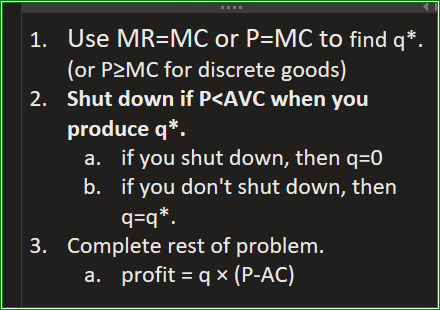
Step 1: The first step is setting , as you note. We can do this with our equations…
We can then use algebra to solve for the q which will make .
Therefore,
Step 2: Is . , so , and
When , then
, so we don’t shut down. We produce .
Step 3:
I won’t shut down, but I’ll be losing money, so I exit in the long run. ✅
🙋 Can you tell us what happens in the long run and the short run?
✔ In the short run, your fixed costs are fixed. You are are stuck paying them.
In the short run, you must pay $20 of fixed costs. I like using the example (just for developing intuition) of the fixed cost being a lease. So let’s assume you have a $20 lease.
In the short run, if you produce , your profit is -1.25.
In the short run, if you produce 0 (shut down), then:
Clearly, in the short run it is optimal to produce
In the long run, you can also exit. If you exit, , , , and , because your firm doesn’t exist.
Now you have three options.
if you produce , your profit is -1.25.
if you produce 0 (shut down), your profit = -20
If you exit, your profit = $0 - $0 = $0.
Clearly, exiting is the best! In the long run, it wouldn’t be optimal to stay in business and produce . Rather, it would be optimal to exit. Exiting is like shutting down because , but it is different because you have no costs at all (your firm doesn’t exist).
Therefore, the firm would just keep on producing units per year until the end of the short run (ie until the lease expires). Then it would exit and produce 0. ✅
Feedback? Email munger.e1010@gmail.com 📧. Be sure to mention the page you are responding to.