🔎 Monopoly Power, Multiple Firms, and Elasticity
🙋 Will you please explain the concepts relating to monopoly power, elasticity, and multiple producers in a market? Also, what’s the difference between a firm’s demand and a market demand?
✔ Let’s start with some terminology:
- The market demand curve tells you the total quantity demanded for all firms for any given market price.
- The firm’s demand curve tells you the quantity that a specific firm can sell based on the price it charges.
Naturally, when a firm is a true monopoly, the market demand curve and the firm’s demand curve will be identical.
The elasticity or inelasticity of market demand and the firm’s demand curve are just what they sound like: the flatness or steepness of those two curves. (An elastic demand curve is relatively flat and an inelastic demand curve is relatively steep.).
A third term:
- Monopoly power or market power just refers to the ability of any firm to raise price above marginal cost. In a perfectly competitive market, firms don’t have any market power, because they will always have to set .
Note that many firms that aren’t monopolies can raise their price above marginal cost. We know that firms can’t do this in perfect competition, but there are other market structures beyond Perfect Competition and Monopoly where a firm can raise price above marginal cost. Therefore, a firm does not need to be a monopoly in order to have market power/monopoly power.
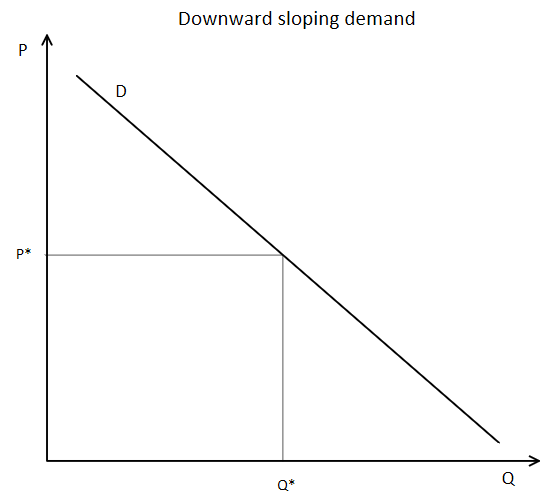
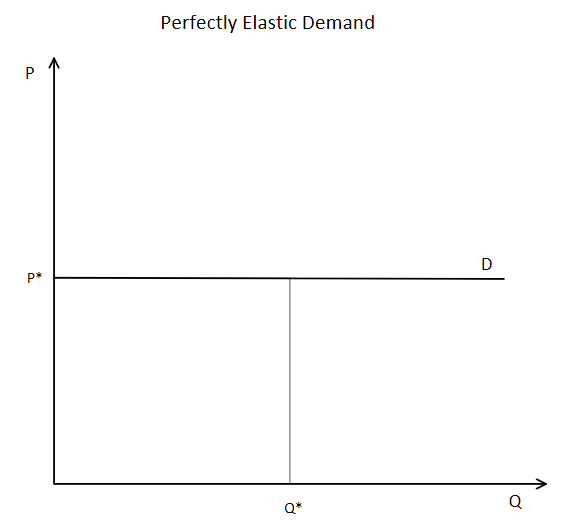
In fact, as long as the firm’s demand curve isn’t perfectly flat (ie perfectly elastic), then the firm will be able to raise prices. To understand why this is the case, consider the following two diagrams.
- The diagram on the left looks like the demand curve faced by a monopolist. Because the demand curve is downward sloping, the firm has the ability to raise prices without losing all of its customers. This is exactly what we mean by market power or monopoly power! Because the firm faces a downward sloping demand curve, it will do the analysis that we learned in this chapter. It will end up raising its price above marginal cost, just like monopolies do.
- In contrast, the diagram on the right, with perfectly elastic demand, looks like the demand curve faced by a perfectly competitive firm. If that firm raised its prices above , what would happen to the quantity demanded of that firm? Drawing any horizontal line above , we can see that the quantity demanded of that firm will be zero, just as we learned when we were studying perfect competition.
The bottom line is that if the firm’s demand curve is downward sloping, then the firm can get away with raising prices somewhat and will have some market power. In contrast, if the firm’s demand curve is perfectly flat (ie. perfectly elastic), then the firm has no option to raise prices above marginal cost and will have no market power.
For any firm, what they care about the most, is their own firm’s demand curve. That is the curve that directly affects the prices they can charge and how much they can sell. Even if a firm is a monopoly, so that the market demand curve is equal to the firm’s demand curve, it is more correct to say that the firm cares about its own demand curve.
The following equation shows that when the firm’s demand curve is “more elastic” (=more price sensitive), the firm has less monopoly power. In contrast, when the firm’s demand curve is less elastic (=less price sensitive), the firm has more monopoly power.
Note that that Ed is a negative number, so by more elastic, we mean that Ed is lower/more negative. Conversely, by less elastic, we mean Ed is higher/less negative. More information can be found here: 🔎 Elasticity, Markup, and Profit
If there are multiple producers in the market, then consumers will have more options. They can be more price-sensitive, because if a price is too high, they will just go elsewhere. Therefore, with multiple producers, each firm’s demand curve will become flatter/more elastic. Basically, firms won’t be able to raise their prices above marginal cost because consumers will take their business to another firm. ✅
Feedback? Email munger.e1010@gmail.com 📧. Be sure to mention the page you are responding to.