🙋 Student Q&A (Lecture 2)
Click here to learn about timestamps and my process for answering questions. Section agendas can be found here. Email office hour questions to munger.e1010@gmail.com. PS1Q2=“Question 2 of Problem Set 1”

📅 Questions covered Thursday, Feb 5
Section titled “📅 Questions covered , Feb 5”🕣 8:17pm
❔ How do we determine which good goes on which axis. What does that have to do with the equations?
✔ You can put either good on the x-axis and either good on the y-axis. And you can do the analysis with either good on either axis. So you get to arbitrarily choose which good goes on which axis. With that said, you have to apply it consistently.
One of our formulas is that the slope of the budget constraint is px over py. And so you have to put the price of the good on the x-axis on the top of the fraction. And you have to put the good on the y-axis on the bottom of the fraction.
So once you choose which good you’re going to put on the y-axis, and which goods you’re going to put on the x-axis, then you got to stick with it. So which good that you’d put on which axis determines the slope of the budget constraint and the slope of the indifference curve
9:11pm
- In the last question from this page: https://1010.robmunger.com/l2/budgetconstraint/
You mentioned that given the budget $20k:
a. The max you can purchase of Y is 20Y
b. The max you can purchase of X is 10X
Could you please let me know where we got 20Y and 10X from? Are these assumptions? I could not understand how we got the max consumption to be 20Y and 10X given a budget of $20k (the only thing the question mentions).
Screenshot below of question I’m referring to:
In video.
9:13pm
- In this question, how did we derive the MU for the second slice? Given that we only have information of the 1st and 3rd slice? From slice 1 to 4 we got 4 units of MU, but that could mean from slice 1-2 we could either get 1 or 3 units.
1 to 4 could be 2+2 or 3+1. How did we assume that the second slice would give 2 units exactly. I’m a bit confused how this question was answered.
✔ The formula calculates the average MU from consuming the second and third slices, as you go from 1 to 3 slices.
9:19ish 4. In this question, the answer is not mentioned. I believe it is b. The price of Pizza fell, is that correct?
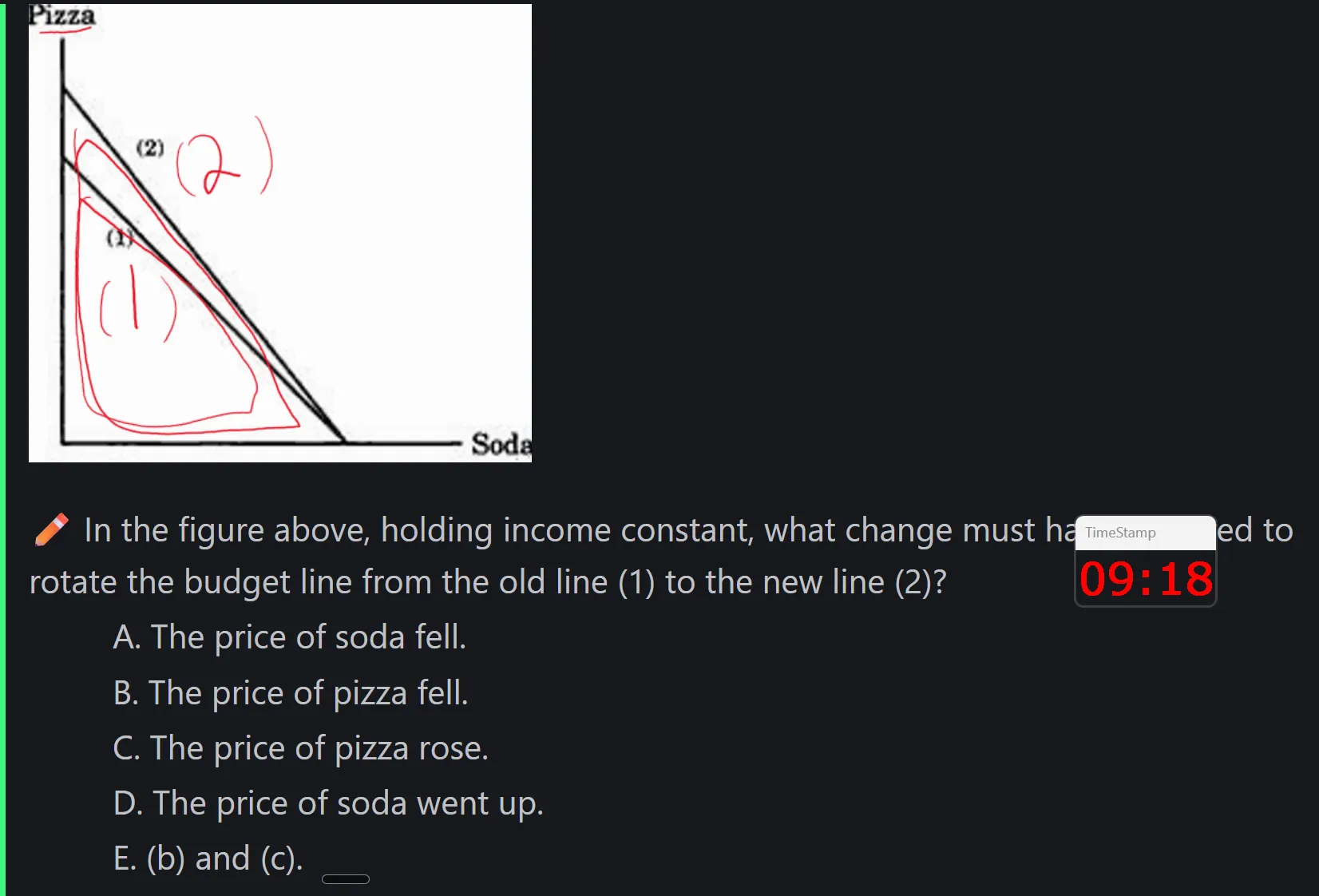
B
🕣
❔ How to ask a good question
✔ Covered this at the start
🕣 Covered earlier
❔ Interaction of IC and BC on graph.
✔
🕣 9:22pm
❔ Can we assume all homework and questions always have a convex MRS?
✔
What makes this challenging is the issue that the official thing that you’re supposed to know in this class is that indifference curves are almost always convex. So it would be very legitimate of you to say in this specific problem set question: “Is this indifference curve convex?” And there’s a very good chance I’ll be able to answer that without any problem. So that’s probably a great interpretation question. In general, yes, typically on a homework you can assume that, but I can’t guarantee that for any homework problem you can, so you should probably ask me an interpretation question.
If you know how to solve a problem set question but just aren’t sure how to interpret it, then you can always ask an interpretation question. It’s generally okay to ask, “Should I assume that an indifference curve is convex in this question?” You can always ask that as an interpretation question about a specific problem set problem.
🕣 9:23pm
❔ If I am given marginal utilities, how can I figure out the total utility?
✔ In some problems, you can assume that when you’re not consuming anything, your total utility is zero. For questions like that, this is an easy question to answer.
Suppose you are told that the marginal utility of your first slice of pizza is 10 utils. The marginal utility of your second slice of pizza is 8 utils. The marginal utility of your third slice of pizza is 6 utils.
MU: 1 → 10 2 → 8 3→ 6
In this case, your total utility after consuming one slice of pizza would be 10 utils. Your total utility after consuming two slices of pizza would be 10 + 8 = 18 utils, and your total utility after consuming three slices of pizza would be 10 + 8 = 24 utils.
With that said, you can only do this type of analysis if you know what your utility is when you are consuming zero slices of pizza. For that, I encourage you to ask me because that’s really an interpretation question. You have the right to know how you should interpret any given question. As long as you can reason through the answer, given that you are good to go.
This is a little bit like the previous question in that the economics is very clear, but the economics can be a little bit ambiguous from a scientific perspective. We can’t assume that your total utility starts out at zero when you are consuming no units of a given good. However, in some problems, people may assume that when you’re consuming no units of a given good, that your total utility is zero. It’s a legitimate thing to ask that question, and it’s a perfectly good interpretation question.
🕣 9:34pm
❔ Could you help explain what the meaning behind the slope is for the curves we learned yesterday. I’m having a bit of a mental block on the meaning of the slopes of the curves.
🕣 9:36pm
❔ Absolute Value
✔ Absolute value just means that you ignore the minus sign. By taking the absolute value, you are deliberately and consciously saying that you are going to ignore all minus signs and turn all negative numbers into positive numbers.
🕣
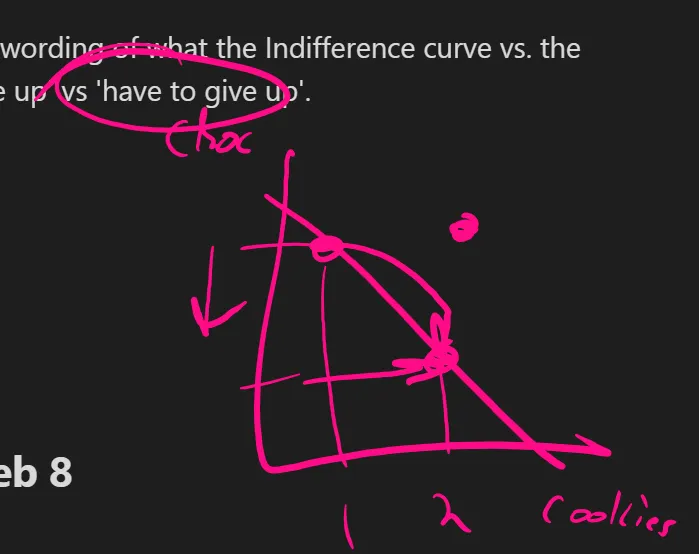
❔ Rob, can we please also go over the concepts or wording of what the Indifference curve vs. the Budget constraint is? I am referring to ‘willing to give up’ vs ‘have to give up’.
✔
📅 Questions covered Sunday, Feb 8
Section titled “📅 Questions covered , Feb 8”🕣 3:06pm
❔ Marginal rate of substitution is the rate at which the person is willing to give up for there loss of utility evens out? Ex. 100 utils goes down to 70 utils due to loss but trades off time to get back 30 utils to get back to that 200 Utils?
✔ Yes. Marginal Rate of Substitution is what happens as you move along the same indifference curve. So you’re going to stay on exactly the same indifference curve, so you’ll have exactly the same utility. It’s asking, as you go along that indifference curve, how many units of good y are you giving up for each unit of good x that you get in return and still being just as happy. And that’s where a topic that comes in and we’ll get to later, is you’re willing to slide along the indifference curve because you’re compensated for the units of y that you give up by the units of x that you get in return.
🕣 3:09pm
❔ Just to be clear the reason why the indifference curve is negative is because it is trying to show the different combinations of the two goods and they have to go along the x and y axis to equal the number of utils which creates the shape it does
✔ In order to be on the same indiffernce curve, you must gain one good and lose the other. recording
🕣 3:10pm
❔ If a consumer has different combinations. As long as they are along the budget line they are still indifferent? Get a clear explanation
✔ I think you are thinking of the indifference curve. So you are indifferent between all of the bundles of goods on the indifference curve. That’s why we call it an indifference curve. So indifferent means that you think they’re equally as good. And that means that they have the same utility because if one bundle of goods had a higher utility, then you wouldn’t be indifferent; you definitely want the one with a higher utility because literally utility tells you which one you want. That’s what utility is.
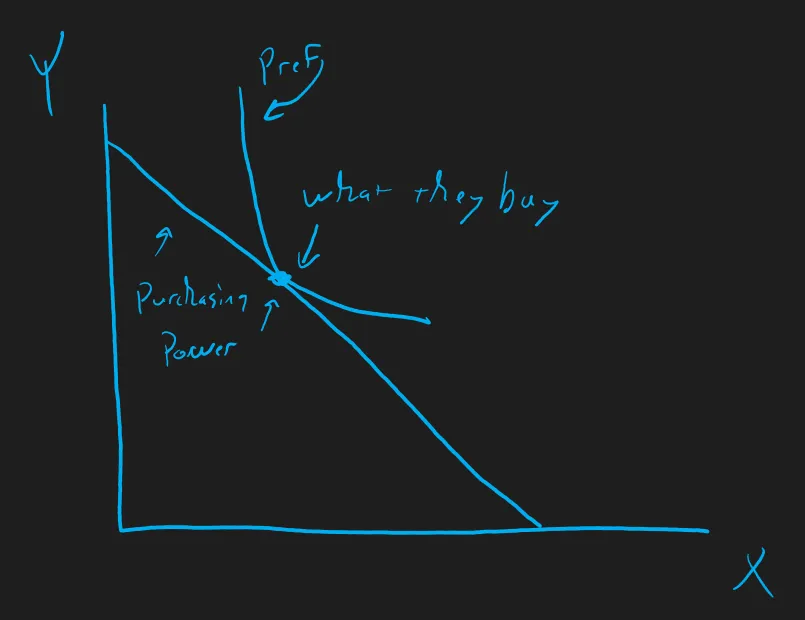
Almost always there is only one point of tangency.
Here are two counter-examples that will almost never happen:
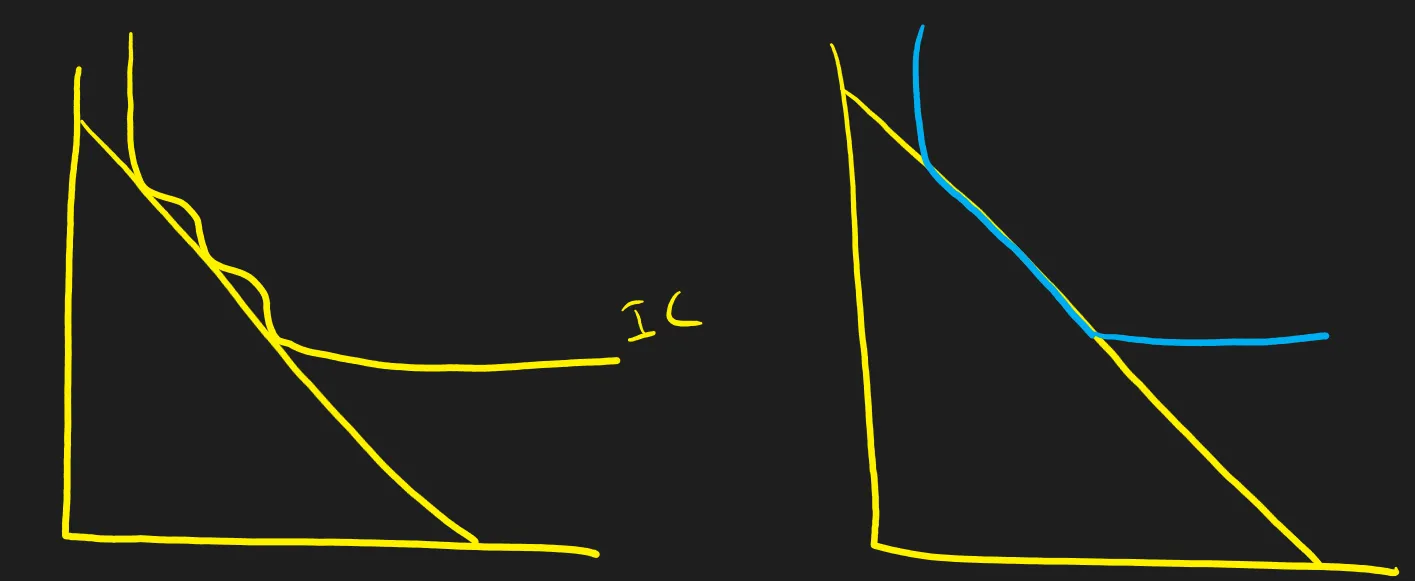
That probably doesn’t make sense yet, don’t worry. What you need to know is that the marginal rate of substitution tells you how steep the indifference curve is. If the marginal rate of substitution is decreasing, then the indifference curve is always getting steeper.
In those two examples, the marginal rate of substitution is not always getting steeper. In the example on the left, you can see that the indifference curve gets flatter and then steeper and then flatter and then steeper and then flatter again. That’s happening in the wiggly part. So in the wiggly part, it’s getting flatter and steeper and flatter and steeper and then flatter again.
🕣 3:22pm
❔ Can you actually make ANY different combinations to create one indifference Curve?
✔ Every single point has an indifference curve going through it.The indifference curves can have all sorts of shapes, with four exceptions. Things that they can’t do:
- They’re usually convex like that. They tend to get flatter as you go down to the right. That’s because there’s diminishing marginal rate of substitution.
Here are the other three:
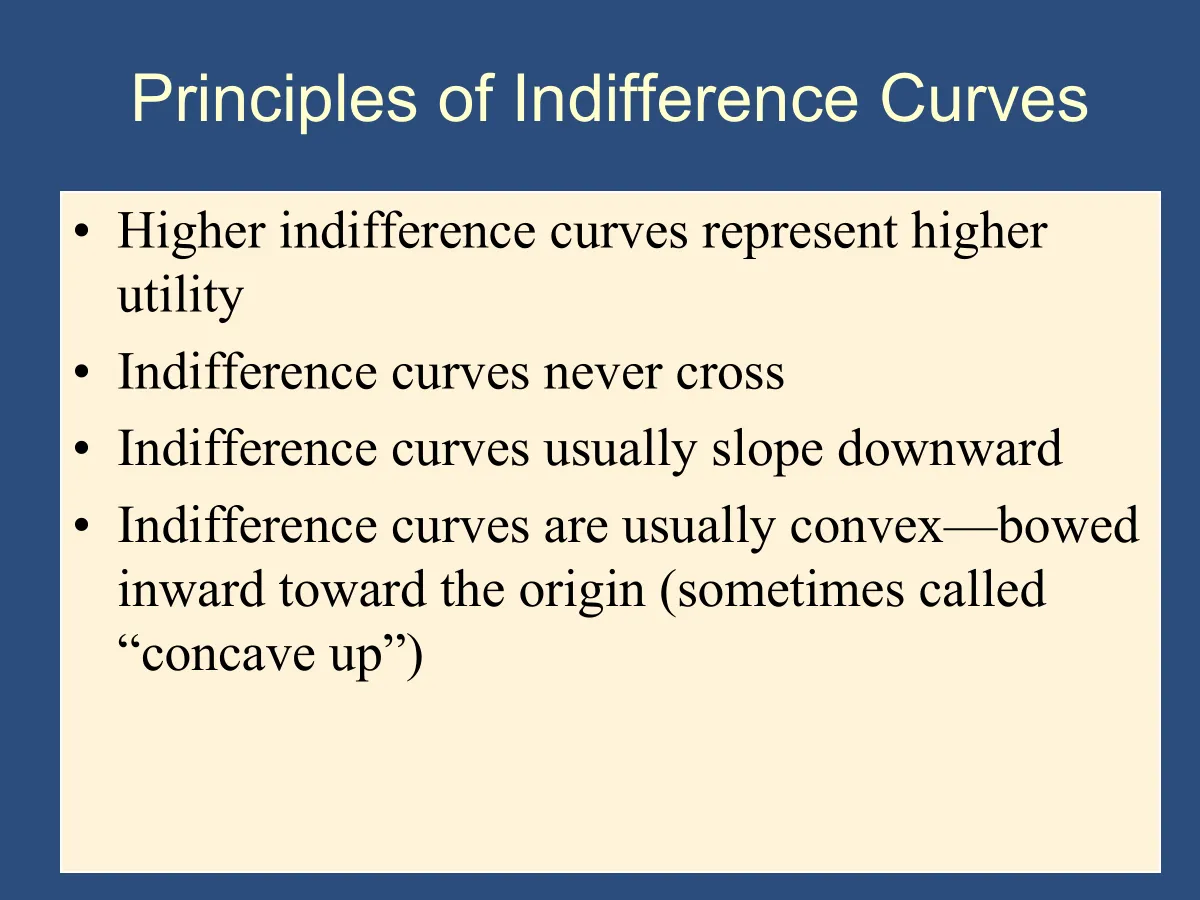
🕣 3:25pm
❔ Is the slope of the budget constraint equal to the marginal rate of substitution between the goods?
✔ The slope of the budget constraint isn’t generally equal to the marginal rate of substitution. It is, however, equal to the marginal rate of substitution at the optimal consumption point. This sometimes throws people off a little bit because they learn to memorize as they go through the next lecture that at the point of optimal consumption, the slope of the budget constraint equals the marginal rate of substitution. But it’s not going to be true everywhere. I think a diagram will help.
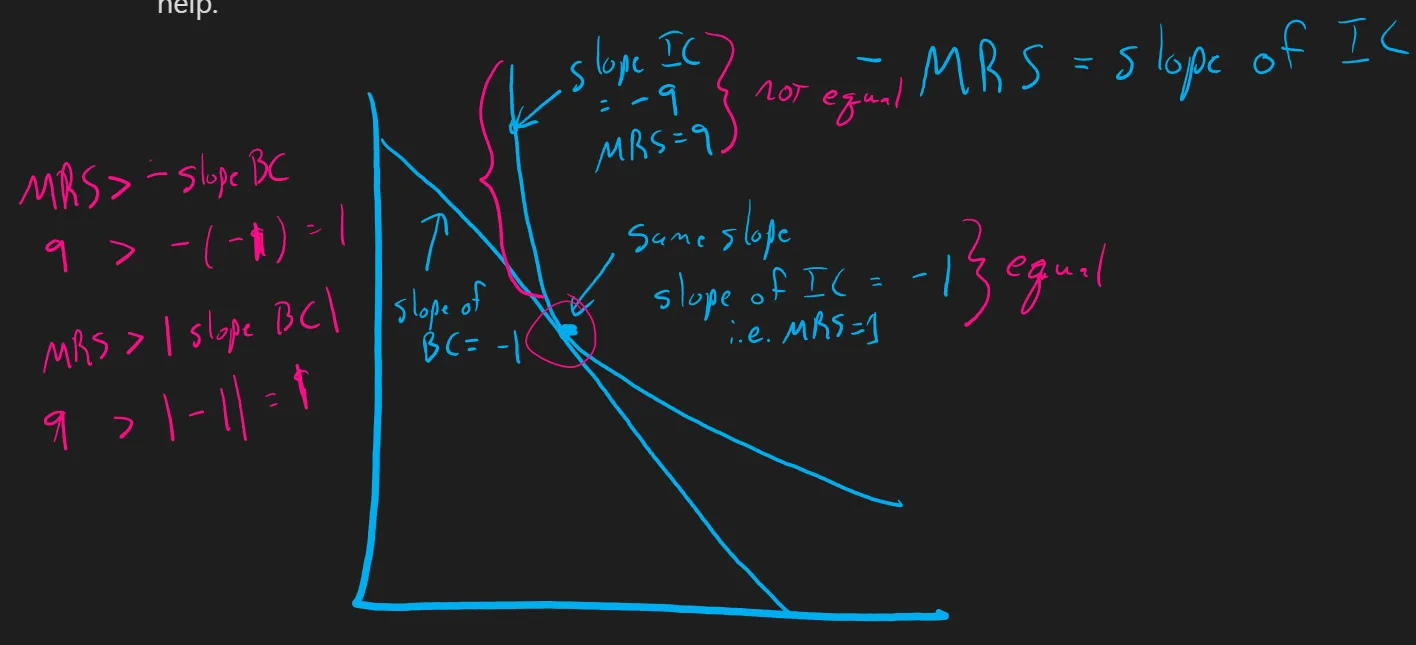
At the point of tangency, the slope of the budget constraint equals the negative of the marginal rate of substitution.
Another thing that you can say is that at the point of tangency, the absolute value of the slope of the budget constraint equals the marginal rate of substitution.
🕣 3:33pm
❔ Interpretation: in question 8, what is meant by “The absolute value of the slope of the budget constraint”
✔ See above!
🕣 3:33pm
❔ Can you explain diminishing Rate of Marginal Rate of Substitution and how to understand the use of it in a real life example?
✔ See video.
🕣
❔ Could you go over again why it’s -MRS = - (MUx / MUy)? Why is the minus sign there?
✔ You can also write MRS = MUx/MUy. That’s fine, too.
However, if we are talking about the slope of the IC, you need the minus. Slope of IC = -MRS = - MUx/MUy this is because the indifference curve is sloped downward reflecting the trade-offs that I mentioned on the video.
🕣 3:54pm
❔ Also why is the slope IC = -MRS? As in why is there the -?
✔ Because the slope is negative. It represents that there must be a tradeoff for you to be indifferent between the two baskets of goods in question.
🕣 3:55pm
❔ Interpretation: Q 7 What is meant by 22 utils from consuming the first can of soda
✔
🕣 3:59pm
❔ Interpretation: Q15: Why is there no indifference curve through point C?
✔
🕣
❔ What does currently willing mean?
✔ Based on the current consumption you would be willing to change.
🕣
❔ Q7 In this question, should I assume that the total utility for zero cans is zero?
✔
🕣 4:05pm
❔ Can you please go over the first paper details?
✔
Feedback? Email munger.e1010@gmail.com 📧. Be sure to mention the page you are responding to.