🙋 Student Q&A (Lecture 8)
Click here to learn about timestamps and my process for answering questions. Section agendas can be found here. Email office hour questions to munger.e1010@gmail.com. PS1Q2=“Question 2 of Problem Set 1”

📅 Questions covered Thursday, Apr 9
Section titled “📅 Questions covered , Apr 9”No questions.
📅 Questions covered Sunday, Apr 12
Section titled “📅 Questions covered , Apr 12”🕣 7:44pm
❔ I do questions the same. Am i missing something?
✔ No, that’s the glory of game theory.
What’s amazing about Game Theory is that a bunch of economists, most famously John Nash, came up with a strategy that lets you solve any game, no matter how different, using the same technique. That means you can take any strategic interaction you can imagine, with simultaneous moves like these, and solve it in exactly that way. There’s one way to solve it, and it makes everything scientific because it gives you a right and a wrong answer.
The core insight is that, in the Nash equilibrium (when we put the little underlines in), we’re finding situations where a given player is doing their best response. When there are two underlines, it means both players are doing their best response. When the stakes are high, it usually makes sense that both players will be doing their best and will probably be doing a best response. We have a great methodology for always finding the Nash equilibrium and the outcomes where both players are doing the best response. It’s often reasonable to discard other outcomes because, when the stakes are high, people are going to play their best responses.
That’s the wonder of Game Theory. With that larger framing in mind, this is not the sum total of Game Theory. If you take a dedicated course in Game Theory, you can learn about game trees, which have a more explicit notion of time (one player moves, then another, then a third, and so on). You can have more than two players. In health economics, for example, we often studied the interaction between physicians, patients, and insurance companies, and each of them has different motivations. There can be interesting strategic interdependence between those roles. You’ll often have more than two players, and you might have thousands of players. Game Theory can handle that too. You might have interactions over time, and you may have hidden information. The math gets tough, but it’s the math that allowed us to precisely formulate information economics, which we’ll cover in the last week or two of the course. It’s very powerful, and it’s amazing what we can do with these games. All of the strategic situations we can capture, as we saw in that little survey of games on Thursday.
🕣 7:49ish
❔ Where si the math?
✔ see video
🕣 7:53pm
❔ Would firm A and B ever have different strategies?
✔ Yes, this is definitely possible and happens frequently in other applications of game theory. For example, in medical situations, with physicians, patients, and insurance companies, the insurance companies can shape and control the contract. You can then think about the different actions the physicians and patients choose.
🕣 7:53pm
❔ Why is it called the prisoner’s dilemma?
✔ It’s called the Prisoner’s Dilemma because these scenarios often come with stories. The classic story we use to illustrate it is about two people who committed the same crime. They’ve been caught by the police and are being interrogated. This is the form of the game I used on the pages “Finding Dominant Strategies” and “Finding Nash Equilibria.”
On those pages, Rob and Bruce have committed a crime together, and they are each being interrogated separately. They can either confess or remain silent. They would both be better off if neither confesses, since they would only go to jail for a year each. For both of them, confessing is the dominant strategy. If these payoffs reflect what they actually care about (which may not be true, for example if they care more about honor, affection, etc.), they will both confess, leaving them both miserable. This is a Prisoner’s Dilemma: a situation in which the cops can outsmart the prisoners by interrogating them separately.
🕣 7:55pm
❔ relationship between terms
game theory
NE
DS
PD
✔
Game theory is a way of analyzing strategic interaction in which you write down the strategic situation in a formal way, as depicted on the following slide.
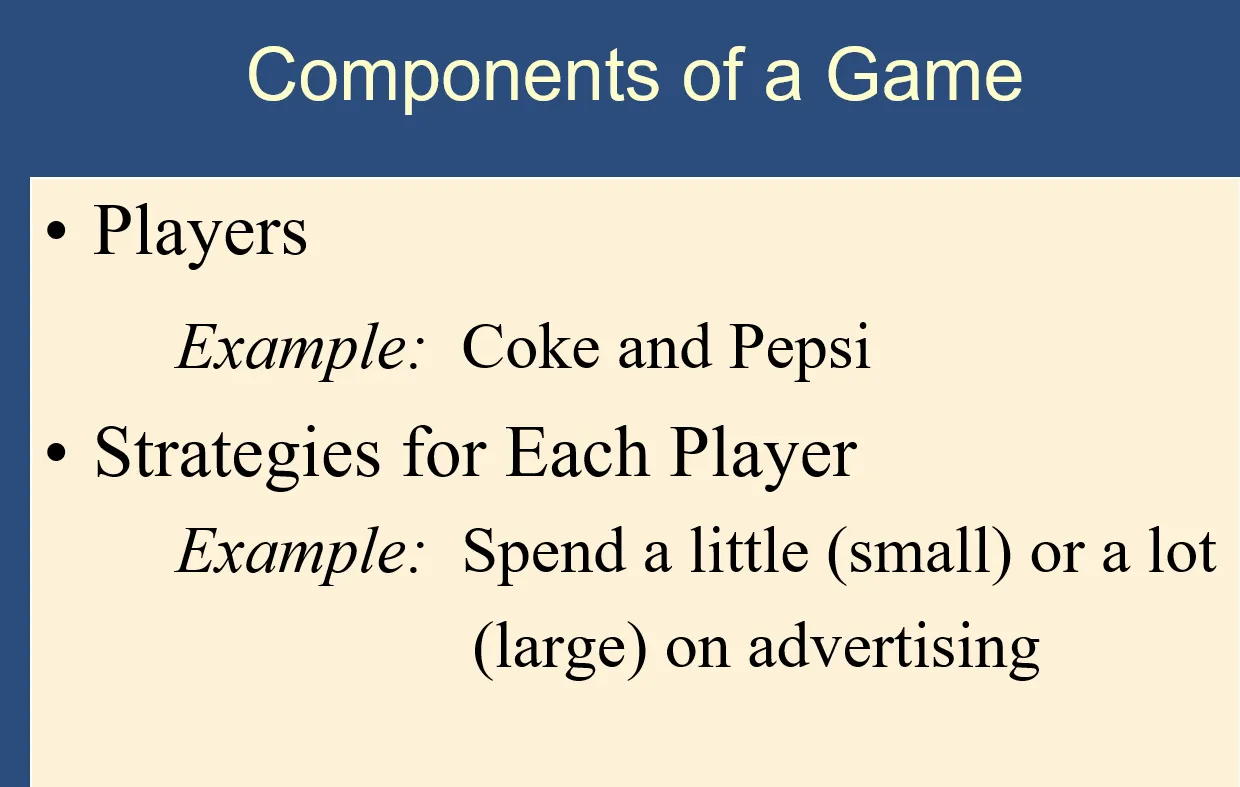
Nash Equilibrium is a specific solution concept in game theory. After you have written down the players, their strategies, and their payoffs, you can look for Nash Equilibria. You can also look for dominant strategies. The dominant strategy equilibrium is another solution concept you can apply to a game.
Game theory is a way of writing down and modeling a situation, and a solution concept like Nash Equilibrium or dominant strategy equilibrium is a way of making a prediction in that game.
I want to be clear about the distinction between a dominant strategy and a dominant strategy equilibrium.
A dominant strategy is when a player has one strategy that is always better than all their other strategies, no matter what their opponents do. In other words, it is better than every other strategy they could choose, regardless of what the other players choose. When that happens, the player has a dominant strategy.
If every player in a game has a dominant strategy, we call that a dominant strategy equilibrium. Since it seems reasonable that each player will play their dominant strategy, we can be fairly confident that the dominant strategy equilibrium will actually occur. That makes it a very robust prediction.
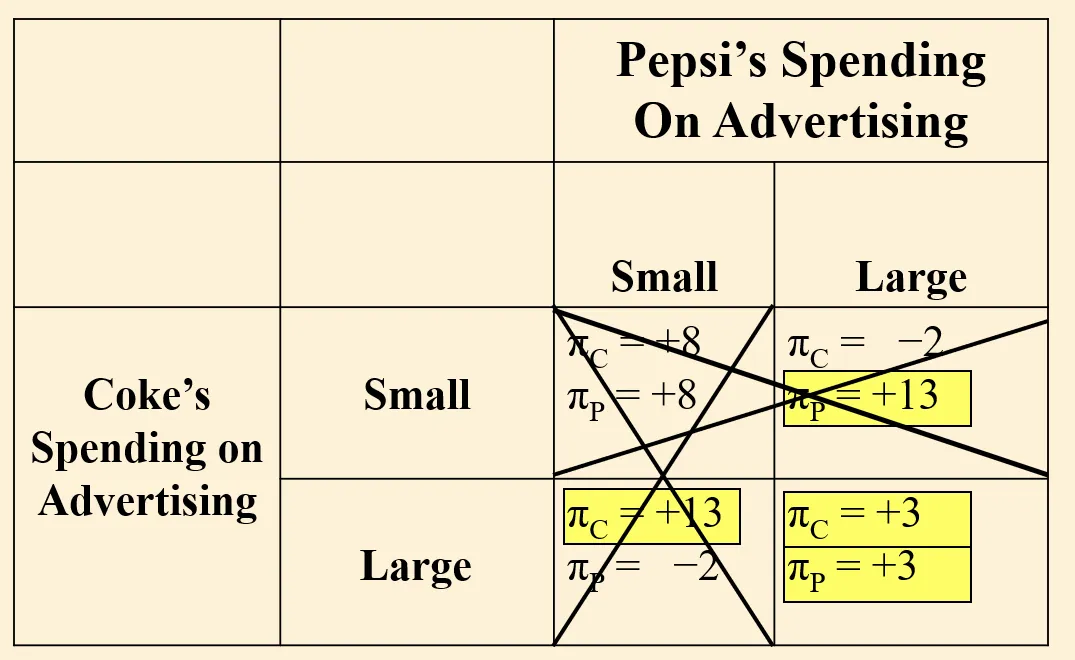
Finally, a Prisoner’s Dilemma is a game where there is a dominant strategy equilibrium, but it is one that both players dislike. One situation you can analyze as a Prisoner’s Dilemma is the classic example of two prisoners being held in separate cells by the police. That is the example I covered on those two web pages. Bruce also gave another Prisoner’s Dilemma example in which two firms had to decide whether to advertise.
In the following slide, you can see that in that game both players have a dominant strategy to spend a large amount of money on advertising.
🕣 8:10pm
❔ Can we agree that the Prisoner’s dilemma can be used in cases where players don’t have to be criminals?
✔ Definitely.
The Prisoner’s Dilemma can also apply to situations involving price fixing. In price fixing, cooperating can actually be illegal, so whenever you think about the Prisoner’s Dilemma and crime, remember that cooperation can be illegal if it involves price fixing. Because price fixing is illegal, it often uses the word “collude” to describe the unethical (and potentially illegal) behavior of two manufacturers colluding to raise prices.
🕣 8:11pm
❔ I got question 12 right but that was more luck than understanding. I had narrowed down to output is higher and lower price but instinct told me output is higher. Could you help explain why the right answer is not lower price? This was one of the benefits listed in the slides.
I get why the answer is output is higher. However, should price also not be lower? Because the monopoly is doing 2nd degree price discrimination and using a lower price to give a bigger quantity.
✔ With price discrimination, you divide the population into two groups: one group pays a higher price, and the other group pays a lower price. You can’t say that prices are generally lower, because some prices are lower and others are higher. The economic benefit comes from more people being able to buy the good, since people who would not have bought it at the higher price may be willing to buy it at the lower price.
🕣 8:13pm
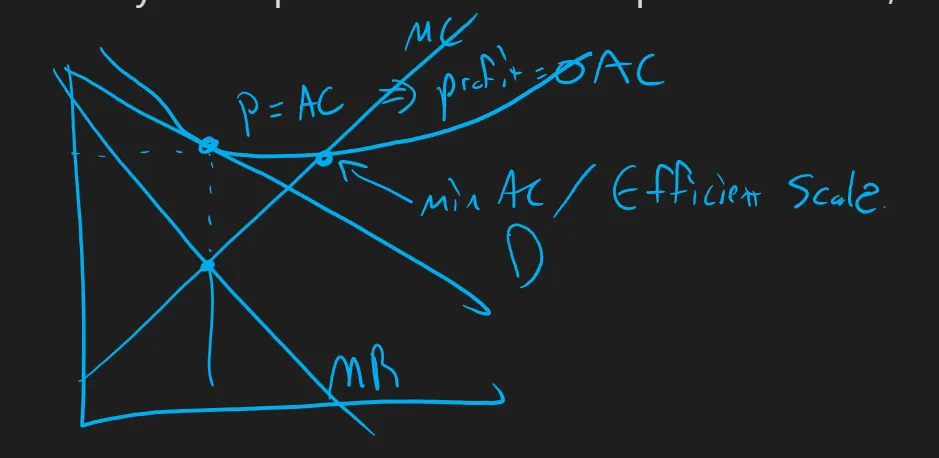
❔ I have a question on April 6th’s class. In the monopolistic market, is it possible price ever equal to marginal cost, and quantity equal to q at minimum AC at equilibrium? from the class slides it seems the answer is no, because that means the sellers give up their markup. Please see the screenshot I took from the slides.
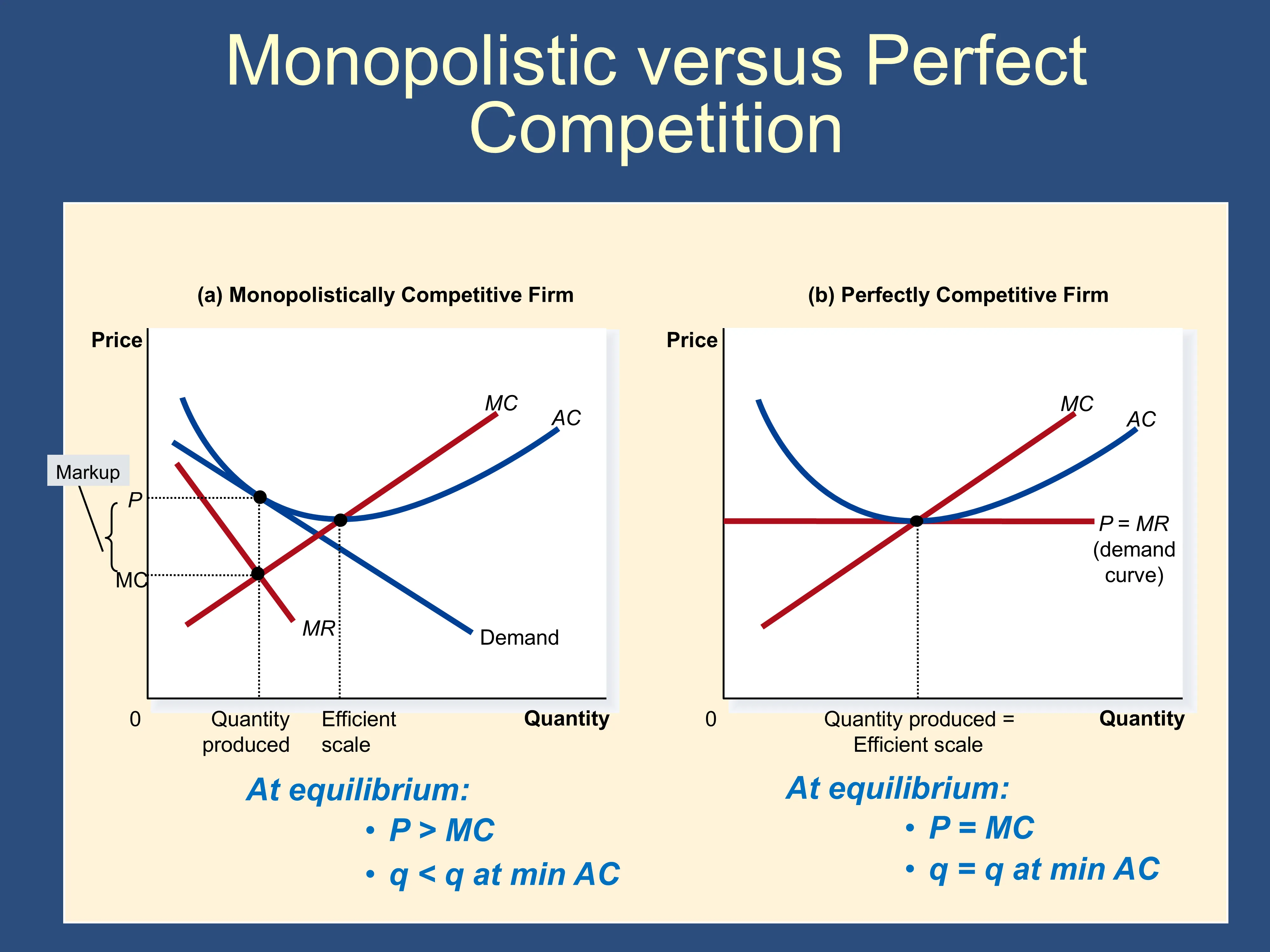
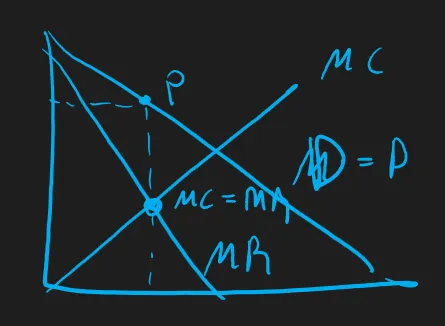
✔ Price can’t equal MC in monopoloy or MC because MC=MR, but P>MR. Therefore P>MR=MC, and P>MC.
🕣
❔ I have an interpretation question for PS7 Q13.
“Both players break the law” - is this in a literal sense? Both are prisoners (who broke the law - past tense) in the illustration, but in an economic application, it is not limited to prisoners. I’m assuming the question is asking if both firms must have broken the law in order to be players but wanted to confirm.
✔ Choose option A if you think it is part of the definition of the prisoner’s dilemma that both players must be breaking the law when they play their dominant strategies. This requires you to reflect on what the prisoner’s dilemma actually means, and whether breaking the law is built into that. We have discussed the definition of the prisoner’s dilemma before, so I hope that helps, but it was a little while ago.
Feedback? Email munger.e1010@gmail.com 📧. Be sure to mention the page you are responding to.