🔎 EV and EU as Weighted Averages
Expected Value
Section titled “Expected Value”Expected Value is a weighted average of several possible value.
Consider the following example:
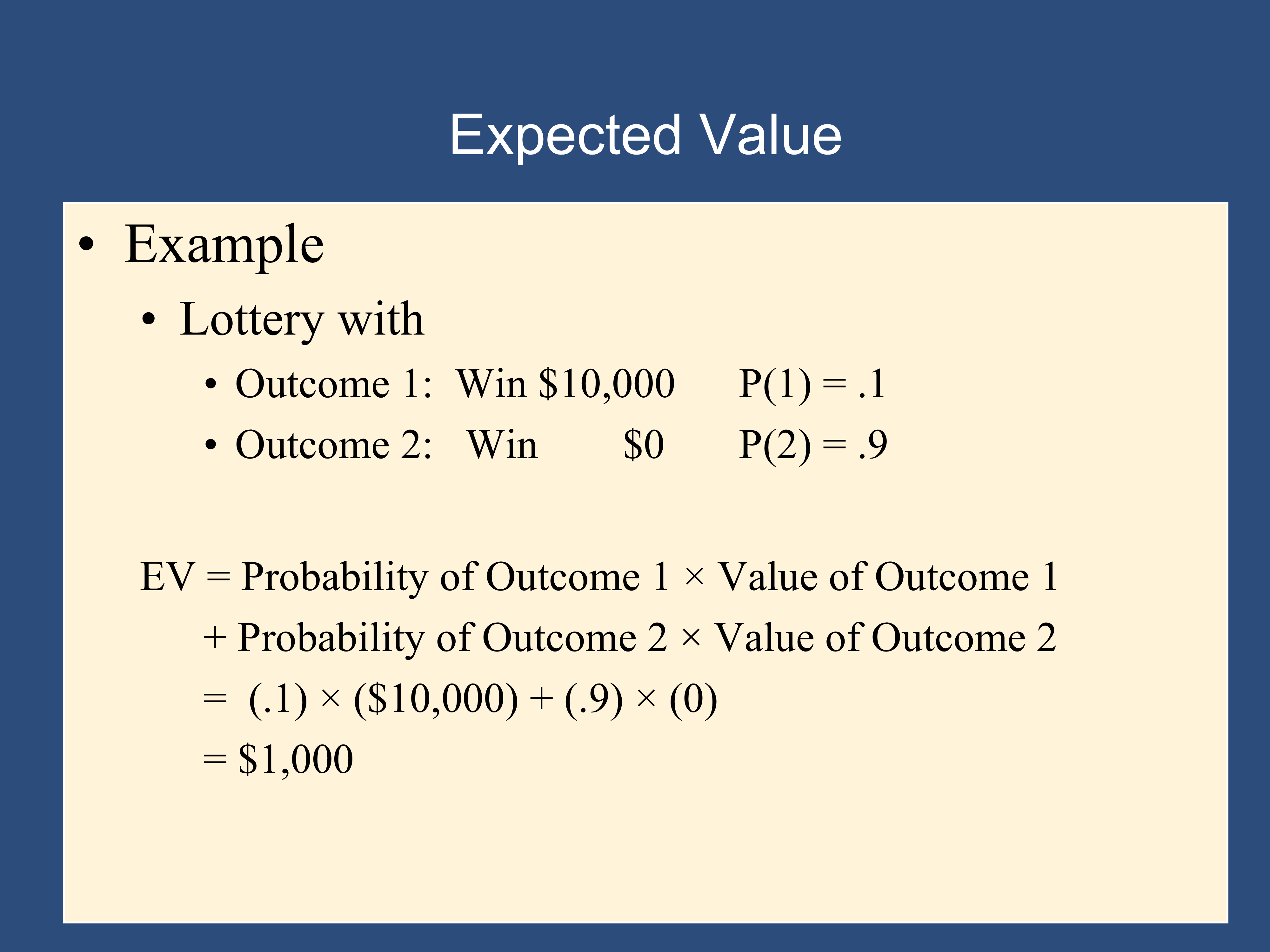
The idea is that if you play a Lottery, you don’t know what the “value” of your winnings will be. Therefore, you “expect” that your winnings will be an average of the different possible amounts you could win.
But, you weight certain values more heavily, based on how likely they are. You give the outcome of winning $10,000 a weight of 10% because it only has a 10% chance of happening. Likewise, you give the outcome of winning $0 a weight of 90% because it only has a 90% chance of happening.
A weighted average with those weights is
This calculation is exactly what the EV formula does. EV is just a weighted average using the probabilities as the weights.
The $1,000 is the amount that you “expect to win.” Because of the “Law of Large Numbers” (Or the “Central Limit Theorem” [You are not responsible for these.]) you can think of the $1,000 as also representing the “fair price” for this lottery ticket.
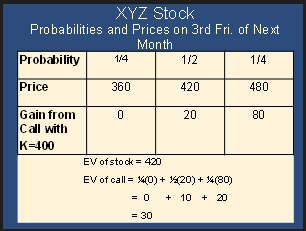
Similarly, in Principles of Finance, Bruce uses expected value as the fair price of a stock or an option contract:
Expected Utility
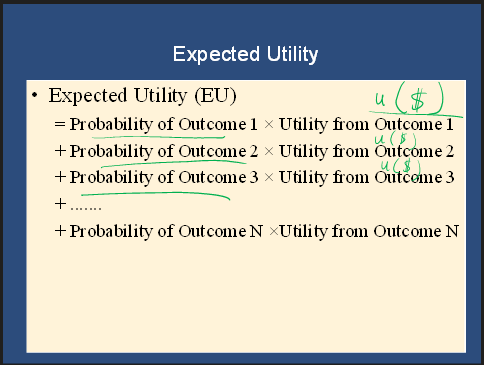
Section titled “Expected Utility”Expected utility is also a weighted average. It is a weighted average of utilities.
Once again, let’s look at an example. Consider the risky Internet start-up job:
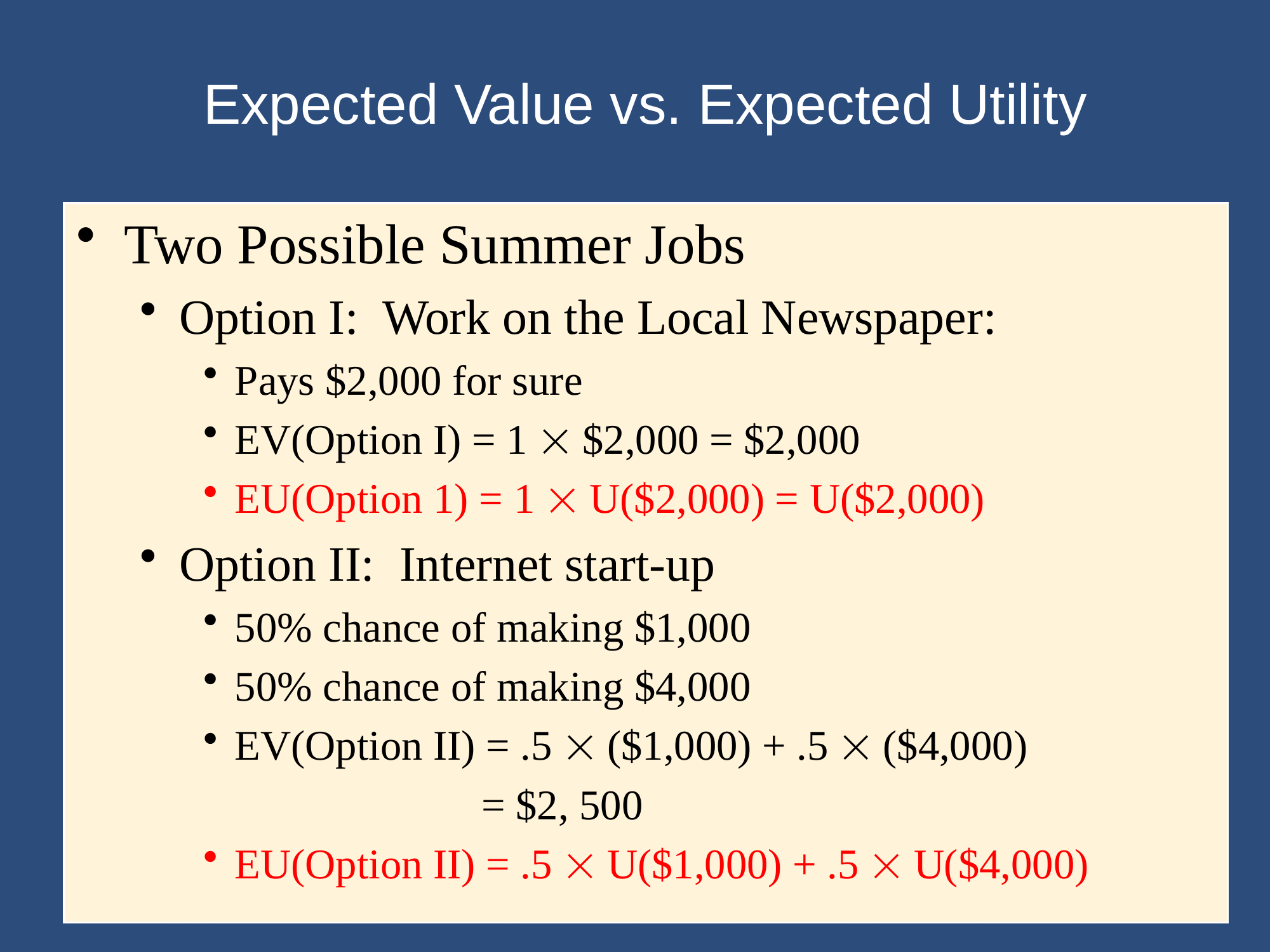
You don’t know whether you will earn $1000 or $4000. Therefore, you don’t know how happy you can be.
How can you evaluate this option? Which job should you take?
Expected utility says that you should take a weighted average of the utilities you would get from the two jobs.
You should weight the different utilities ( or ) based on their probabilities of occurring.
The “utility” you “expect” to get from the start-up is:
Like expected value, expected utility is just a weighted average.
✏️ Without doing any calculations, can you estimate what the EV will be for each of the following lottery tickets?
| Ticket A | Ticket B | Ticket C | Ticket D |
|---|---|---|---|
| Payoff: $2 (100%) | Payoff: $2 (80%) | Payoff: $2 (40%) | Payoff: $2 (0%) |
| Payoff: $10 (0%) | Payoff: $10 (20%) | Payoff: $10 (60%) | Payoff: $10 (100%) |
✔ Click here to view answer
When you have a 100% chance of receiving $2, your EV must be $2.
When you have an 80% chance of receiving $2 and only a 20% chance of receiving $10, then your EV should be between $2 and $10, but it should be much closer to $2, because you are much more likely to receive $2. In other words, $2 receives a heavier weight in the weighted average.
Sure enough, the answer is much closer to $2 than to $10.
When you have a 40% chance of receiving $2, and a 60% chance of receiving $10, then your EV should still be between $2 and $10, but it should be somewhat closer to $10, because you are somewhat more likely to receive $10. In other words, $2 receives a lighter weight in the weighted average, and $10 receives a heavier weight in the weighted average.
Sure enough, the answer is somewhat closer to $2 than to $10.
When you have a 100% chance of receiving $10, your EV must be $10.
✏️ Suppose and .
What is the EU of Ticket A, Ticket B, and Ticket D?
✔ Click here to view answer
Ticket A says that you have a 100% probability of winning $2, so it puts a 100% weight on $2. The utility of $2 is 12 utils, so .
As we will see later on, the line of expected utilities is just all of the weighted averages of two outcomes - each weighted average is a different probability. One weighted average is like Ticket A, another like Ticket B, and so on…
Feedback? Email munger.e1010@gmail.com 📧. Be sure to mention the page you are responding to.