🔎 How much would you pay to reduce the chance of loss to zero?
❔ Let’s say that, considering this graph, the person has 50% of chance of getting 2000 dollars and 50% of getting zero dollars. In this case, considering that CE is, let’s say, $800 dollars. How much would this person be willing to pay to reduce his chance of getting nothing (zero dollars) to zero?
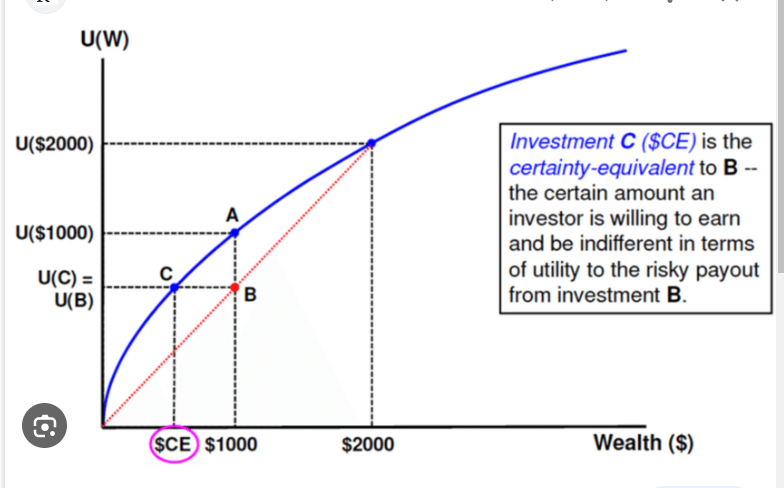
✔ Generally, the person would be willing to pay to reduce the probability to zero. This is because they would know for sure that they would receive the $2,000, and after they paid the $1,200, they would be left with . In other words, if they paid $1200 for insurance, they would be guaranteed to receive $800 at the end of the day. Because $800 is their certainty equivalent, they are completely indifferent between purchasing the insurance or not purchasing the insurance. This follows from the definition of the Certainty Equivalent. By definition, you are always indifferent between having the certainty equivalent or taking the risk (in fact, this is why we say that the CE and the risk are “equivalent.” The CE is a “certain amount” that is “equivalent” to the risky situation because it’s just as good). Given this, $1,200 is the most they would possibly be willing to pay in order to reduce their chance of getting nothing to zero.
You can find the four step process for solving questions like this one here: 🔎 How do I find the Certainty Equivalent?
In general, they would be willing to pay the value of the best outcome minus their certainty equivalent. In this case, for example, the best outcome is $2000 and the certainty equivalent is $800 (this is what we’re assuming). Mathematically, they will pay up to:
Let’s suppose that someone pays and is guaranteed that they receive the best outcome. Their final wealth will always be because they are guaranteed the best outcome but must pay . Note that In other words, they are guaranteed to be left with their certainty equivalent.
Because they are guaranteed the end up with their CE, they are indifferent between the gamble and the insurance. This means that is the highest amount that they would possibly pay for the insurance. (They might not be willing to pay it because they are indifferent. However, they might pay for it, which is good enough.)
Feedback? Email munger.e1010@gmail.com 📧. Be sure to mention the page you are responding to.