👨🏫 Notes on Lecture 5
Pindyck and Rubinfeld: Sections 6.1, 6.4, 7.1 - 7.2, 7.5
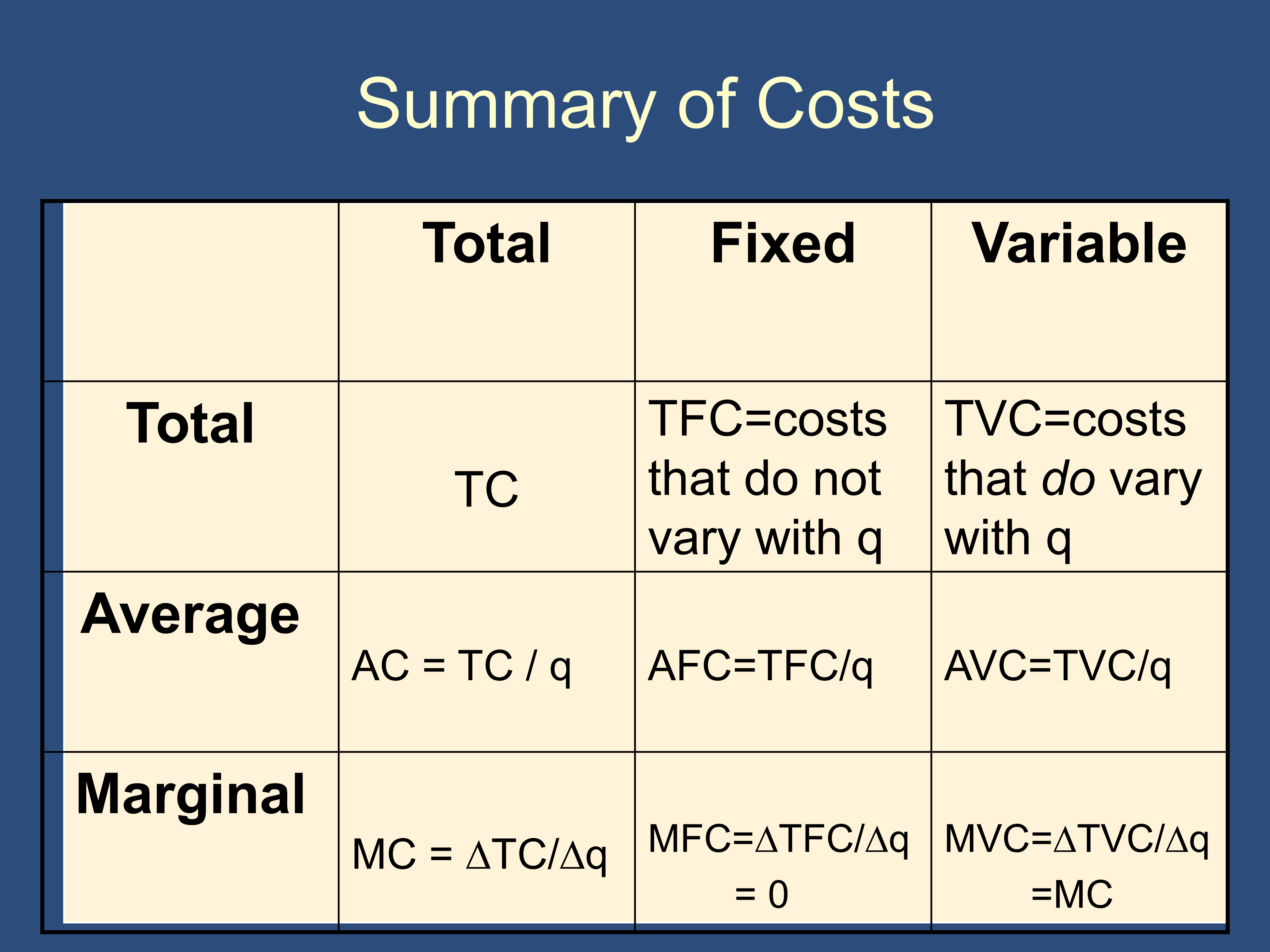
Key insights from the above table:
-
Top Row: Costs are broken down into fixed costs and variable costs. Likewise, in addition to looking at total costs, we can also look at the average per-unit costs and the costs for an additional unit.
-
Middle row: . For example:
-
Bottom Row: Marginal costs are the additional costs from producing one more unit. . The least important part of the table are the two cells in the bottom right:
- MFC = ΔTFC/Δq Because Total Fixed Costs are fixed, there are no additional fixed costs from producing one more unit. Therefore, MFC = ΔTFC/Δq = 0.
- MVC = ΔTVC/Δq. Because fixed costs don’t change all of the MC come from changes in the variable costs and MVC = ΔTC/Δq = MC.
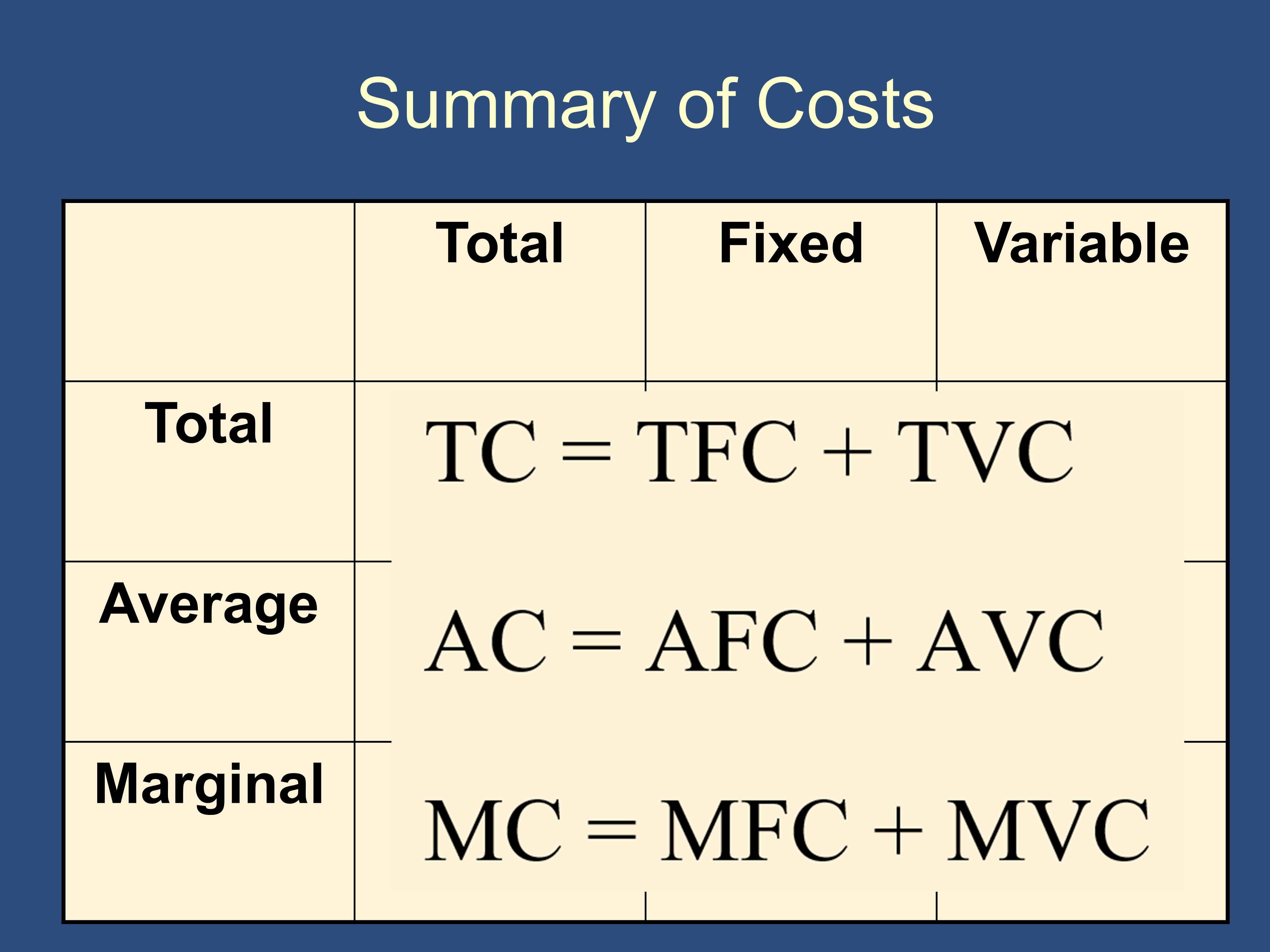
Likewise, the two righthand columns add up to the lefthand column:
Or, on the original table:
How MC, AC, and AVC relate:
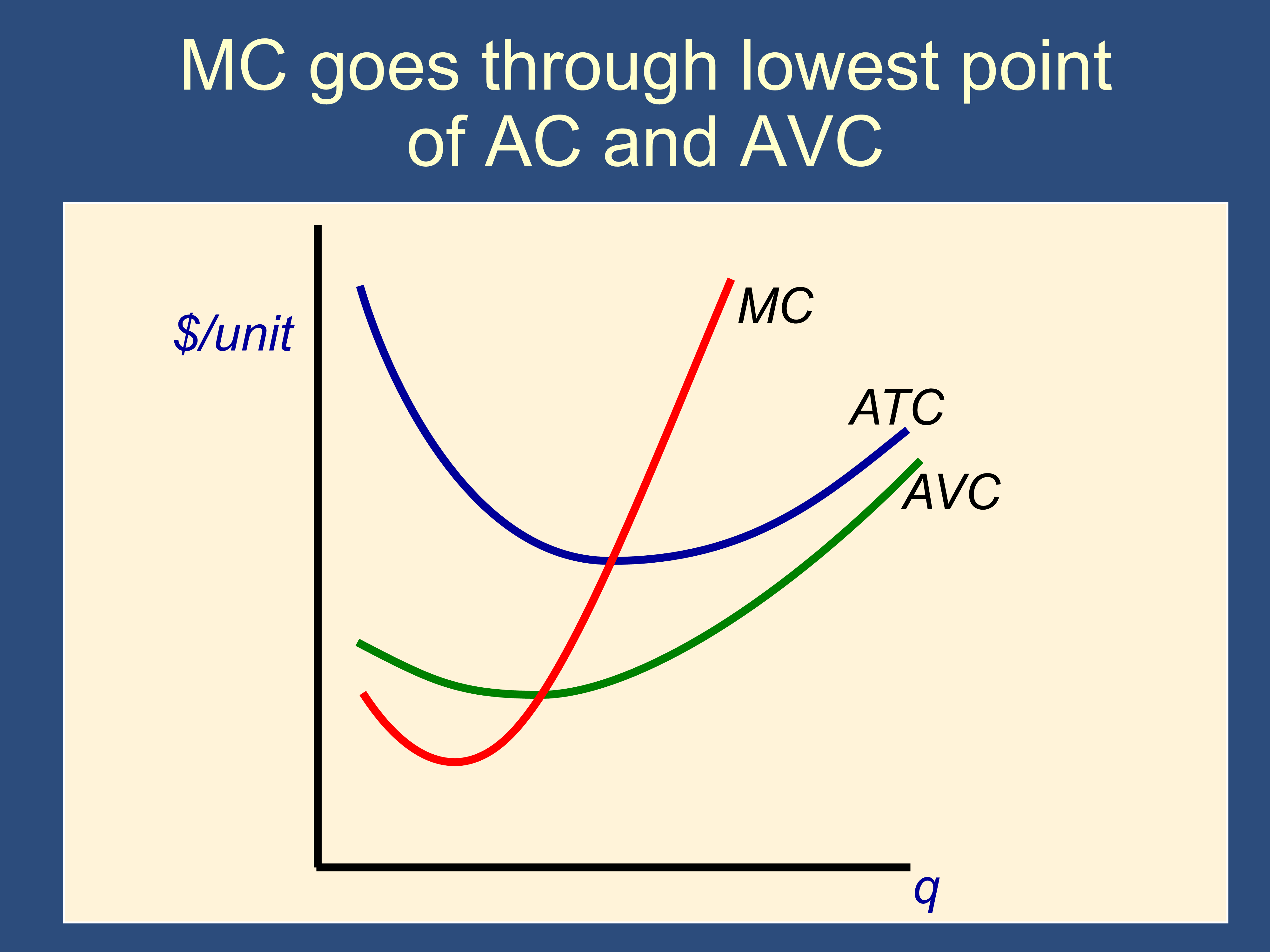
- When AC is above MC, on the Left, AC gets lower because it wants to be with MC.
- When AC is below MC, like on the right, AC gets higher because it wants to be with MC.
- This causes AC to be U-shaped: It starts by going down on the left and then goes up on the right.
- What causes it to switch from going down to going up is crossing paths with MC, like on the diagram.
- Therefore, at the bottom of the ‘U,’ their paths cross. In other words, AC and MC typically intersect at the lowest point in the U of AC. Basically, MC cuts through the lowest point of AC.
🙋 How could ideas like the above show up in a question?
✔ Virtually anything on a slide can be turned into a multiple choice question fairly simply. Here is an example:
✏️ At relatively low quantities, AC is often decreasing (sloped downward). Why does it do this?
A. Because
B. Because
C. Because
D. Because
✔ Click here to view answer
Answer: D
Whenever , AC will decrease as quantity increases.
The best way to think of this is with a metaphor. If you have 4 twenty dollar bills in your wallet, what happens to the average value of the of the bills in your wallet when you add a ten dollar bill?
Well, previously, the average value of the bills was $20. However, the “additional” bill that you are adding has a value less than the average. Therefore, the new bill drives the average value down from $20 to .
Hopefully this makes intuitive sense and you will see that whenever you add a new bill to your wallet, if the additional bill has a value that is lower than the average, it will bring the average down.
Remember that “marginal” is just a synonym for “additional.” In general, whenever the marginal unit has a lower value than the average, it brings the average down. This is why, in this case, , AC will decrease as quantity increases. ✅
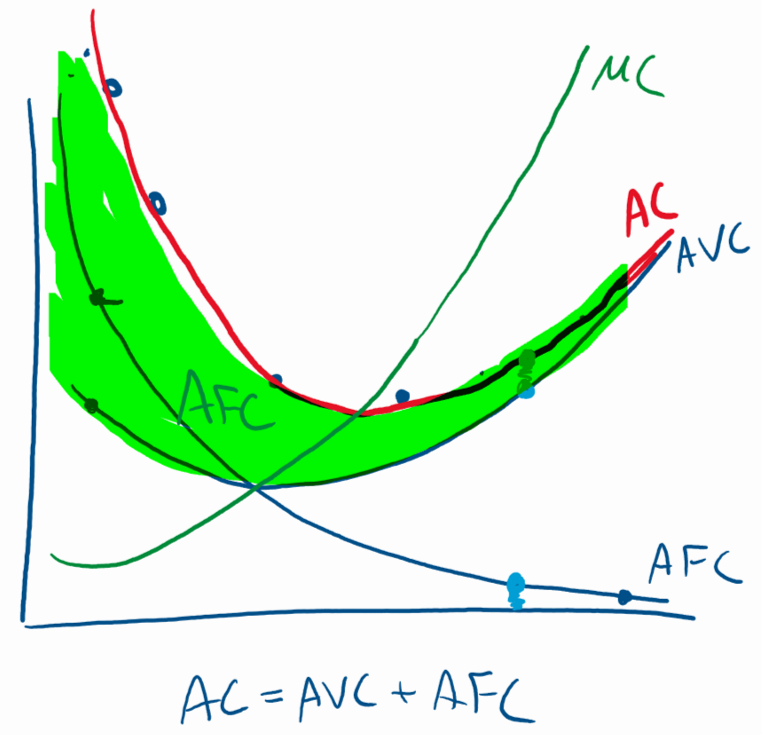
AC is generally U shaped
AVC is generally U shaped.
AC is generally higher because
AFC lifts up AC, so it is always above AVC.
MC goes through the lowest points of AC and AVC (at least if we assume that MC starts low and rises continuously).
AFC is always decreasing. It typically starts very high and gets closer and closer to zero.
AC and AVC get closer and closer together
because the distance between AC and AVC is just AFC (because )
AFC is always getting closer and closer to zero.
(Note: some of the above results depend on the marginal cost curve being upsloping)
Identifying Fixed and Variable Cost from a Formula
Section titled “Identifying Fixed and Variable Cost from a Formula”Variable cost is the part of the formula that has the quantity variable in it.
If , then and
✏️ Suppose . What are FC, AFC, VC, AVC?
✔ FC = $10
AFC = $10/q
VC = 3q^2 + 7q
SPECIAL CASE: (Constant Marginal Cost)
Section titled “SPECIAL CASE: TC = FC + MC×q (Constant Marginal Cost)”Suppose it always costs $5 to build another unit, no matter how much you have already produced. We call this situation “constant marginal cost” because the Marginal Cost doesn’t vary as you produce more or fewer units..
If there is a constant marginal cost, you can write the total cost function as . For example, if the marginal cost of each new unit is $5 and the total fixed costs are $100,000, then the Total Cost function is .
Likewise, suppose you can write the total cost function in what is known as “point-slope” form: for some constant numbers, and . If you can write it like this, then is the fixed cost, and is the marginal cost.
There’s more! If you ever know that you have constant marginal cost, then you also immediately know VC and AVC. If MC is constant, then TC = FC + MC×q.
We know from above that VC is always the portion of the formula that has the variables in it. Therefore, . Likewise, we can calculate AVC: In summary, if MC is constant, we know:
- TC = FC + MC×q
- VC = MC×q
- AVC = MC
Likewise, if you are given that, for example, TC = 100,000 + 5q, then you immediately know that
- MC = $5
- FC = $100,000
- VC = $5q
- AVC = $5
✏️ Suppose it costed your company $50 M to discover a drug and that it costs $0.87 to produce one dose of the drug. Assume that there are no other costs. What is your cost function? What else do we immediately know?
✔ From the prompt, we immediately know that FC = $50M and MC = $0.87. Therefore TC = $50M + $0.87×q. Likewise, VC = $0.87×q and AVC = $0.87.
If you see curves like the following, think of the above formulas:
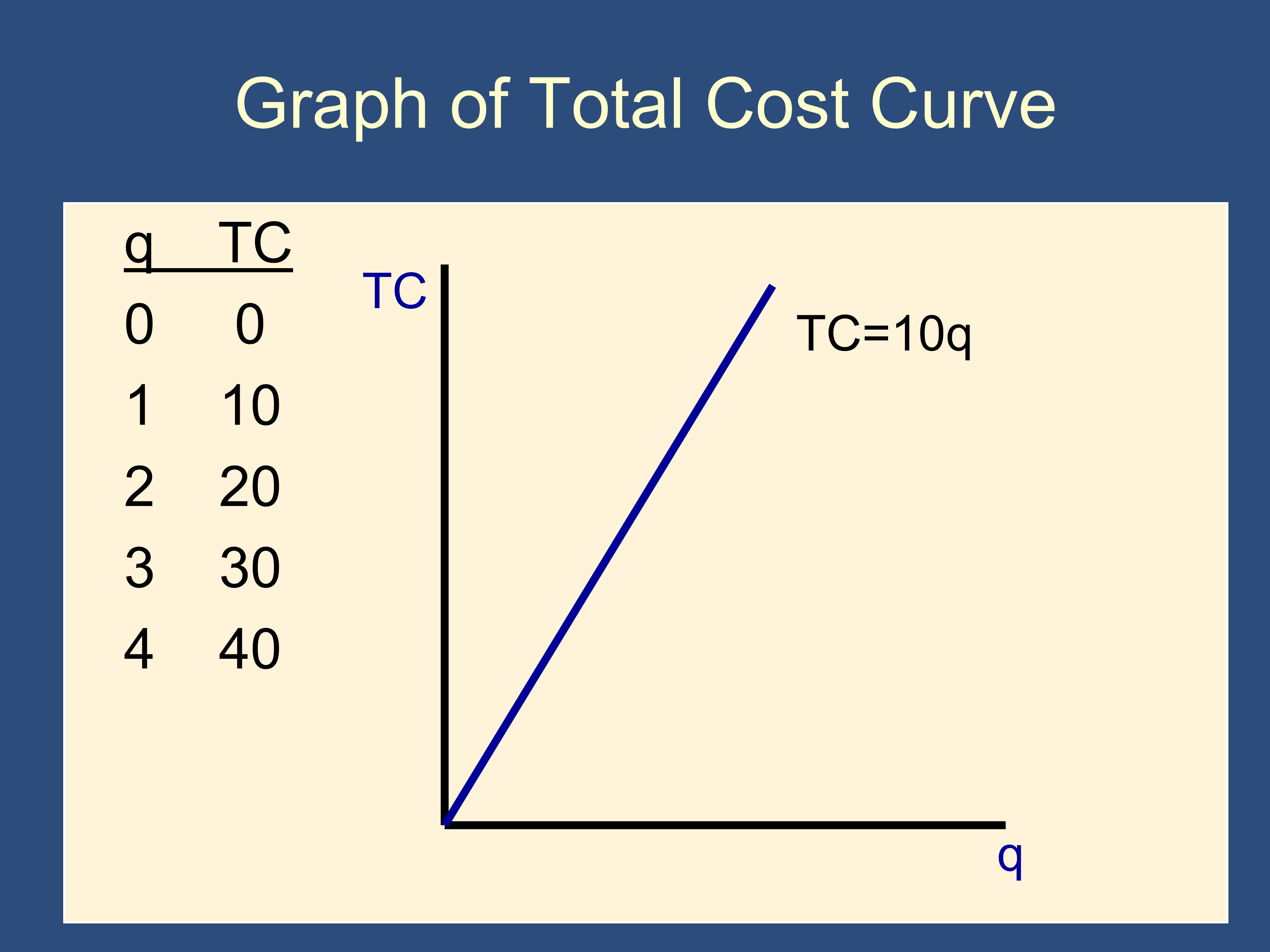
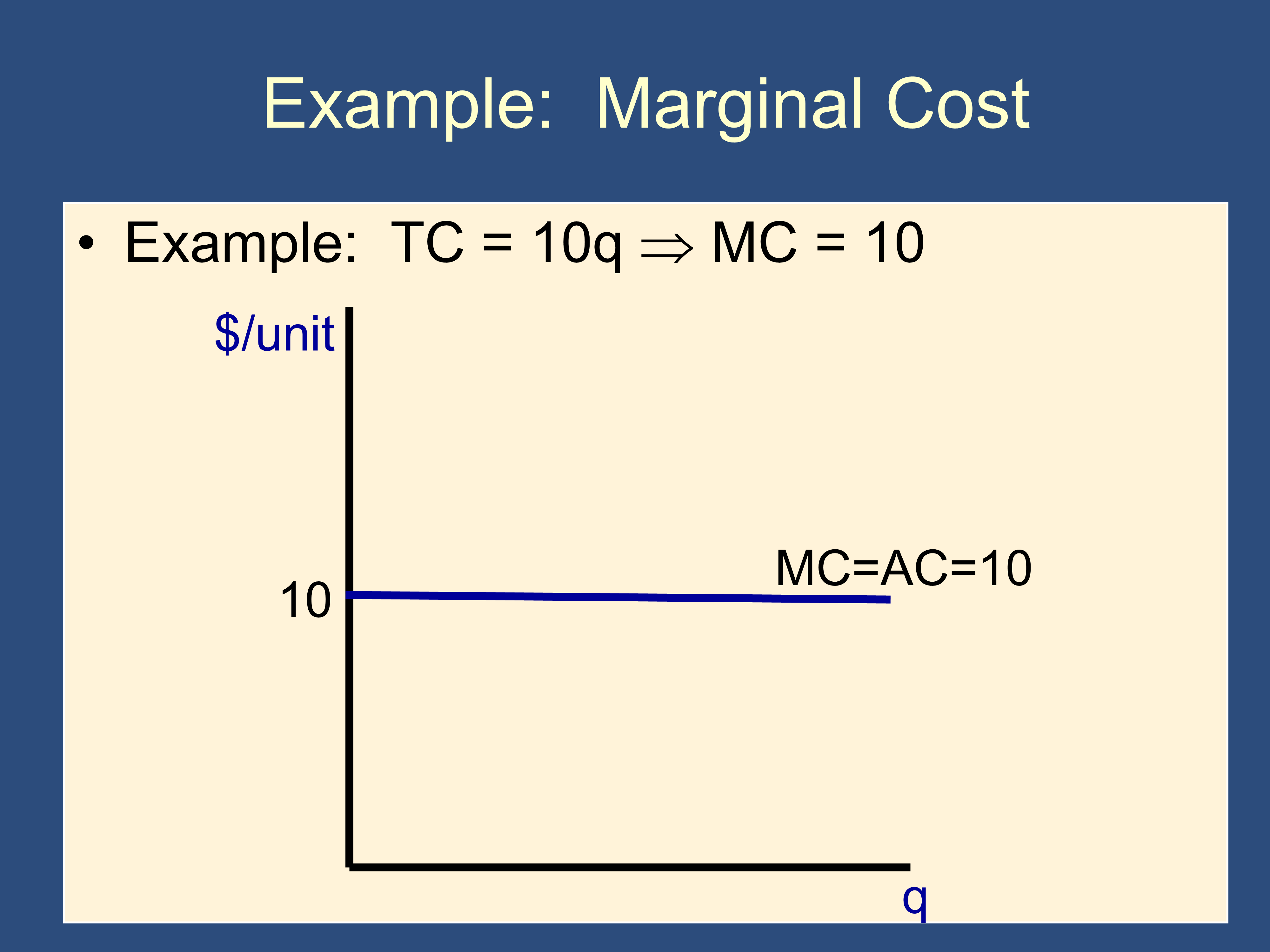
Likewise, if you ever see a TC function like , then you immediately know that and
✏️ Suppose at all levels of production and that .
Write down the TC function.
✔ Click here to view answer
✏️ It takes Bruichladdich distillery a MC of $20 to make a bottle of the Botanist gin. It also takes a Fixed cost of 3,000,000 per year to maintain the distillery. What is their TC function?
✔ Click here to view answer
Feedback? Email munger.e1010@gmail.com 📧. Be sure to mention the page you are responding to.