👨🏫 Notes on Lecture 8b
Pindyck and Rubinfeld: Sections 13.1 - 13.4
Game Theory
Section titled “Game Theory”Ways to solve a game
- Nash equilibrium
- Dominant strategies
Notes:
- “Row” means the player who chooses the row strategy.
- First payoff is generally for Row Player. Second payoff is for Column player.
To add rectangles for ROW
- Choose one action for column and put a “blue circle” around that column.
- Underline the payoffs for Row in that circle
- Put a rectangle around the higher underlined #
- Do the same for the other column.
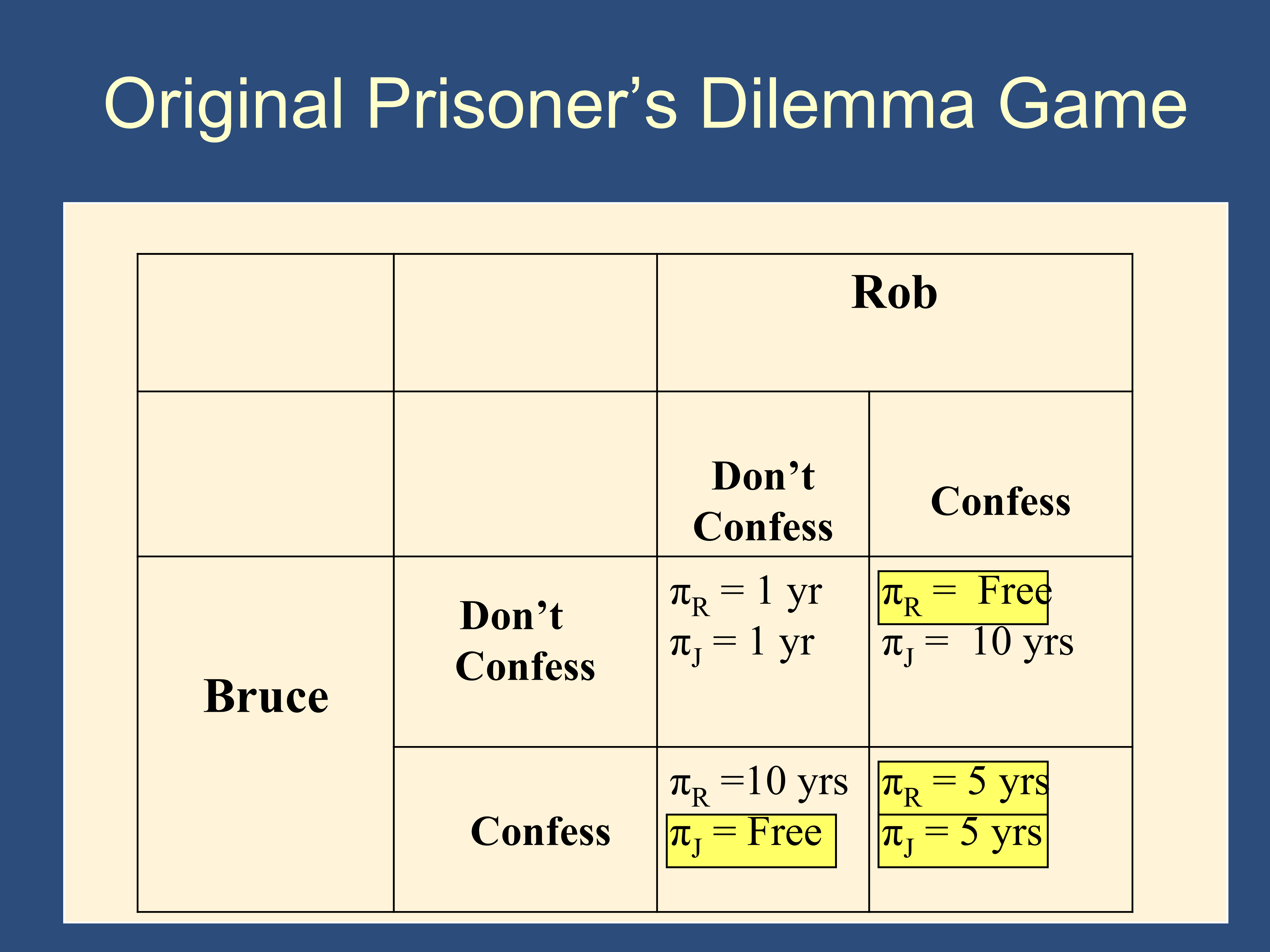
Intuition: The blue circle says that Row believes Column will confess. (It represents Row’s beliefs about his opponent.) Row cares only about his payoffs - these are indicated by the underlines. He chooses the higher payoff, so the rectangle indicates that row’s choice is optimal in that cell.
Nash Equilibrium:
Two rectangles in same cell = Nash = optimal for both players
Dominant Strategy:
A full row of rectangles for Bruce means that Confess is always optimal, so it is a dominant strategy for the row player.
A full column of rectangles for Rob means that confess is always optimal, so it is a dominant strategy for Rob.
Feedback? Email munger.e1010@gmail.com 📧. Be sure to mention the page you are responding to.