🙋 Student Q&A (Lecture 10)
Click here to learn about timestamps and my process for answering questions. Section agendas can be found here. Email office hour questions to munger.e1010@gmail.com. PS1Q2=“Question 2 of Problem Set 1”

📅 Questions covered Thursday, Apr 23
Section titled “📅 Questions covered , Apr 23”Notes from start of section: Social costs include private costs.
The supply curve shows you marginal private costs.
- “95% of the time” the private costs are the only costs becauase there are no externalities. Therefore, “95% of the time” the supply curve shows you ALL costs. We call this Marginal Social Cost.
- For making a hamburger, all of the costs are private costs. Therefore, MPC = MSC.
- Sometimes (“5% of the time”) there are external costs. When there are external costs of production, the MSC drifts away from the MPC. Likewise, there may also be external benefits of production. These can cause MSC to drift as well and can also cause MSC ≠ MPC.
🕣 9:15pm
❔ In the last slide, when they are internalizing the negative production externality, does the price rise as we move from the market quantity to the efficient quantity?
Bruce said that the quantity will change. Will that shift the demand curve?
✔
🕣 9:37pm
❔ When we are talking about price discrimination, where does auction falls into? 1st, 2nd or 3rd?
✔ When we talk about price discrimination, we usually mean selling a fixed number of identical units. With auctions, that is not always the case, so we can have multi-unit auctions.
Auctions are often used to estimate where the demand curve lies when you are not sure how strong demand really is. They are used for pricing, but not so much for charging different people different prices.
You can think of it as a form of price discrimination, and there is some truth to the connection you are drawing. If you want to learn more, auctions are studied in a field called mechanism design, and they are used with game theory to think through strategies for setting up the rules of the auction to extract the most money from the people who want the good.
It turns out there are four famous mechanisms, and they all do a good job of extracting money and giving the good to the person who wants it the most. They often charge that person the highest price the second-highest bidder is willing to pay, so the winner gets a little consumer surplus, but most of it is extracted. Explaining that in detail would take a long time, so we can talk about it if you want. Let me know if you want me to go over it more.
📅 Questions covered Sunday, Apr 26
Section titled “📅 Questions covered , Apr 26”🕣 8:22pm
❔ What is up with the extra upload for graduate papers?
✔ Students taking the course for graduate credit must upload three papers. If you have a valid reason (e.g., professional or family obligations, illness), you can submit one paper late by the date of the final exam. You can upload your third paper through the extra upload slot in the Assignments group.
No one is required to submit more than three papers, and you will not receive credit for a fourth paper. This only applies if you missed a previous deadline.
🕣 7:48ish
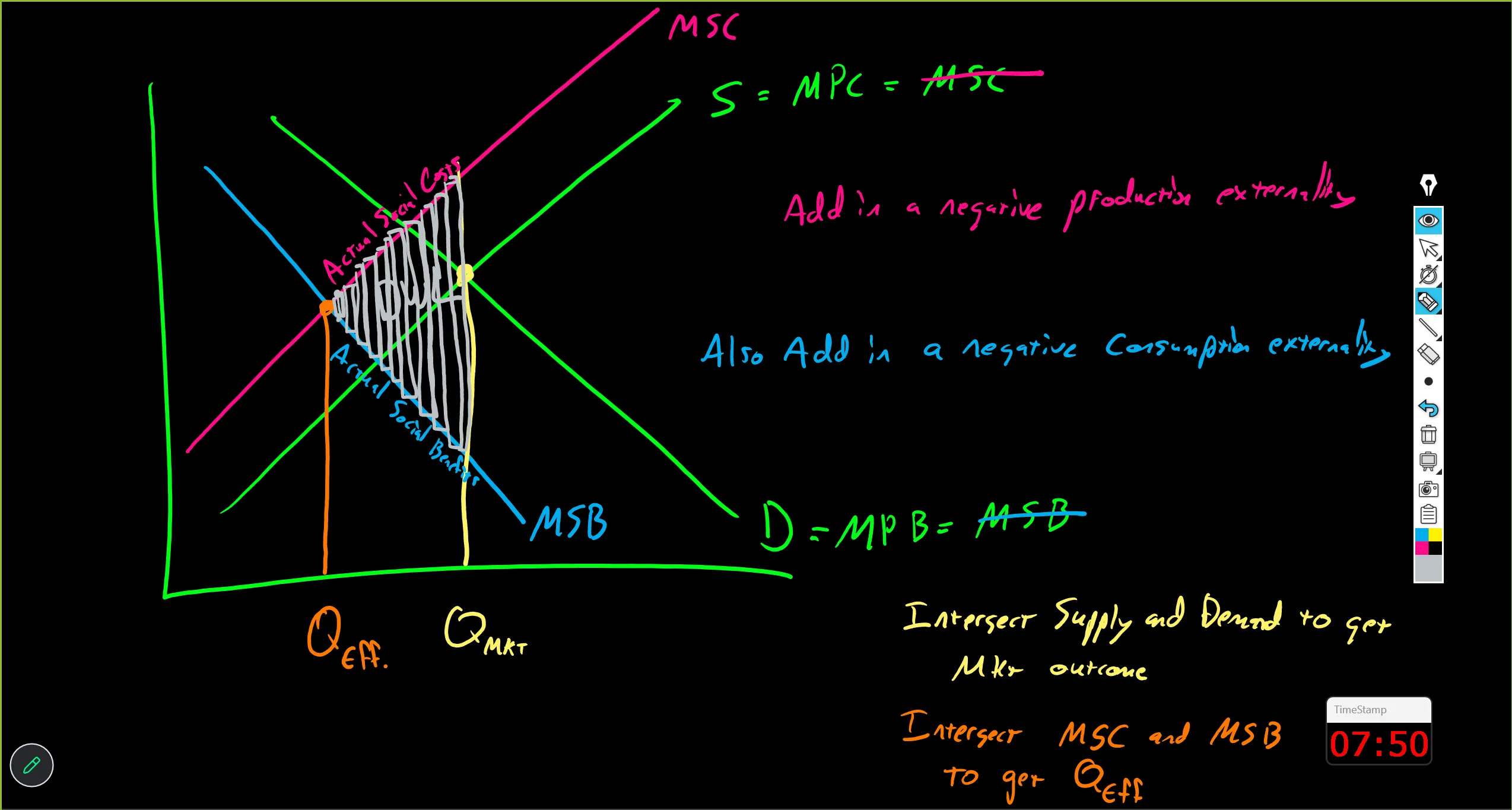
❔ What happens if we have both a production and a consumption externality? In particular, how do you identify the deadweight loss?
✔ 
🕣 7:51pm
❔ PS9, Q18: What does ‘marginal external cost’ mean? I dont think the professor covered this term in the lecture. The same thing with PS9, Q18, I’m not sure what ‘external costs & benefits’ mean.
✔ The marginal external cost is the cost of producing and/or consuming one more unit of a good, specifically the part of that cost that affects people other than the producers and consumers themselves. “External” means it affects people who are not producing the good, and “marginal” means it is associated with an additional unit.
In Q18, you may assume that these external costs are caused by production of the good rather than consumption of the good. Specifically, they are caused by the prodution of an additional unit of the good.
External costs and benefits just refer to costs and benefits that affect someone other than the producer or the consumer.
🕣 7:58pm
❔ What was last year’s Final Exam like?
✔ 2 hours for 60 questions. I’d be surprised if he changed that.
Feedback? Email munger.e1010@gmail.com 📧. Be sure to mention the page you are responding to.