🙋 Student Q&A (Lecture 5)
Click here to learn about timestamps and my process for answering questions. Section agendas can be found here. Email office hour questions to munger.e1010@gmail.com. PS1Q2=“Question 2 of Problem Set 1”

📅 Questions covered Thursday, Mar 5
Section titled “📅 Questions covered , Mar 5”🕣 8:19pm
❔ https://canvas.harvard.edu/courses/166274/discussion_topics/1266888
✔
🕣
❔ Can you outline the remaining sections? Do we have one on Sunday and Monday?
✔ Thursday ← New material Extra section 7:30pm ET Friday ← Exam Prep. Saturday & Sunday ← Hit the books! Sunday 7:30pm ← Mop up section - whatever people ask for. Probably 85% on the new material. Extra section 12:00 pm Monday ← Quick. Last minute. Lower attendance.
🕣 10:15pm
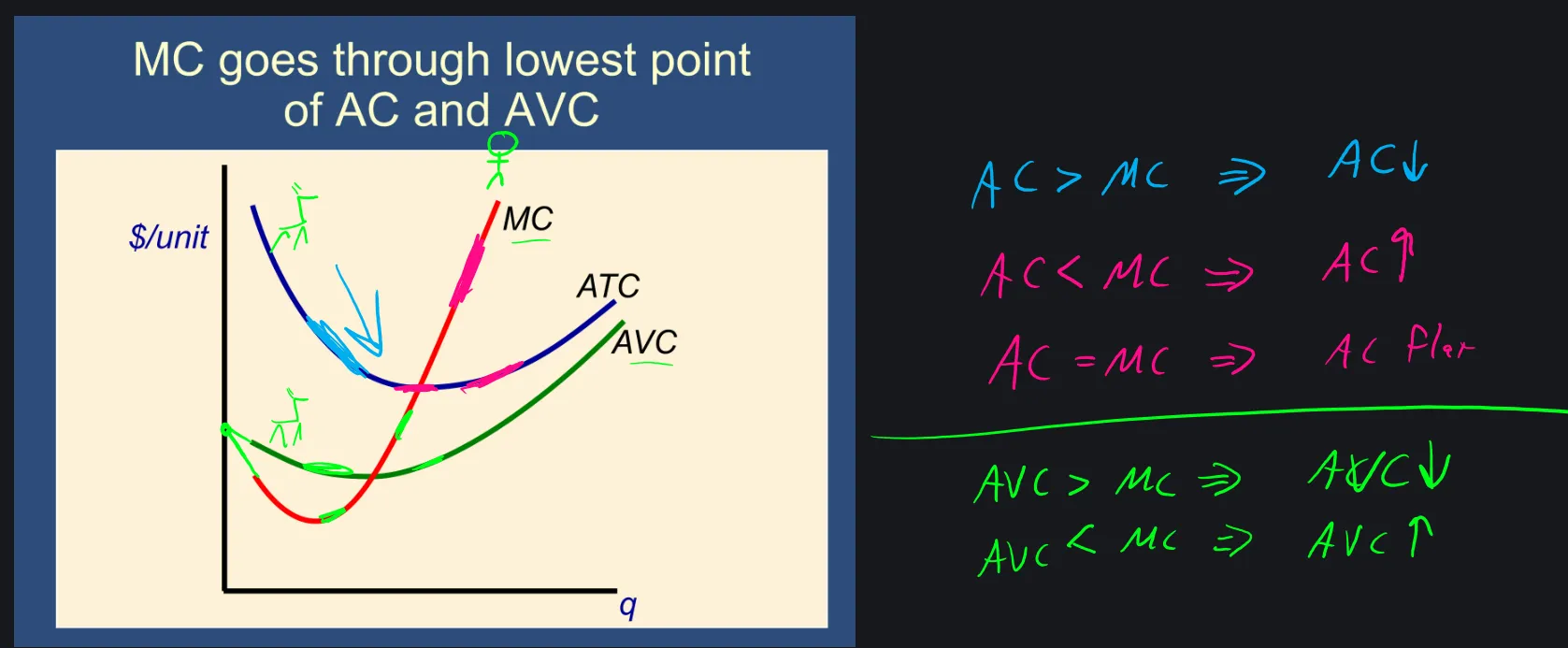
❔ How would the tables be plugged in? (slide 19)
✔
🕣 10:18pm
❔ Can you go over law of diminishing marginal return? Is this not clear on the slides?
✔earlier
🕣 10:9pm
❔ Average product of labor? Where is this on the slides?
✔Just did! See 10:15pm
🕣 10:19pm
❔ Output in quantity — can you make this clear?
✔This is for a production function. The production function tells us how many widgets we can create. The number of widgets we create is called our output, and it’s the quantity of widgets.
🕣 10:19pm
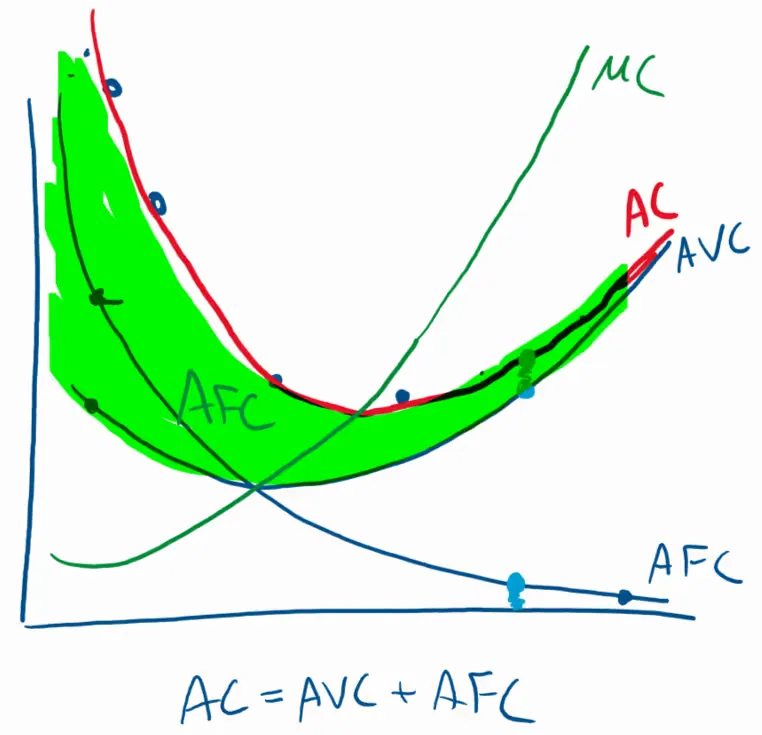
❔ The larger the firm the smaller ATC? What about AVC and AFC? I assume these last two could vary whether it was one large firm or two different medium size firms?
✔ 
🕣 10:22pm
❔ Can you show us an example using this? MC = ∆TC/∆q
✔covered earlier
🕣 10:23pm
❔ AVC? When we have the formula for TC is it just the number next to q? So in the slides it is just 10? That simple?
✔That will be true in the case when there is constant MC, ie when TC = a×q + b, where a and be represent fixed numbers. (ie what we covered earlier.)
In general, to find AVC, you strip off the part of the formula that has variables: (this part is the VC) Suppose TC= q^5 +7q^4 - 8q^3 + 23q^2 +100 VC = q^5 +7q^4 - 8q^3 + 23q^2 FC = 100 AVC = (q^5 +7q^4 - 8q^3 + 23q^2)/q AVC = VC/q
🕣 10:26pm
❔ Little confused how to read the graphs, FC, AVC, MC etc… I understand economies of scale but everything else is confusing — do you have graph examples? Which is the best slide to refer to?
✔I’ve given the best graph examples I have.
🕣 10:27pm
❔ When talking about returns to scale does capital and labor have to increase consistently? For example only by 1 margin or by 2 and they not have to increase by the the same amount consistently
✔They must increase by the same proportion.
K=20, L=10 K=22, L=11. K went up by 2 and L went up by 1, but they both went up by the same proportion= 10%. Proportion = (22-20)/20 = 10%
🕣 10:28pm
❔ when it comes to return to scale if we increase, decrease or have constant input what should we expect regarding the output?
✔In general, it will typically be the case that if you increase all inputs, output will increase. If you decrease all inputs, output will typically decrease. If all inputs stay the same, output will stay the same.
To apply RTS, the first step is always to calculate the proportions. Once you do that, you ask yourself whether all inputs are increasing by the same proportion. If they are, you can talk about RTS. If they aren’t, then you typically can’t say anything about RTS.
🕣 10:31pm
❔ Could you explain why the MC curve slopes downward and then goes up?
✔It typically slopes downward because there are, loosely speaking, economies of scale. As you produce more, you find efficiencies. However, at a certain point, the fixed inputs become a real problem. You only have one kitchen to make pickles in. As a result, your marginal costs start rising and rising.
🕣 10:33pm
❔ PS4, Q8: Is it asking the avg fixed cost of production at 100 units of production?
✔ Fixed cost of production is fixed, so it doesn’t matter the number of units being produced.
🕣 10:34pm
❔ PS4, Q12: The question has number written as ‘$24 thousand’. Should we put the answer in the same format or completely in numerical format (Ex: 24000)?
✔Economies of scope is generally a relatively small number between -10 and +10. The thousands will cancel out when you plug the numbers into the formula. You’ll see the bigger numbers go away.
📅 Questions covered Friday, Mar 6
Section titled “📅 Questions covered Friday, Mar 6”🕣 8:53pm
❔ IE, SE, CE problem?
✔
✏️Suppose that you purchase apples and bananas. Suppose that the price of apples increases. Analyze your consumption of apples and bananas in terms of IE, SE and CE. Bananas are a normal good and Apples are an inferior good. For CE, write your answer as “if IE>SE, then ___ and if IE<SE, then ___”
SE: apples are relatively more expensive. In comparison to apples, bananas are relatively less expensive because their price didn’t increase.
Therefore:
- Apples SE ↓
- Bananas SE ↑ Inferior vs. Normal has no effect on SE.
IE: Because you purchase apples and they are more expensive, your purchasing power decreases. You feel “poorer.” Therefore, you will consume less of normal goods and more of inferior goods.
- Apples, inferior: IE ↑
- Bananas, normal: IE ↓
CE: Combined effect just refers to combining IE and SE. Apples: SE↓ + IE↑ = ?
- If SE↓ > IE↑, then CE↓ (buy less)
- If SE↓ < IE↑, then CE↑ (buy more) Bananas: SE↑ + IE↓
- If SE↑ > IE↓, then CE↑
- If SE↑ < IE↓, then CE↓ A similar calculation applies…
“Suppose that the price of apples increases.” part 2
✏️ What will be required for Apples to be a Giffen good? Can bananas ever be an Giffen good?
A Giffen good is when a price rises and people buy more (or a price falls and people buy less). For the apple, its price rose and people will buy more if CE↑. CE↑ if SE↓ < IE↑. Therefore, Apples will be Giffen if SE↓ < IE↑.
Alternatively, we know that any Inferior good is Giffen if IE>SE.
Bananas can’t be Giffen because they are normal goods. https://1010.robmunger.com/l3/giffenvsinferior/
🕣
❔ 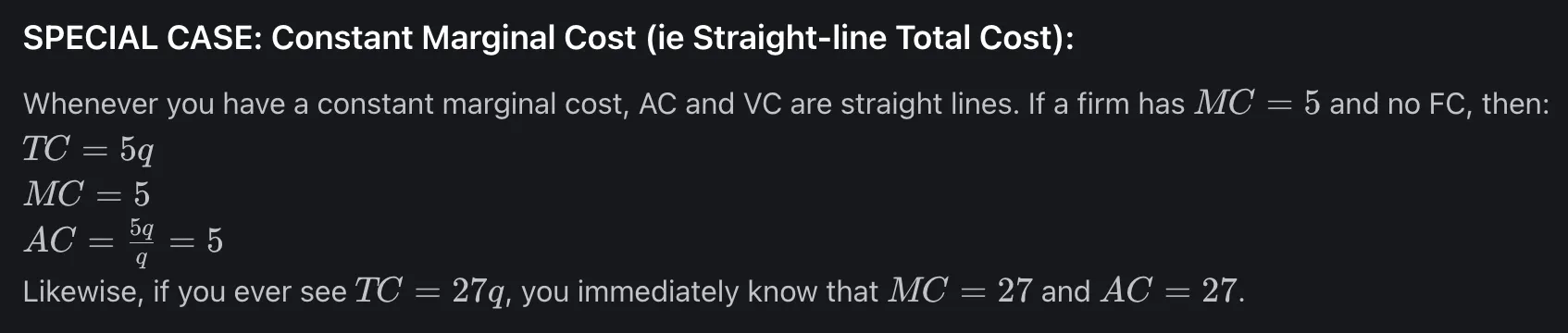
✔ In this example, we just assumed that MC = 5. “If a firm has MC=5” was the second sentence and it says we are assuming that MC=5.
✏️ Suppose that TC = 27q +1000
What is MC?
✔ MC = 27, because whenever you have a TC formula like that (ie linear), you may read MC directly off of the formula.
You absolutely can’t be asked to find the marginal cost of using derivatives because we know you don’t know derivatives.
✏️ Suppose that TC = 3q^2 +10. Write out the TC when q=3 and when q=4. What is the MC of the 4th widget.
✔
When q=3, TC = 3*q^2+10 = 37
When q=4, TC = 3*q^2+10 = 58
MC = ΔTC/Δq = (58-37)/(4-3) = 21
🕣
❔ Could you explain the difference in the text of question 7 and question 10?
How come question 7 is asking for the risk profile but question 20 is asking about the marginal utility of wealth?
✔
🕣
❔ Professor Watson mentioned we can use the slides and our notes on the midterm. Do we have to print them out? Or can we simply open another browser window that has the slides during the test?
✔ Another browser window is fine! One monitor, but many tabs and many windows. Test it in the Proctorio readiness quiz! It’s configured identically.
🕣 9:36pm
❔ Could you explain why the MC curve slopes downward and then goes up?
✔ It goes downward because there are efficiencies to be gained with a certain level of scale. As you increase your production at low levels of production, you decrease your marginal cost. However, it increases later on; it goes up later on because usually there’s some factor of production which is relatively limited. Eventually, that causes the marginal cost to increase.
🕣
❔ PS4, Q8: Is it asking the avg fixed cost of production at 100 units of production?
✔
Different people will see different numbers. With the following question you need AVC, MC, and AFC at 50 units.

🕣 9:39pm
❔ PS4, Q12: The question has number written as ‘$24 thousand’. Should we put the answer in the same format or completely in numerical format (Ex: 24000)?
https://1010.robmunger.com/l5/economiesofscopeexample/
Even though the numbers on the top and bottom are in hundreds, the hundreds cancel out and SC is only 0.105 - very small!!

🕣 9:46pm
❔ What should we do if we have questions during the exam……?
✔ https://canvas.harvard.edu/courses/166274/discussion_topics/1266888
📅 Questions covered Sunday, Mar 8
Section titled “📅 Questions covered , Mar 8”🕣
❔ Could you clarify. If we have to find the marginal variable cost which is the same as the marginal cost, it means, we have to be told it’s between the 2nd and 3rd or 3rd and 4th quantities, correct?
ie, we have to calculate the difference of the variable cost between q1 and q2.
✔
🕣
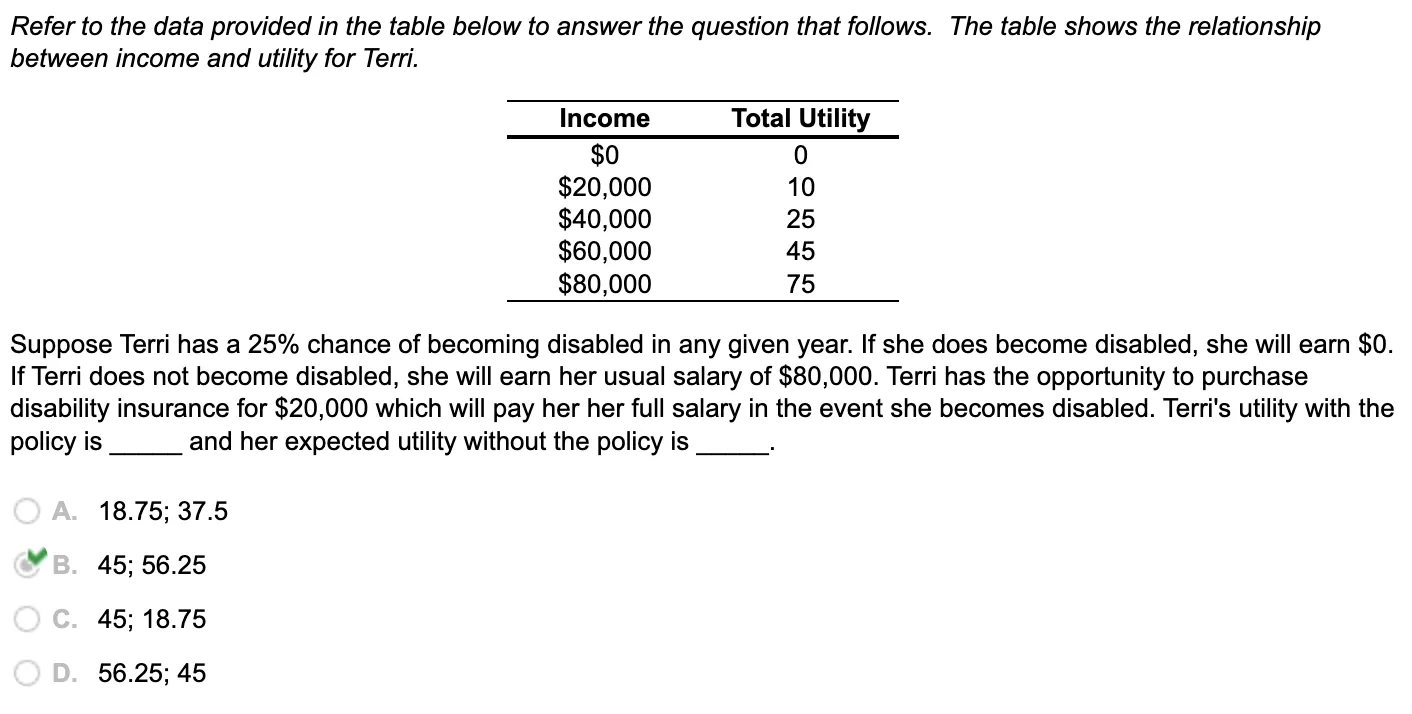
❔ I am reviewing the problem sets as part of my test prep and was looking at question 18 on PS #3
✔
First part: correct.
Second part: we can go deeper. EU = p(nodisability) × u(nodisability) + p(disability) × u(disability)
EU = 75% × 75 utils + 25% × 0 utils = 56.25 utils.
🕣
❔ Can we refer to the homework sets during the exam?
✔Policy-wise yes. Practically, no. You really need to know how to do each of those problems by heart.
🕣 7:56pm
❔ Can we refer to lecture recordings?
✔ Yes, watch them online. Harvard won’t let you download them.
🕣
❔ Rob, if no one has any questions, can you go on short-run and long-run again? I am struggling to wrap my head around this entire concept.
✔
🕣 8:46pm
❔ Could you confirm if there will be a PS4 review session at 12pm Boston time Monday?
✔ Yes, just to give you a chance to ask questions after seeing answers for PS4. You can also email questions and I’ll cover them then.
📅 Questions covered Monday, Mar 9 ✅ Noon
Section titled “📅 Questions covered Monday, Mar 9 ✅ Noon”🕣 1:08pm
❔ What happens if I lose my internet during the exam?
✔ You can just head back into the exam and start the exam back up. Someone recently said it only takes about 30 seconds. Maybe it takes more, maybe takes a minute, but I don’t know how long it takes. Just literally had a student tell me it took 30 seconds recently.
🕣 1:08pm
❔ Proctorio. Calculator. Do we need to show which calculator we’re using? Do we need to show written notes? Switching docs - is that fine?
✔ All of that is fine.
📅 Midterm Solutions Review Thursday, Mar 19 ✅
Section titled “📅 Midterm Solutions Review , Mar 19 ✅”No questions emailed.
Feedback? Email munger.e1010@gmail.com 📧. Be sure to mention the page you are responding to.