🔎 Omniscient Planner
This slide is always challenging and also conveys some deep intuition.
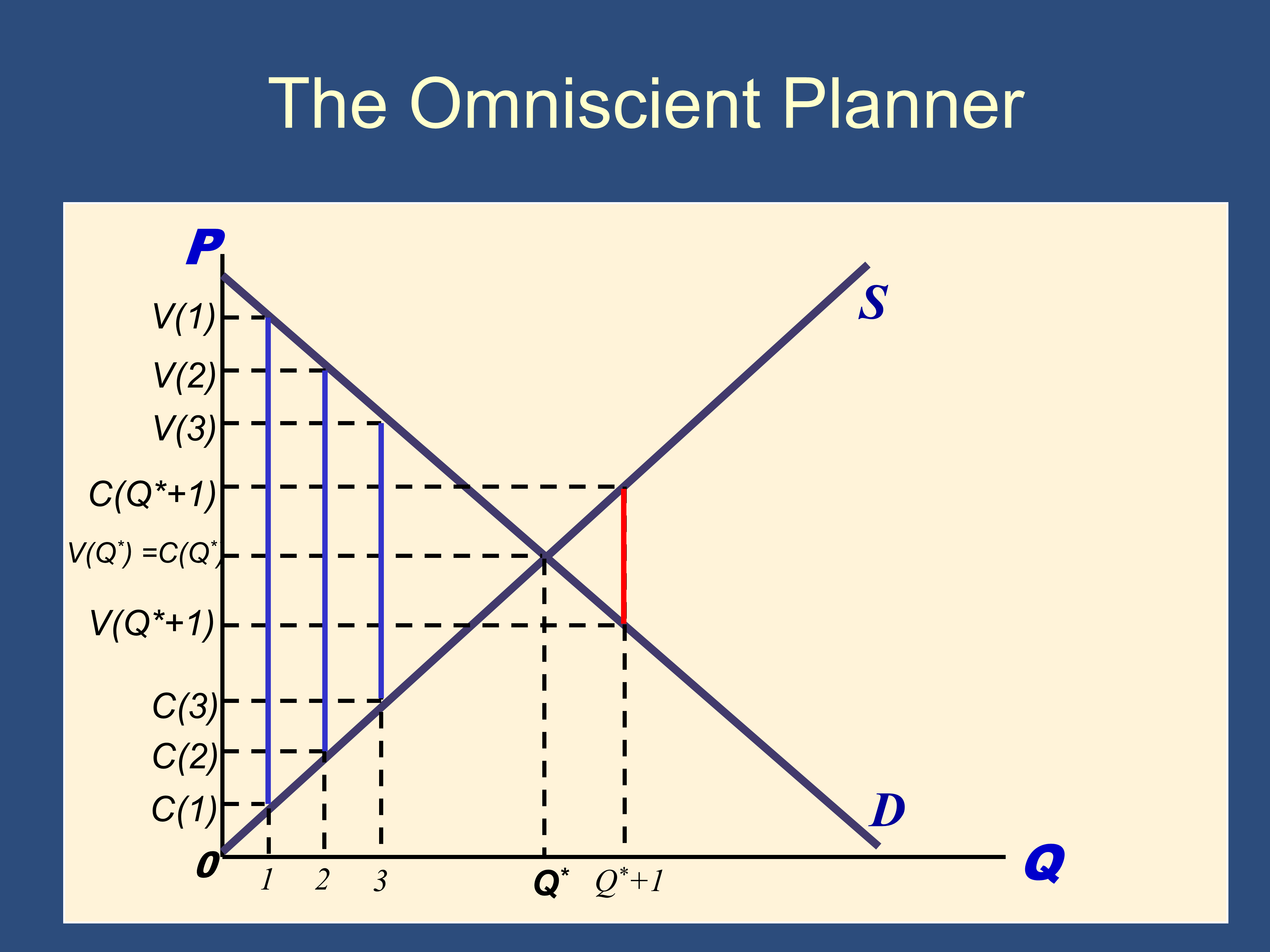
Imagine that the benevolent and omniscient social planner is going to allow one unit of the product to be produced. By benevolent and omniscient planner, imagine a non-market system, where there was a huge computer who decided what is produced, who produces it, and who gets to consume it (for all possible goods in the society). Basically, this is a perfect version of a mid-20th century communist “command and control” economy. In this type of economy, the communist planners decide how many of each good are produced.
Personal memory - I went to Russia in the 80s and experienced this. Bureaucrats determined which goods would be produced and who would get them. They were the social planners.
This benevolent and omniscient would assign the first unit of the good to the consumer who values it the most. They would have a value of . This would be a natural thing for them to do to maximize happiness in their society. (This would, of course, be the highest priority of the benevolent social planner.) For example, they would give the little red balloon to the child who loved little red balloons more than anyone else in the society.
Next, we must decide who makes the balloon. Naturally, it would be produced by the balloon factory with the lowest marginal costs: .
Assuming the social planner did this, what is the Total Surplus created by the first balloon being allocated in this way?
The total social surplus would be the length of the blue line from to . The length would be equal to .
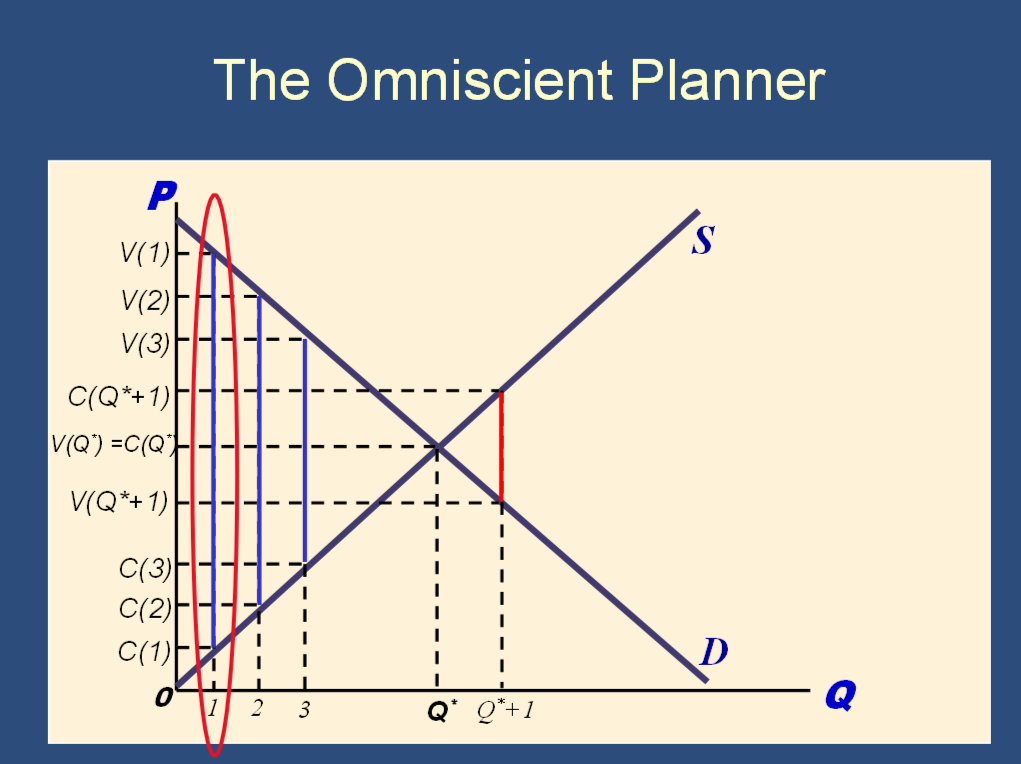
Was it a good idea to make this balloon?
It’s difficult to talk profit of consumer surplus because we don’t know what the price would be. It might be that the social planner simply says that a firm makes the balloon and then gives it to the customer.
Therefore, let’s pivot away from CS and PS to simply “costs and benefits.” We can say that this was a “socially efficient” or “economically efficient” unit to produce because the benefits to society are greater than the costs to society
benefits to society (note that there are no external costs or benefits, so the private benefit equals the social benefit)
costs to society (note that there are no external costs or benefits, so the private benefit equals the social benefit)
This allows us to answer the following question:
🙋♂️Does a difference between consumer surplus and producer surplus create a potential deadweight loss?
✔Not that I can think of. However, as we can see from this discussion, the difference between “social benefit” and “social cost” is the main driver of total surplus. Because DWL is simply when total surplus isn’t optimized, we see that social benefit and social cost drive DWL.
🙋♂️Rob, you haven’t made that case yet.
✔True. So far, we’ve argued that whenever the social benefit is higher than the social cost, it increases social surplus (and economic efficiency) to make the product (such as a balloon).
We can see that for each of the units up until , we have a blue line, which indicates that is higher than . Therefore, for each of the “blue line” units, social surplus is increased, and it was economically efficient to make the balloon.
In other words, whenever the demand curve is above the supply curve, it will generally be socially efficient to make the product.
Likewise, for the red lines, less than the , so it is a net loss to the society to make the good.
The difference between the following two things determines whether there is deadweight loss:
- Marginal benefit to society / / Willingness to pay ← indicated by the demand curve.
- Marginal cost to society / / Willingness to accept ← indicated by the supply curve.
In the presence of externalities, we can apply exactly this framework:
The difference between the following two things determines whether there is deadweight loss:
- Marginal Social Benefit
- Marginal Social Cost
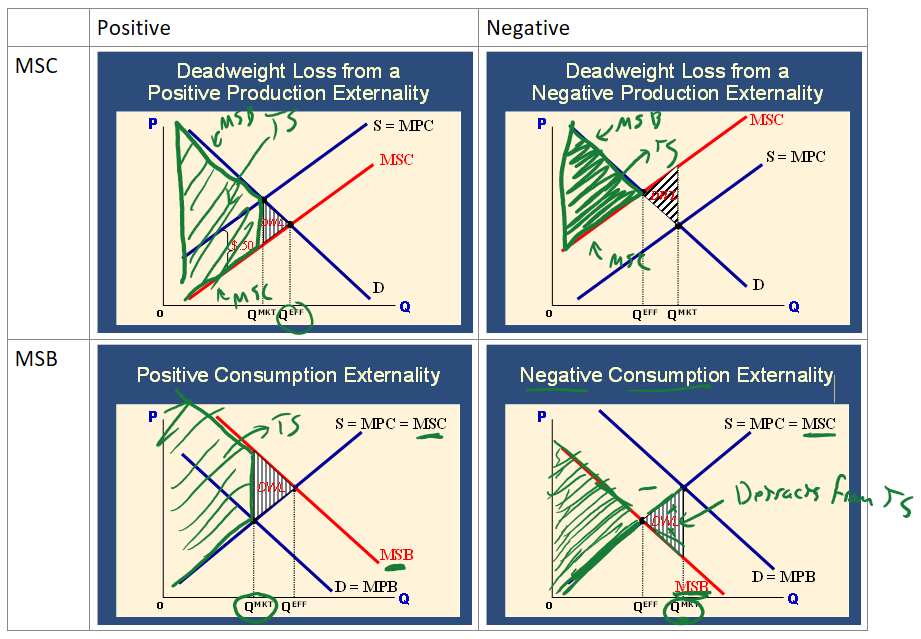
All that I want you to take from the above, is that total surplus is the area:
- below the Marginal (Social) Benefit - MSB
- above the Marginal (Social) Cost - MSC
- to the left of the # of units actually produced.
In summary, returning to the core question:
When the MB (MSB) MC (MSC), then total surplus is increased.
When the MC (MSC) MB (MSB), then total surplus is decreased (makes it less economically efficient).
Feedback? Email munger.e1010@gmail.com 📧. Be sure to mention the page you are responding to.