🔎 Principles of Indifference Curves
Let’s break down the following slide:
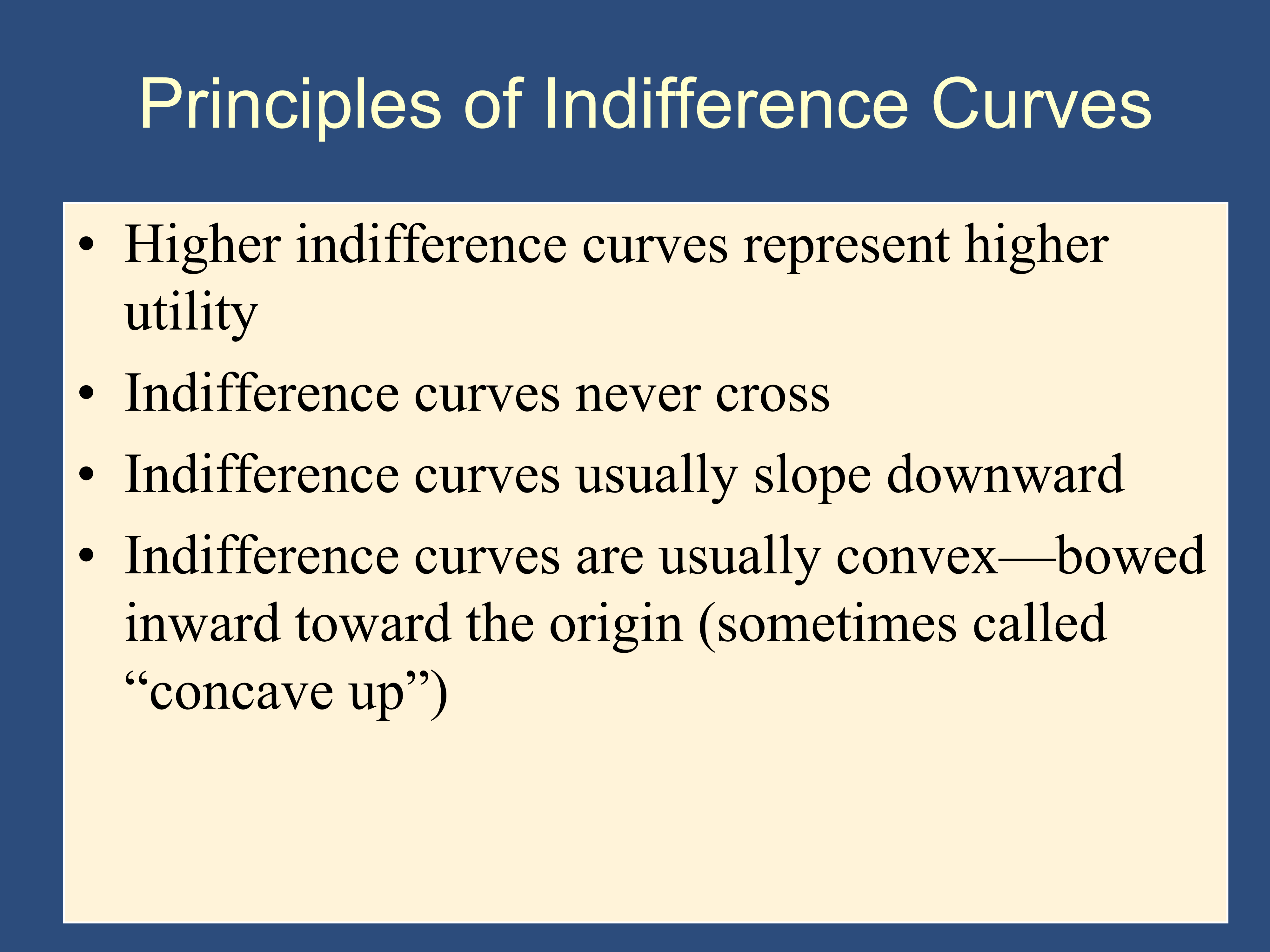
We will cover each bullet point in turn.
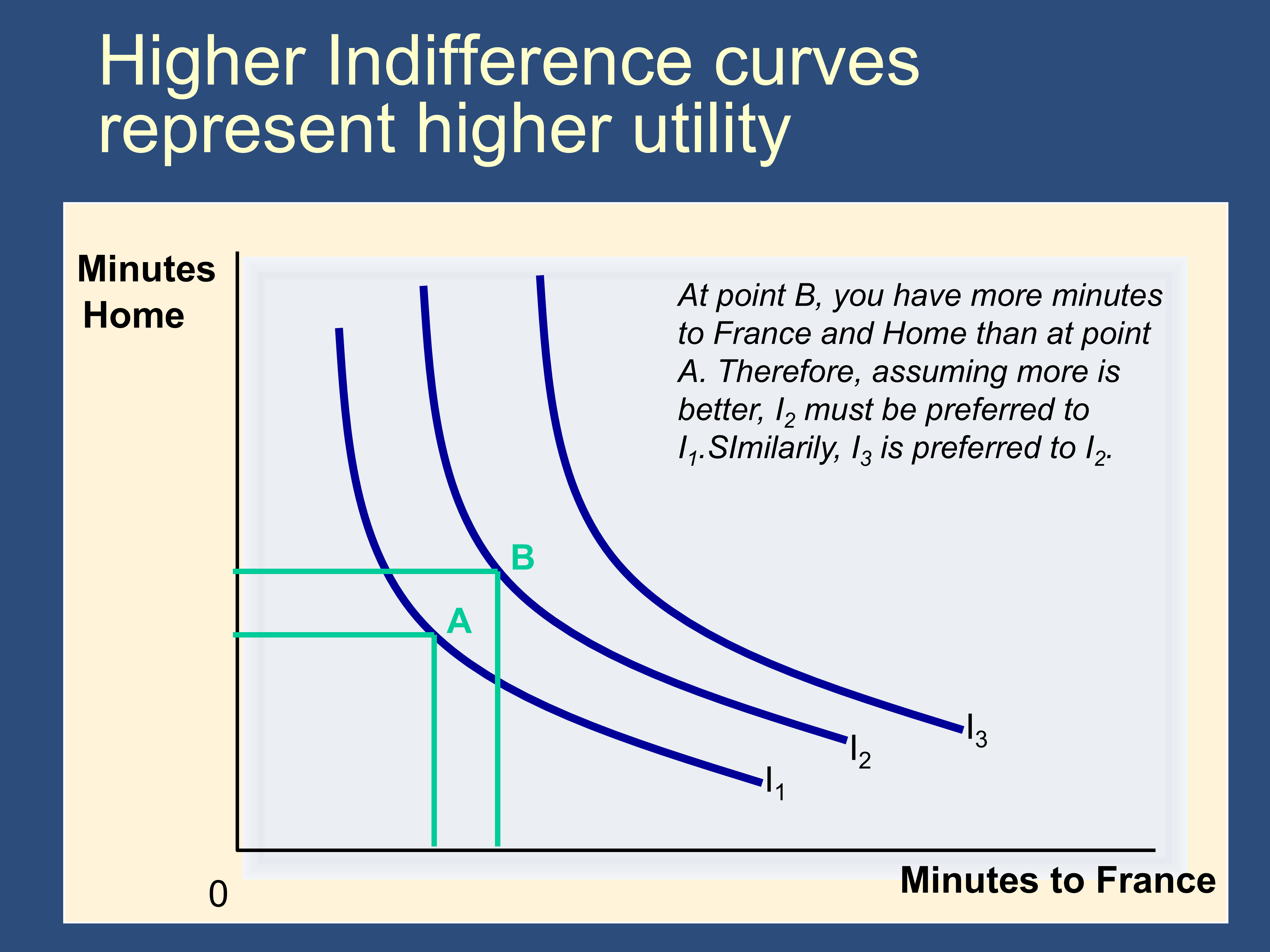
1: Higher indifference curves represent higher utility
Section titled “1: Higher indifference curves represent higher utility”The idea behind this is that more is better, and when an indifference curve is higher (ie more Minutes to France and more minutes Home) then our consumer will have higher utility.
The exception to this is if the product is not a “good” but a “bad,” meaning a product you don’t like. We won’t focus on this case, because different logic applies.
2: Indifference curves never cross
Section titled “2: Indifference curves never cross”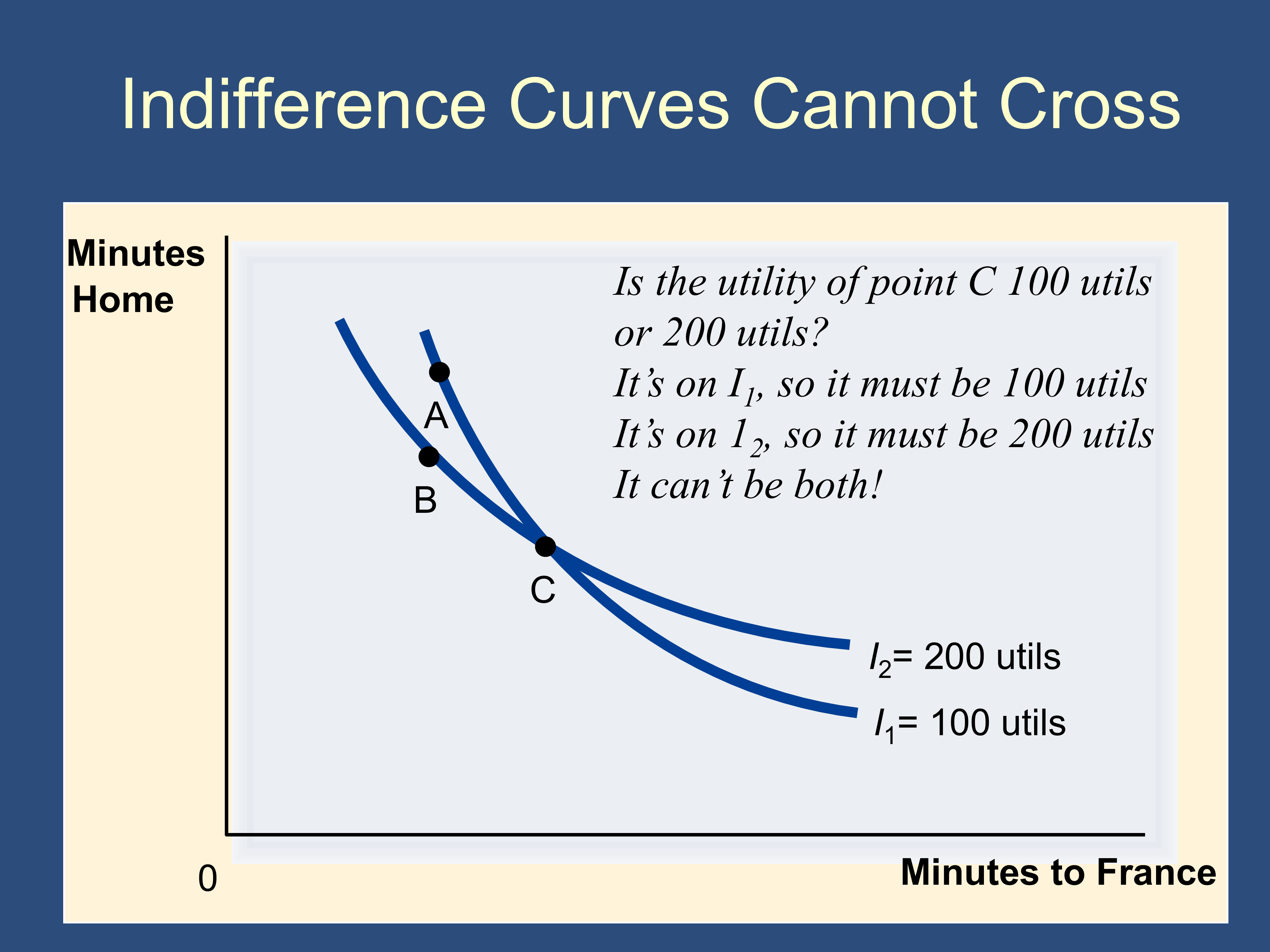
3: Indifference curves usually slope downward
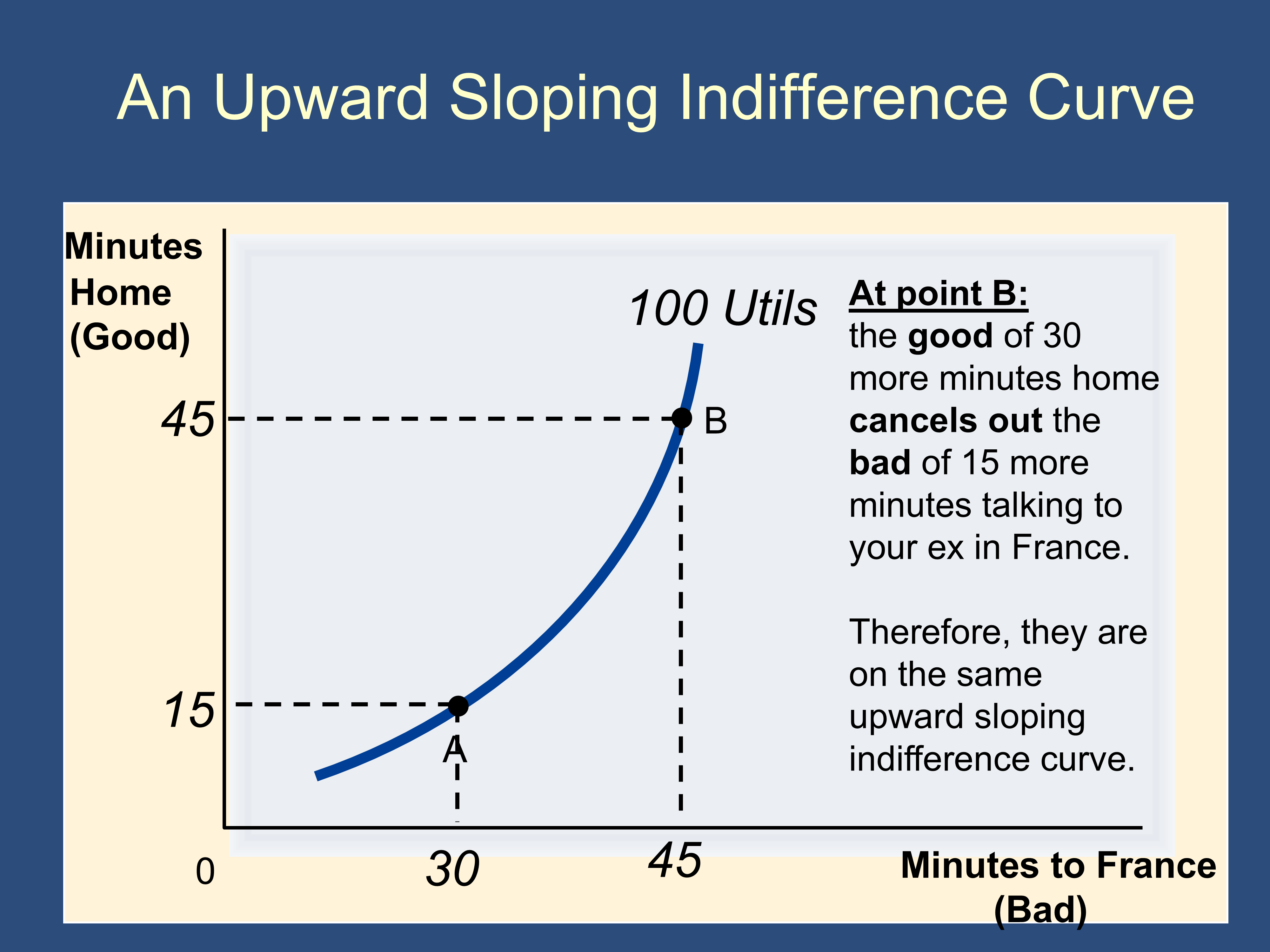
Section titled “3: Indifference curves usually slope downward”Indifference curves are only upward sloping if one of the goods is “good” and the other is “bad.” For example, imagine if you broke up with your ex in France, so you don’t want to talk to them anymore. But you still want to call home. In that case, you might be indifferent between
- 15 minutes home / 30 minutes France and
- 45 minutes home / 45 minutes France
4: Indifference curves are usually convex
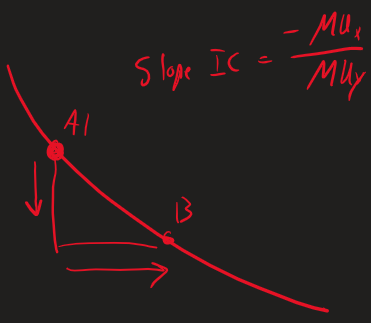
Section titled “4: Indifference curves are usually convex”- As you “slide down the curve,” MUH will increase, because you will have fewer minutes home.
- MUF will decrease, because you will have more minutes to France.
- This will cause the MRS to decrease, which causes the indifference curve to get flatter.
- The net effect is that ICs are typically convex.
- Convex = bowed inward toward the origin (sometimes called “concave up”)
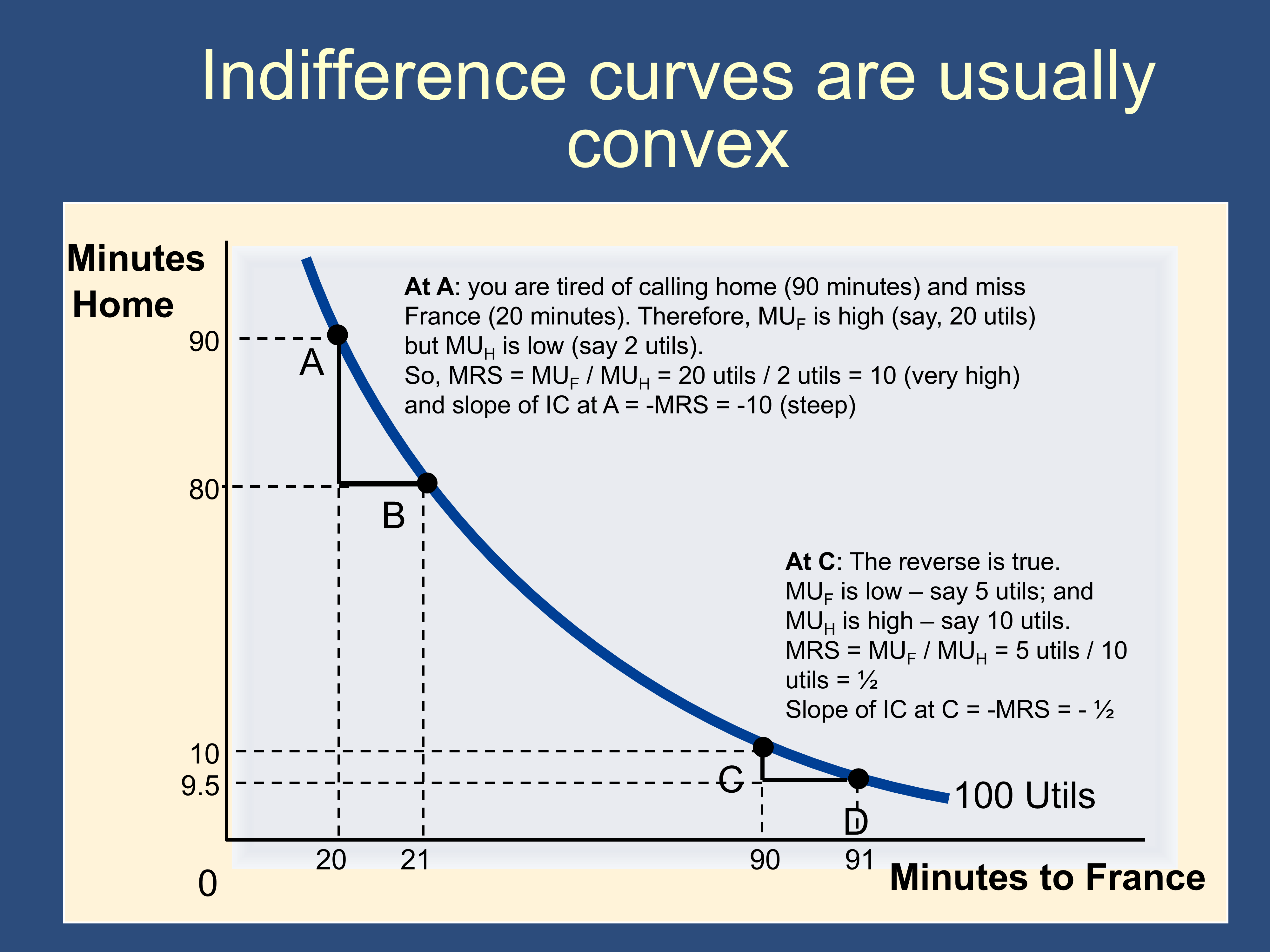
If the above isn’t clear enough, there is a more detailed breakdown below.
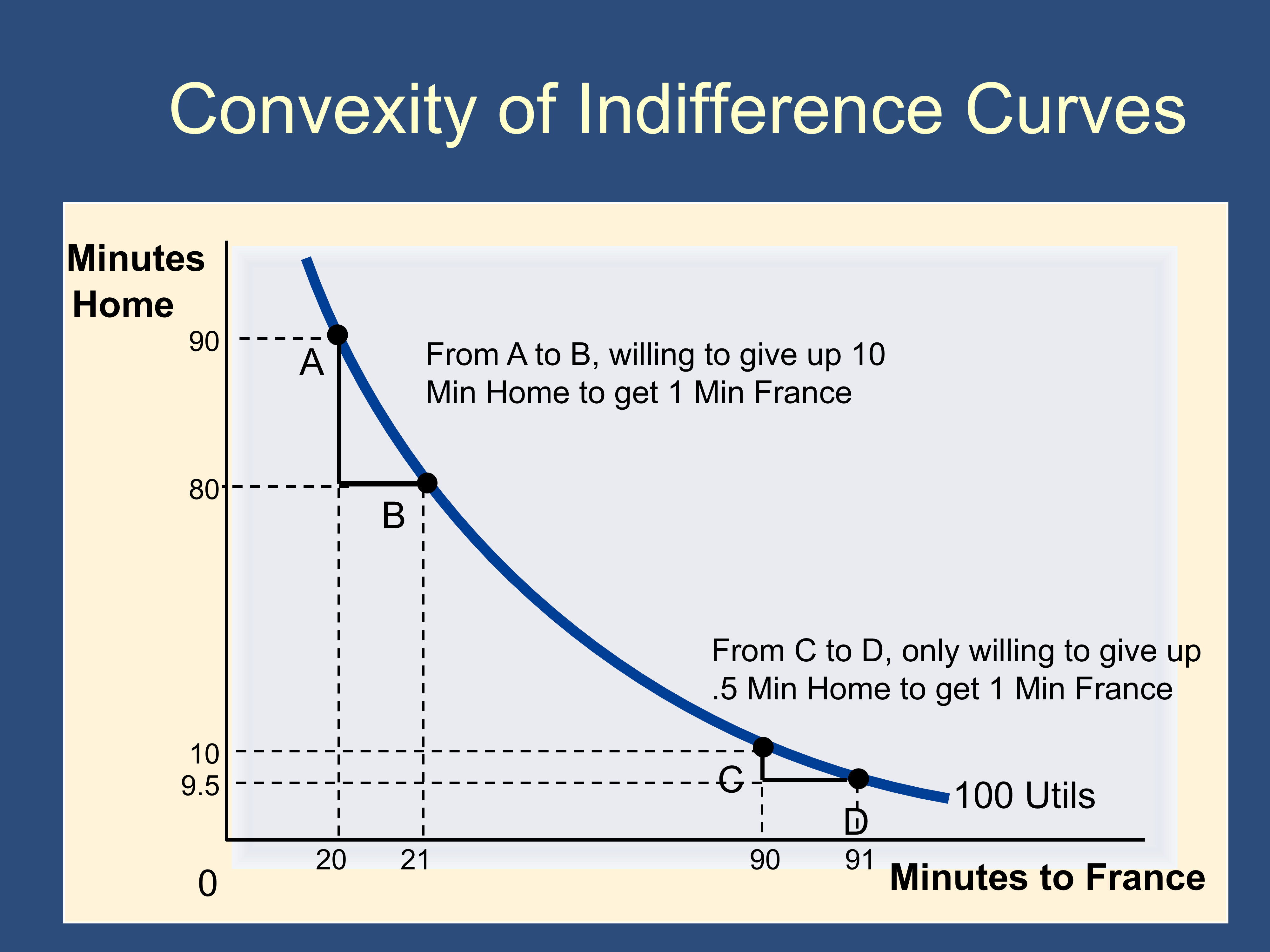 | At point A, the college student only get 20 minutes with France. Therefore, those minutes are quite precious to him. Economically speaking, this means that they have a high marginal utility (MUF is high). At point A, he gets a full 90 minutes with Home. Therefore, the marginal utility of speaking with your parents will be relatively low (MUH is low). In this situation, to get one more minute of speaking with France, you would be willing to sacrifice many minutes of talking with your parents. The difference between the consumption bundles at points A and B is that at point B, he has one more minute talking to France and 10 fewer minutes talking to home. Because the two points are on the same indifference curve, he is indifferent between them. Therefore, he is willing to sacrifice up to 10 minutes Home to get 1 minute speaking to France. The economic way of saying this is that his MRS at point A (as he goes from point A to point B) will be 10. |
| | At point C, you get a whole 90 minutes with France. Therefore, those minutes are far less precious and MUF is lower. In the story behind the graph, you are running out of things to say to your girlfriend. In contrast, at point C, the student only has 10 minutes to speak with his Home. Our college student begins to miss talking to his parents. Therefore, MUH is higher. In this situation, to get one more minute of speaking with France, he would not be willing to sacrifice many minutes of talking with his parents. The difference between the consumption bundles at points C and D is that at point D, he has one more minute talking to France and .5(one half) fewer minutes talking to home. Because the two points are on the same indifference curve, he is indifferent between them. Therefore, he is willing to sacrifice up to half a minute talking to Home to get 1 minute speaking to France. The economic way of saying this is that his MRS at point C (as he goes from point C to point D) will be .5 (one half.) |
Above we have shown that the between points A and B is 10 while the between points C and D is .5. This illustrates how the gets smaller as you “slide down the curve” from point A to point C.
We can also take a mathematical approach to see why the declines from A to C. At point A, we noted that is relatively high and is relatively low. Because we know that , it therefore follows that the must be relatively high (because, whenever you divide a large number by a small number, you get a relatively large number).
Similarly, at point C, we can see, we noted above that is relatively lower and is relatively higher. Because , must be lower than at point A. After all, when you divide a lower number by a higher number, the result is a smaller number.
Feedback? Email munger.e1010@gmail.com 📧. Be sure to mention the page you are responding to.