🔎 How does price discrimination affect individual consumers and social welfare?
Let’s consider a movie theater in a college town with a student discount. It’s the only theater in town, so we will think of it like a monopoly. Let’s assume that students are more price sensitive because their income is constrained.
Suppose that before price discrimination, the price of a movie was $6 for everyone. The theater had to keep the price low to get as many students as possible.
After price discrimination, the theater can raise the non-student price to $7 and drop the student price to $4. Dropping the student price to $4 allows it to capture as much revenue from students as possible. Because students are more price sensitive, implies that a smaller markup is optimal (we talked how markup depends on elasticity here).
| Before Price Discrimination | After Price Discrimination | |
|---|---|---|
| Student | $6 | $4 Many more students go to movies |
| Non-student | $6 | $7 |
Side note:
- Let’s assume . It’s still profitable for it to charge $4 per seat because it is a monopolist, and at $7, P is much larger than MC. Therefore, at $4, . When price is higher than marginal cost, it’s generally profitable.
Because the students are all getting student discounts, this allows the theater to charge more for non-student admission. With the students removed from the general population, the average Ed of the general population falls (becomes less price sensitive). Therefore, implies that the theater can impose a larger markup.
From a social and consumer surplus perspective, price discrimination is generally good. It lowers Deadweight Loss. This is because the inefficiency/DWL comes from monopolists raising prices and decreasing quantities. When the firm can price discriminate, it can serve more clients. For all of the clients , so the more the better!
In perfect competition, QS is very high and the price is low, so firms don’t make much profit.
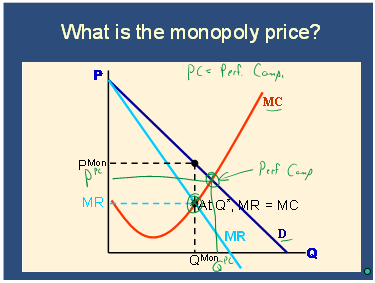
Inefficiencies of monopoly arise because monopolist lowers QS and raises price.
Paradoxically, because price discrimination allows firms to charge different prices to different people, it allows them to sell to more people. You can raise your price to some people without losing other customers. This actually increases surplus.
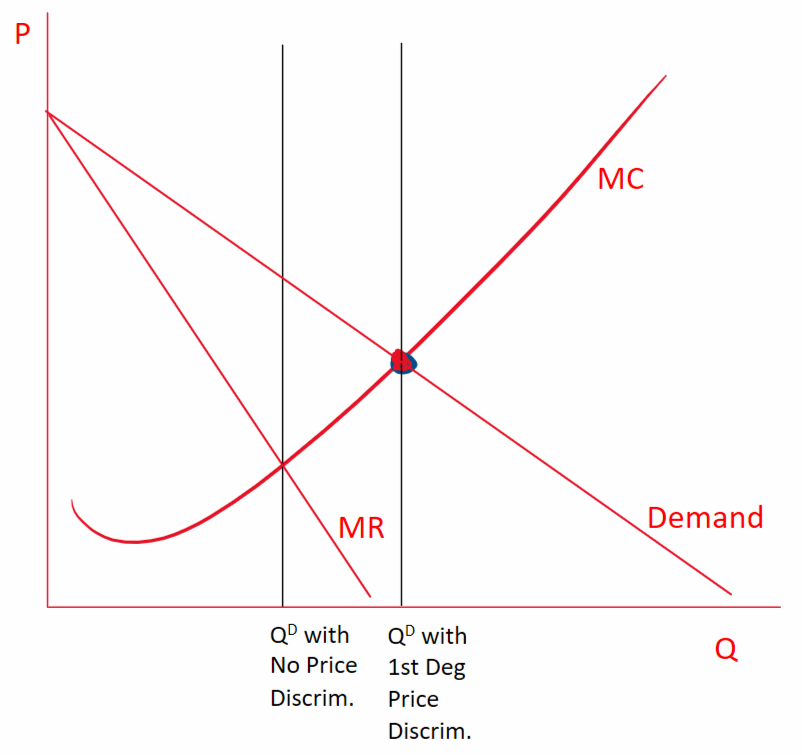
The following diagram illustrate the quantity supplied by a monopolist with no price discrimination (the usual case) and with perfect first degree price discrimination. In the latter case, the monopolist charges all consumers their maximum willingness to pay.
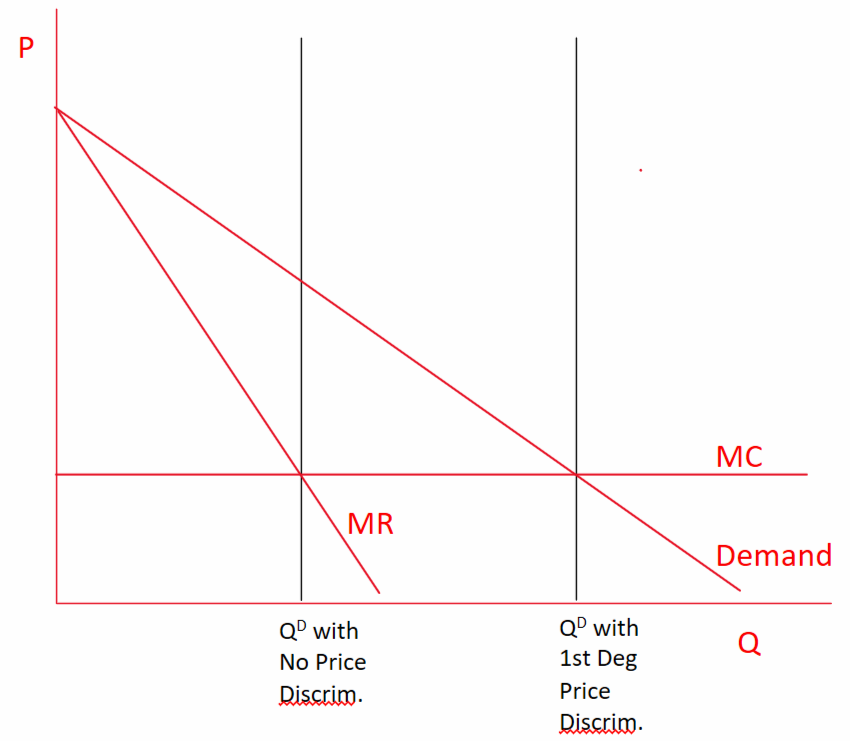
The following diagram updates the previous diagram with a constant marginal cost. Assuming a constant marginal cost can sometimes be helpful when analyzing monopolies.
Feedback? Email munger.e1010@gmail.com 📧. Be sure to mention the page you are responding to.