🔎 Why is a firm's demand curve flat?
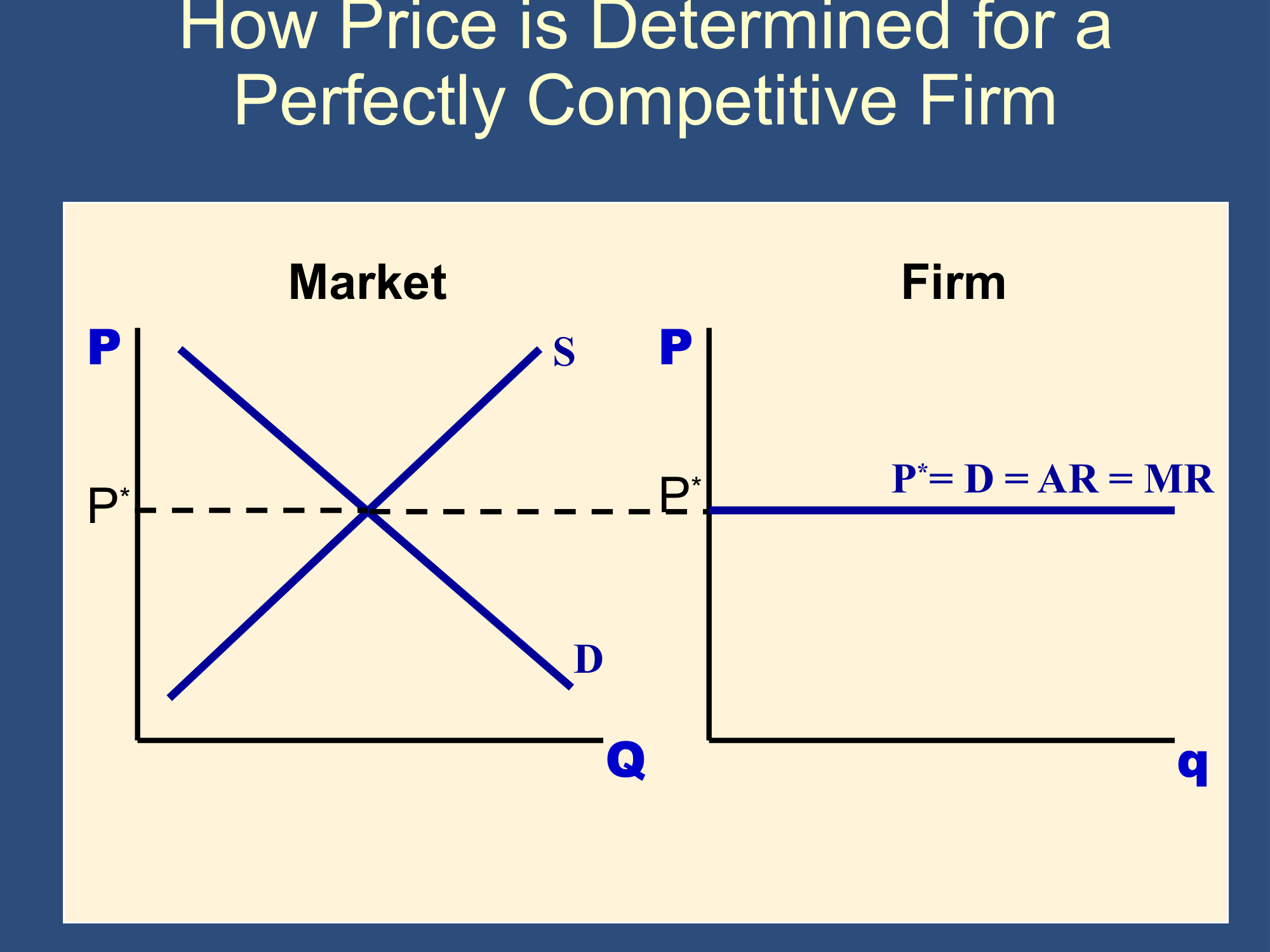
❔ With perfectly competitive firms, there are two demand curves - one demand curve for the entire market and one demand curve just for the firm:
Why is this true?
✔ We do refer to the “demand curve for the market” and the “demand curve for the firm.” However, they are actually the same demand curve, just viewed at different scales. It’s a matter of perspective.
Suppose the total output of wheat in the United States is 2 billion bushels per year and that one farm can produce 10,000 bushels. This means that our single farm produces only one 200,000th of the total output in the country - basically nothing.
To change the market price of wheat would require an increase or decrease in the wheat supply of tens or hundreds of millions of bushels of wheat. Clearly, if the maximum that a single farm can produce is 10,000 bushels, the total amount produced by that farm will have no impact on the price of wheat. Therefore, the small farm can produce as much or as little wheat as it wants. It will not affect the market price.
You should use this example to think about competitive markets. In a competitive market, each individual firm is so small relative to the entire market that they cannot affect the market price. If it produces only one unit of output, the market will demand that output at the market price. If it produces as much as it can, the market will demand all of that output at the market price. From the competitive firm’s perspective, the demand curve is essentially flat. This is why we say that the demand curve faced by the firm is flat even though the actual demand curve is downward sloping.
Each individual firm in a competitive market can be thought of as a tiny little ant on the demand curve. It can see the demand curve at the current level of production, and it can also look to the left (ie decreasing Q) and the right (ie increasing Q) based on whether it increases or decreases its own production. However, because its own production is incredibly small compared to the market, the demand curve doesn’t appear to slope downward to the ant. As far as the ant is concerned, the demand curve is completely flat.
The lefthand diagram in the slide above shows the entire demand curve. The righthand diagram in the slide above shows the demand curve from the perspective of the ant. Based on the level of output that the farm can produce, the market price will be unchanging, Therefore, from the ant’s perspective, the demand curve looks flat.
In summary, there is only one demand curve. The diagram on the left shows the entire market demand curve, whereas the diagram on the right shows the demand curve that, practically speaking, an individual competitive firm (ie an ant) would face.
🙋 Does this relate to why we say that the demand curve faced by the firm is perfectly elastic?
See answer
✔ Yes!
Elasticity of demand is one way of measuring how steep the demand curve is. When a demand curve is more elastic, it will be flatter. The demand curve faced by an individual firm is perfectly flat, so we say that it is perfectly elastic. ✅
🙋 How does this relate to price-taking behavior?
See answer
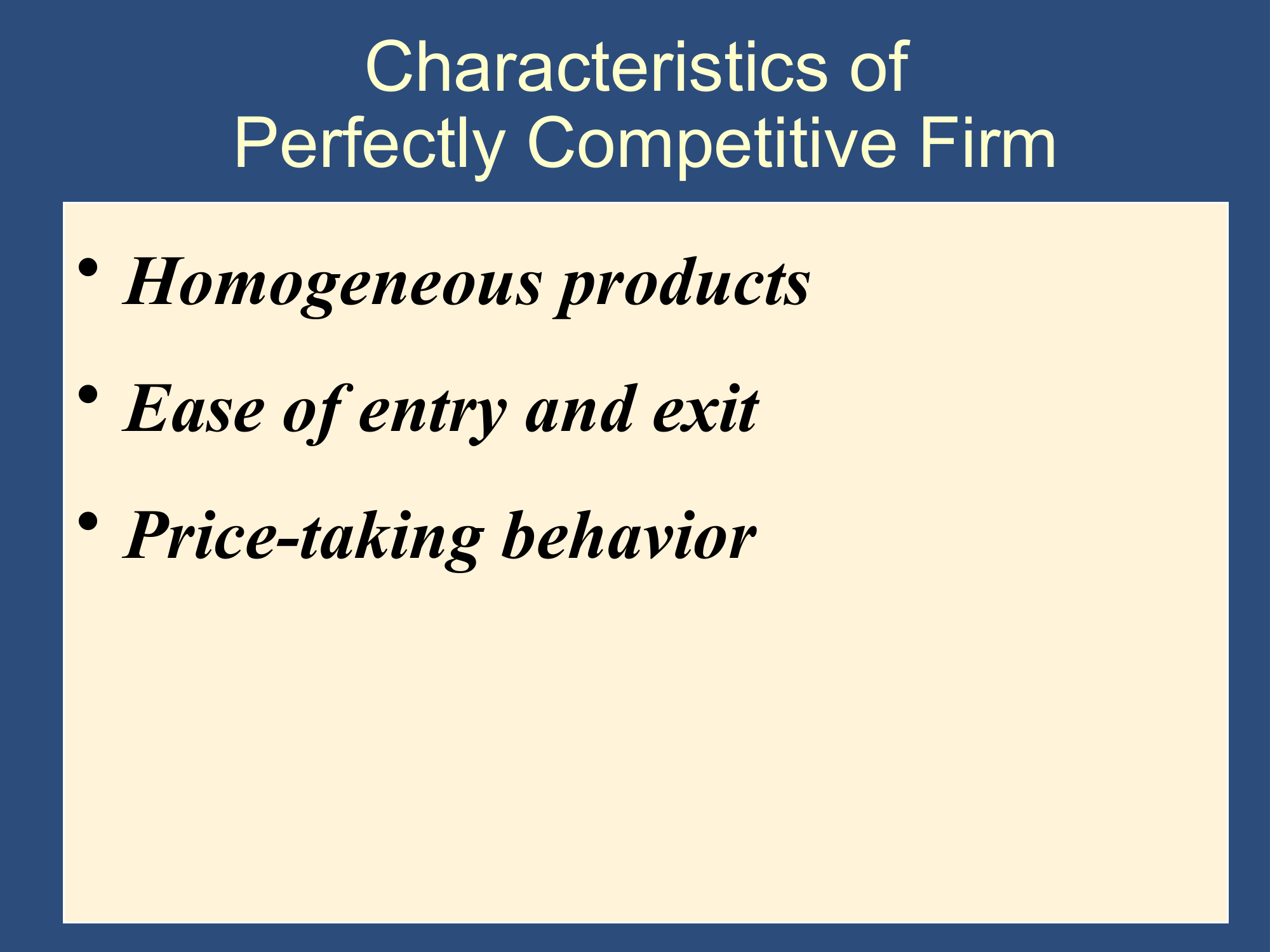
✔ Two of the assumptions of perfect competition are that there are homogenous products and many buyers and sellers:
 |  |
|---|
Because there are so many sellers, if the small competitive firm attempts to charge a price above the market price, that firm’s customers will simply buy the products from another firm. The customer’s won’t mind switching to another firm because the products are homogenous. (Homogeneity just means that products from different firms are identical.)
The supply and demand diagram, on the left, above, implies that other firms are willing to satisfy the entire market demand at the market price. Therefore, if a firm attempts to sell the goods for more than the market price, customers won’t buy any of the good from the firm. For example, if the market price for wheat is $5.92, and a farmer tries to sell their wheat for $5.93, its customers will simply buy from someone else. Remember, the products are homogenous and the buyers have complete information about the quality of the goods, so the buyers have no incentive to stick with a farmer that sells the same good for a higher price. ✅
🙋 Is the demand curve for a firm always perfectly flat?
See answer
✔ If the farm was a monopoly instead of a participant in a competitive market, it would no longer be “an ant.” There also wouldn’t be any other firms to buy the good from. The firm could raise its prices and customers would have nowhere else to go. Because the market demand curve is downward sloping, consumers would purchase less of the good, but they would still have to purchase the good from the monopolist. Therefore, we say that the demand curve for a monopolist is downward sloping.
Later on, we will see the demand curve for other market structures are also downward sloping. Competitive markets are very unique in having perfectly horizontal demand curves for individual firms.
In the future, . ✅
Feedback? Email munger.e1010@gmail.com 📧. Be sure to mention the page you are responding to.