🔎 Learning the MRS
Learning the Marginal Rate of Substitution (MRS)
Section titled “Learning the Marginal Rate of Substitution (MRS)”The following is the core information you should learn regarding the Marginal Rate of Substitution of good X for Y. It’s challenging to master, so you want to read it very slowly and carefully, checking in regarding whether you understand each sentence.
I present it first as the MRS of Cookies for Chocolates, because it’s easier to build up intuition with concrete goods you probably have strong opinions about. If you can read each sentence slowly and understand each word, move on to the more abstract formulation below, which restates everything in terms of the MRS of Good X for Good Y.
If you don’t understand each word of each sentence, feel free to email me at munger.e1010@gmail.com and I will be happy to help. If you prefer, I’ve included some textbook presentations below for you to read. Rewatching the relevant portion of Bruce’s lectures is another excellent resource, as it will make clear exactly what he wants you to know. Every word is important.
MRS of Cookies for Chocolates
Section titled “MRS of Cookies for Chocolates”What would your MRS be of homemade chocolate chip cookies for traditional confectioner’s chocolates? Imagine the cookies on the X axis and the chocolates on the Y axis . What would your Marginal Utility be for each desert? How would this Marginal Utility change as you consumed more or less of each very sweet food? (Diminishing marginal utility suggests that your marginal utility would decrease as you ate more.) How would the Marginal Utility relate to the MRS? Finally, as you switched from consuming Chocolates to consuming Cookies, how would your MRS change?
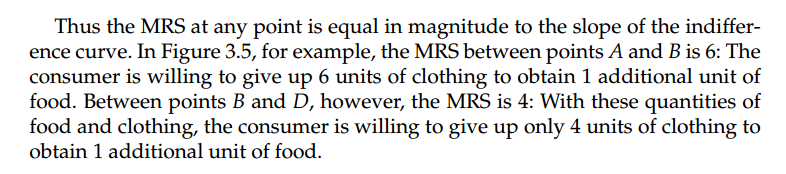
- Marginal Rate of Substitution (MRS of cookies for chocolates) measures the number of chocolates you are willing to give up to get one more cookie.
- low MRS = doesn’t like cookies (or loves chocolate). Ie either MUCo is low or MUCh is high.
- high MRS = loves cookies (or doesn’t like chocolate)
- “MRS measures the marginal value of one more cookie…that value being measured in pieces of chocolate”
- (Recall that the MU of a good declines as you consume more of it.)
- Intuitively, if MUCo is high, I’ll give up many pieces of chocolate to get one more cookie, so I would expect the MRS to be high. The above formula, , tells us that when MUCo is high, MRS is also high. It does this because whenever the top number in a fraction is larger, the fraction itself gets larger (this is a general math fact)
- Intuitively, if MUCh is high, (ie a chocolate lover) then I wouldn’t give up many pieces of chocolate to get another cookie. Therefore, the MRS should be low. The above formula, , also tells us that when MUCh is high, MRS is also low. It does this because whenever the bottom number in a fraction is larger, the fraction itself gets smaller (this is another general math fact)
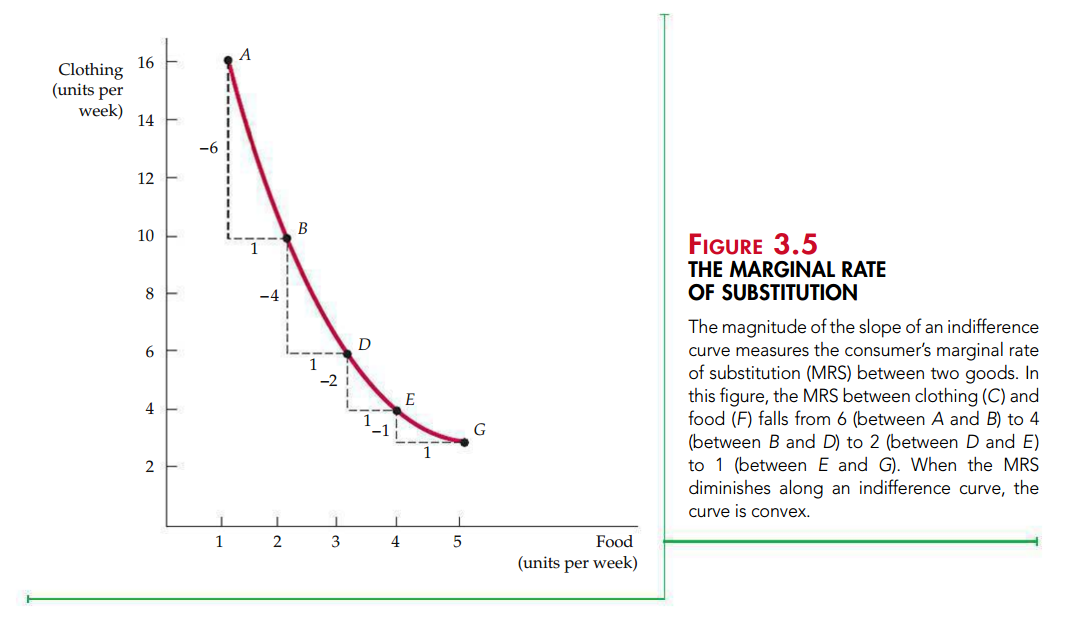
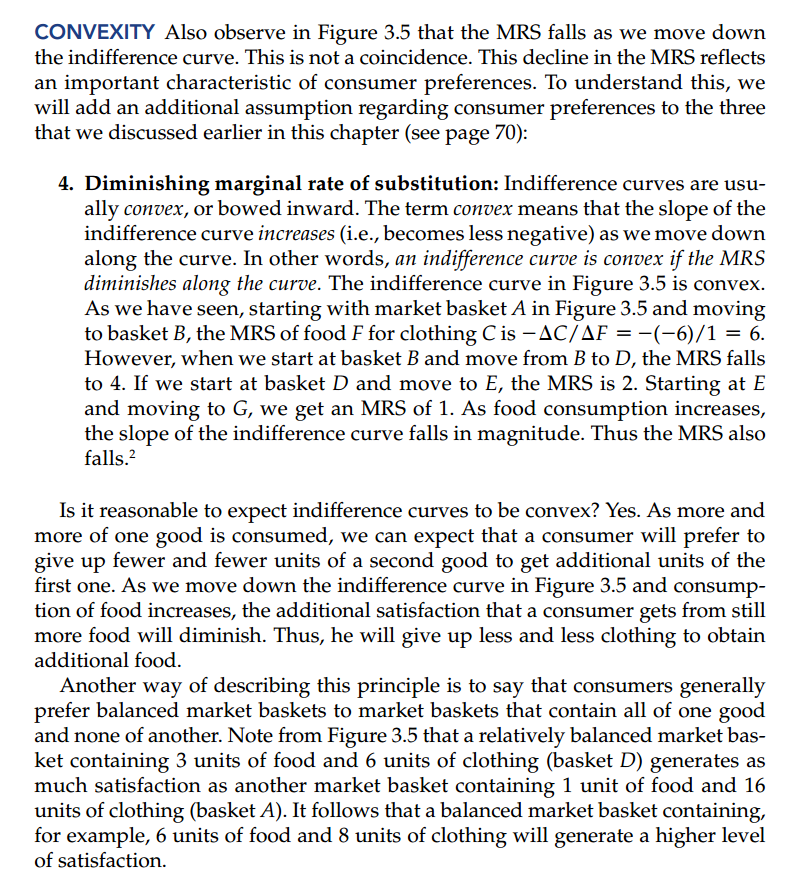
- Diminishing Marginal Rate of Substitution means that as you move down along an indifference curve, MRS decreases (in other words, the IC gets flatter, as you move down along it).
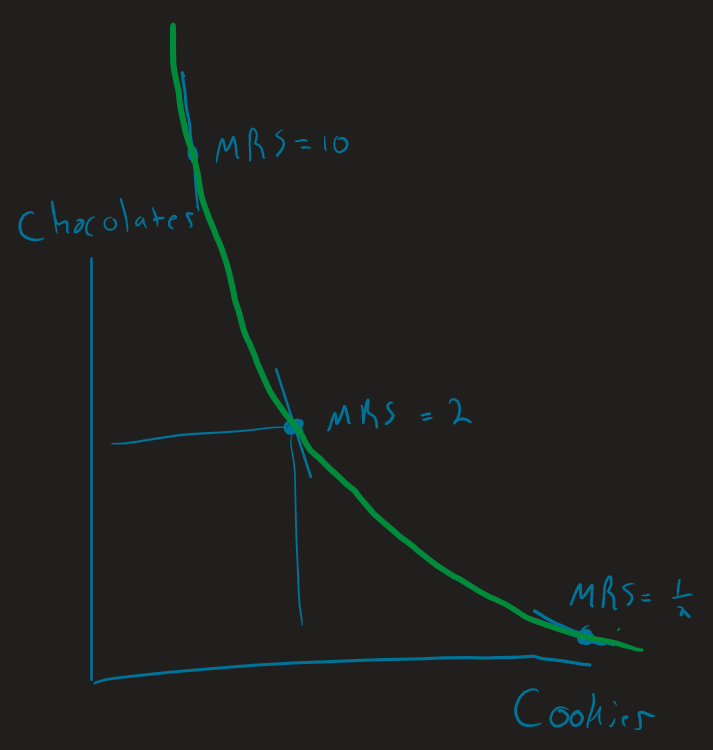
I would trade two chocolates for one cookie. Therefore, my MRS of Cookies for Chocolates is 2.
MRS = 2
MRS of Good X for Good Y
Section titled “MRS of Good X for Good Y”The following section replicates the text above, but with an arbitrary ‘good X’ on the X axis and an arbitrary ‘good Y’ on the Y axis. You’ll want to know it very well. Once you feel you understand each sentence of this section of the page, word for word, you’ve got everything you need from this page. Feel free to skip the rest! (Thought the rest of the page would never hurt to read it and may build confidence.)
- Marginal Rate of Substitution (MRS of X for Y) measures the amount of good Y you are willing to give up to get one more unit of X. If you value X more than Y, you will give up more units of Y to get an additional unit of X
- MRS measures the marginal value of one more unit of X…that value being measured in units of Y
- (Recall that the MU of a good declines as you consume more of it.)
- Intuitively, if MUx is high, I’ll give up many units of Y to get one more unit of X, so I would expect the MRS to be high. The above formula tells us that when MUx is high, MRS is also high.
- Intuitively, if MUy is high, then the MRS should be low.
- Diminishing Marginal Rate of Substitution means that as you move down along an indifference curve, MRS decreases (in other words, the IC gets flatter, as you move down along it).
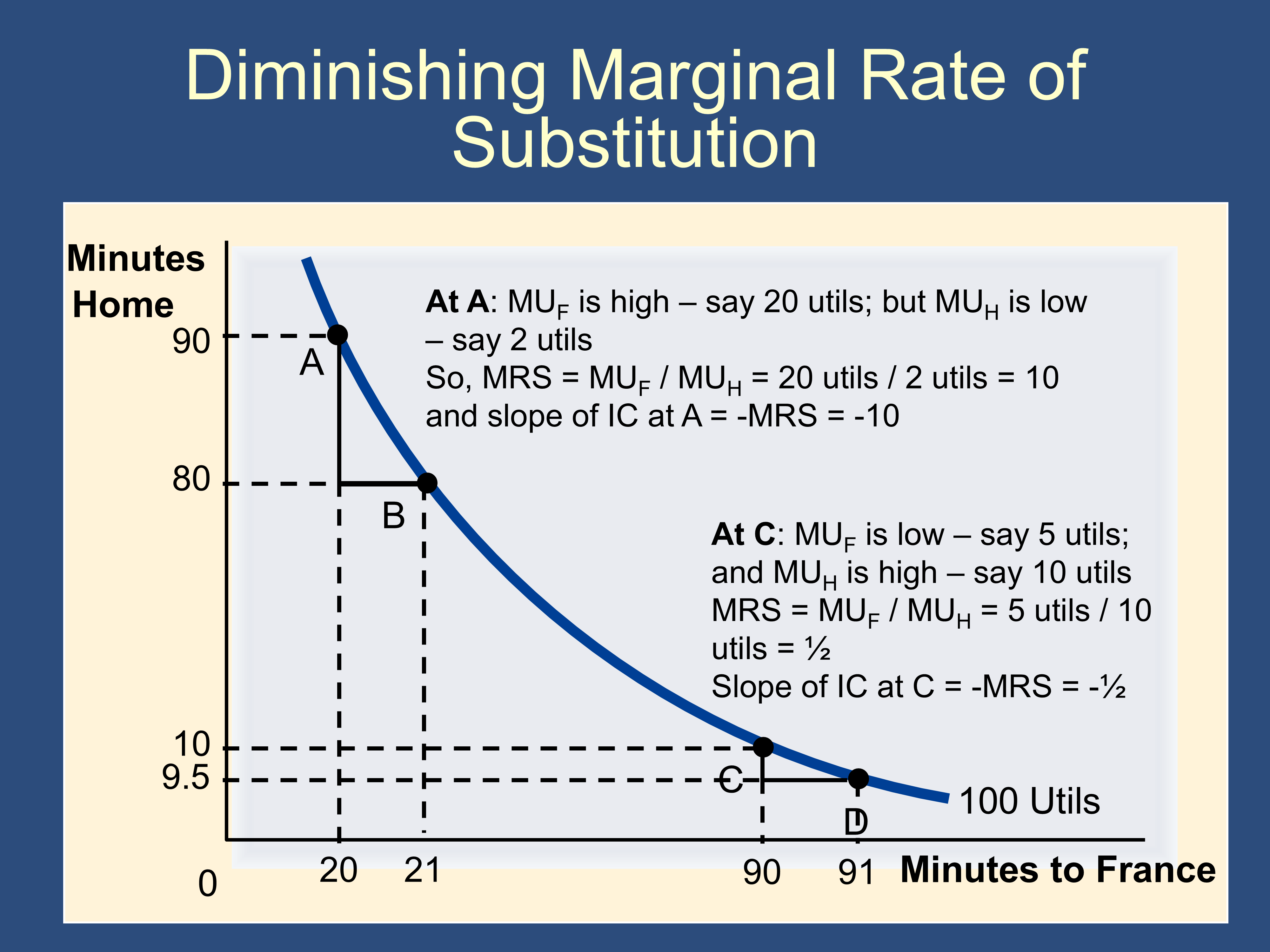
A basic textbook presentation of the MRS:
Section titled “A basic textbook presentation of the MRS:”The following is a very basic explanation of MRS. It is taken from an appendix to Hubbard and O’Brien, the textbook we use in E1000.
Background:
The table in Figure 1 gives Dave’s preferences for pizza and Coke. The graph plots the information from the table. Every possible combination of pizza and Coke will have an indifference curve passing through it, although in the figure we have shown only four of Dave’s indifference curves. Dave is indifferent among all the consumption bundles that are on the same indifference curve. So, he is indifferent among bundles E, B, and F because they all lie on indifference curve I3. Even though Dave has 4 fewer cans of Coke with bundle B than with bundle E, the additional slice of pizza he has in bundle B results in his having the same amount of utility at both points.
Figure 1: Plotting Dave’s Preferences for Pizza and Coke
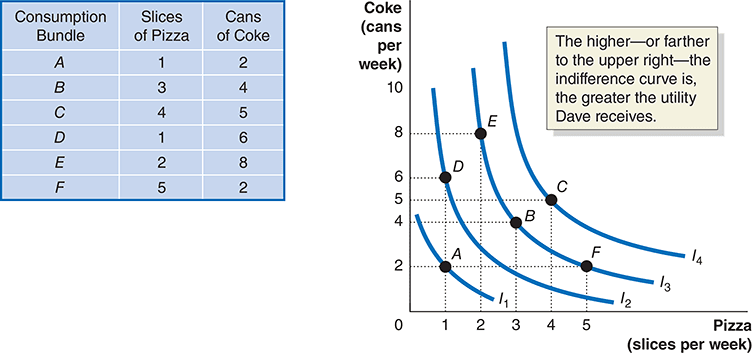
Moving to the upper right in the graph increases the quantities of both goods available for Dave to consume. Therefore, the farther to the upper right the indifference curve is the greater the utility Dave receives.
Remember:
- MRS = “How much you like X in terms of how much Y you would give up for it.”
- MRS = -slope of IC
The Slope of an Indifference Curve
Section titled “The Slope of an Indifference Curve”Remember that the slope of a curve is the ratio of the change in the variable on the vertical axis to the change in the variable on the horizontal axis (). Along an indifference curve, the slope tells us the rate at which the consumer is willing to trade off one product for another while keeping the consumer’s utility constant.
Economists call this rate the marginal rate of substitution (MRS).
We expect that the MRS will change as we move down an indifference curve. In Figure 1, at a point like E on indifference curve I3, Dave’s indifference curve is relatively steep. As we move down the curve, it becomes less steep, until it becomes relatively flat at a point like F. This is the usual shape of indifference curves: They are bowed in, or convex. A consumption bundle like E contains a lot of Coke and not much pizza. We would expect that Dave could give up a significant quantity of Coke for a smaller quantity of additional pizza and still have the same level of utility. Therefore, the MRS will be high. As we move down the indifference curve, Dave moves to bundles, like B and F, that have more pizza and less Coke. At those points, Dave is willing to trade less Coke for pizza, and the MRS declines.
- Steep = really wants X
- Shallow = really wants Y (doesn’t want X)
Concept Check
Section titled “Concept Check”✏️ Along an indifference curve, the slope tells us the rate at which the consumer is willing to trade off one product for another while keeping the consumer’s utility constant. True or false?
✔ Click here to view answer
True ✅
The MRS as it is presented in our textbook
Section titled “The MRS as it is presented in our textbook”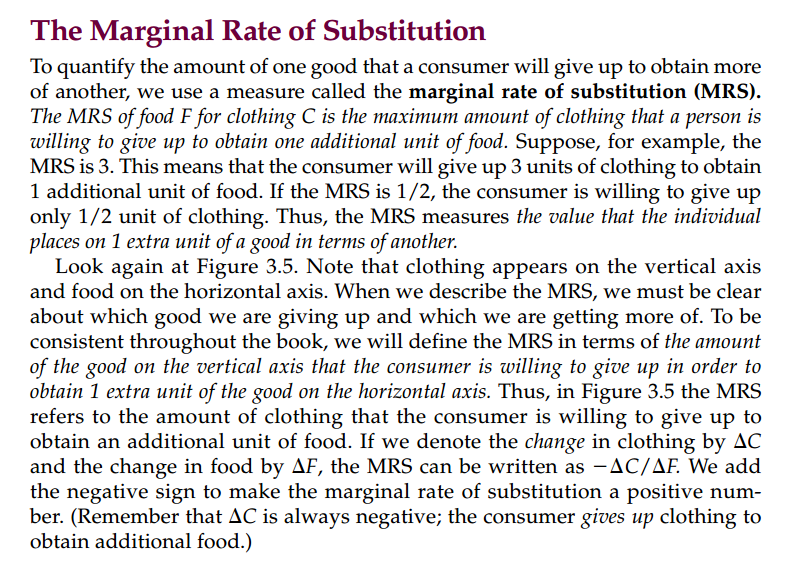
Feedback? Email munger.e1010@gmail.com 📧. Be sure to mention the page you are responding to.