🔎 The Big Picture
Goal:
- You only have a finite budget. What do you buy?
Answer:
- You buy the things that provide you with the most satisfaction. ← “maximize your utility”
Preferences + Budget = Optimization
Section titled “Preferences + Budget = Optimization”There are two components that go into our optimization decisions:
- What we want (Preferences)
- What we can afford (Budget)
We analyze both of these using diagrams:
| Concept | Diagram |
|---|---|
| 1.) What do I want? (i.e. preferences, utility and indifference curves) | 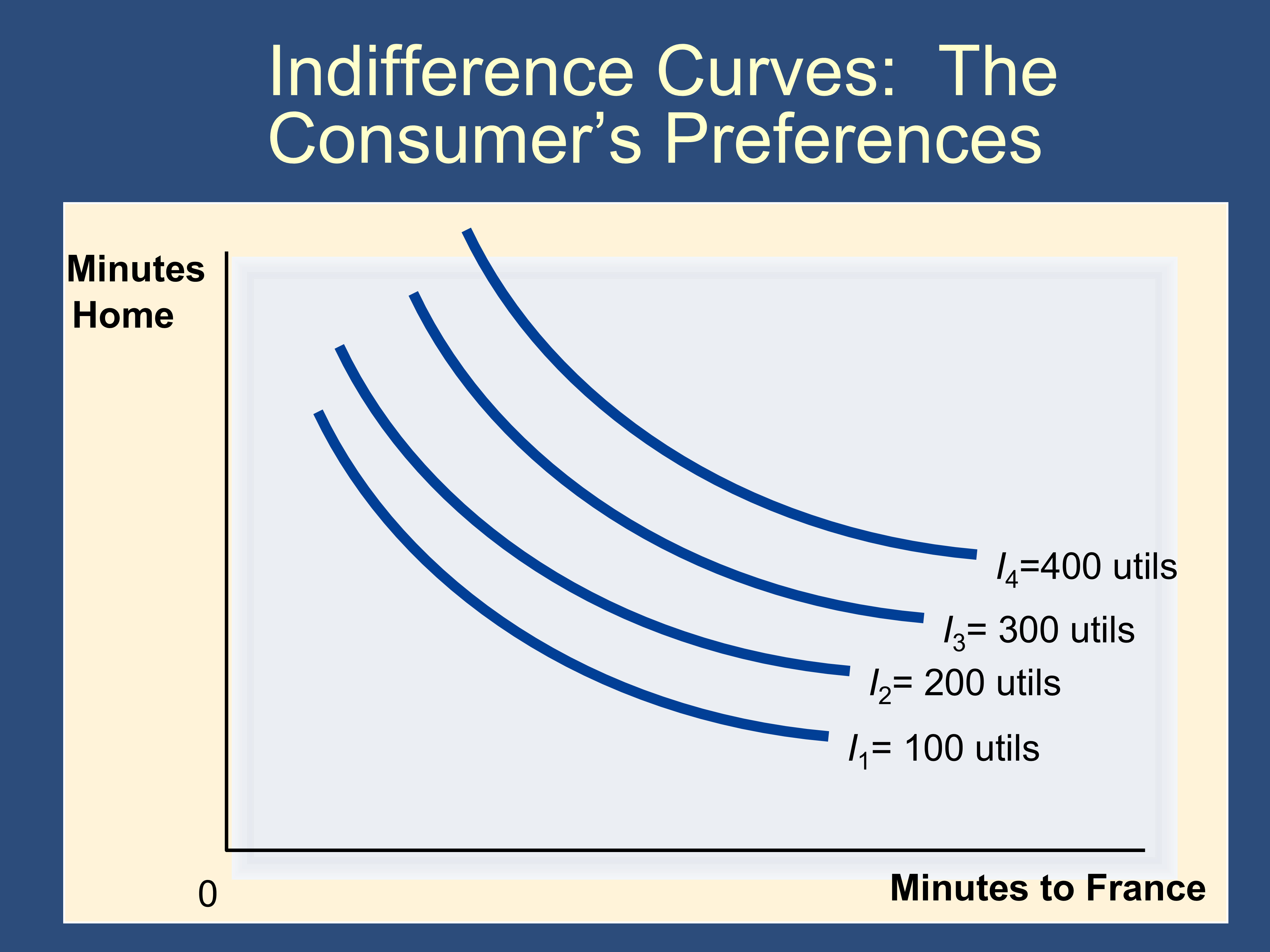 |
| 2.) What can I afford? (i.e. my budget constraint) | 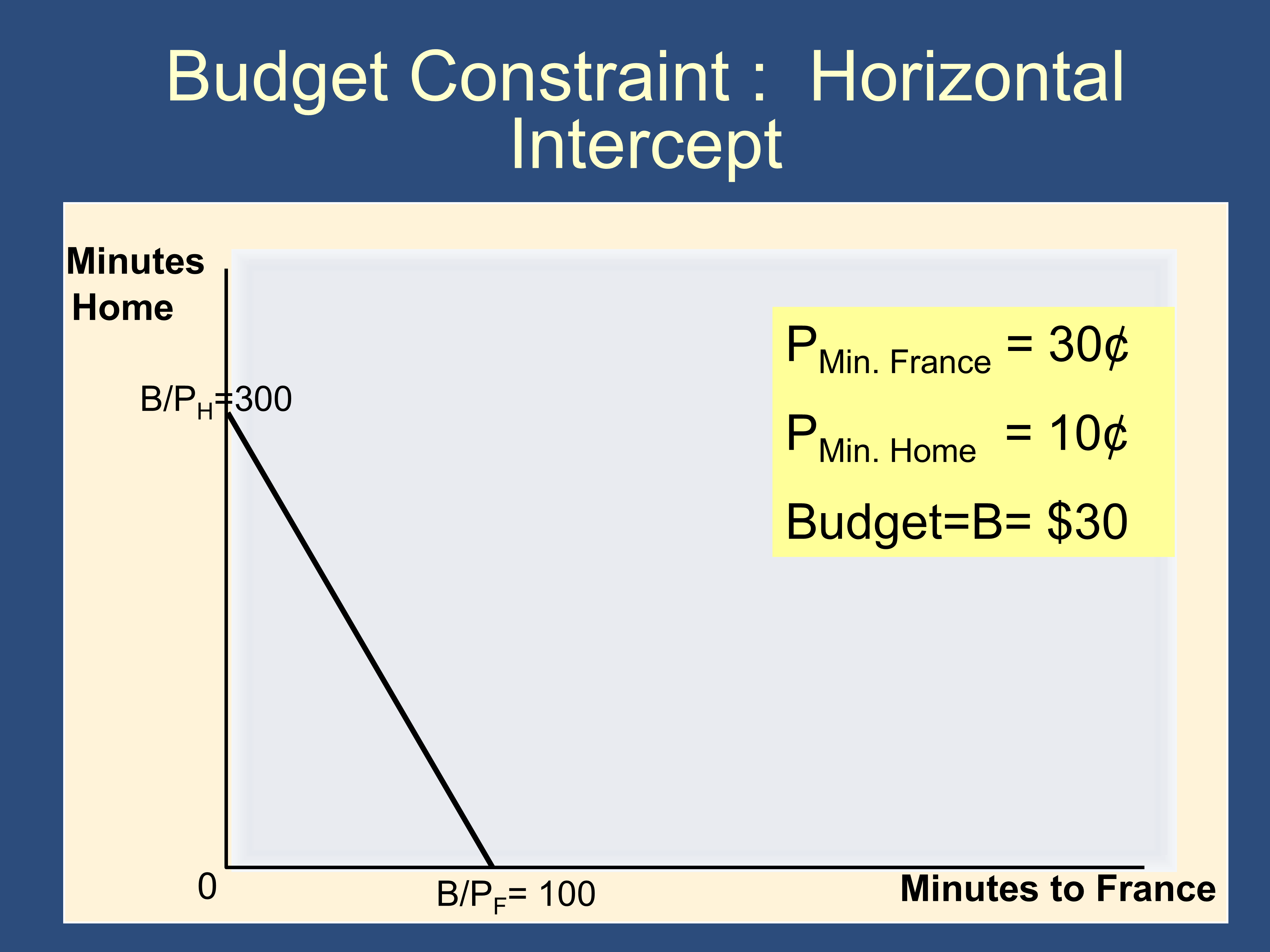 |
Each point on the diagram represents a specific “consumption bundle” or “basket of goods.”
Two Optimization Conditions
Section titled “Two Optimization Conditions”Our analysis shows that two “optimization conditions” are satisfied when you make an optimal consumption decision:
- First optimization condition: we must spend all of our money
- Second optimization condition: we must spend all money efficiently, so that the slope of the budget constraint equals the slope of the indifference curve.
First Optimization Condition
Section titled “First Optimization Condition”The first optimization condition is very intuitive - to maximize our happiness, we must spend all of our money. This follows from the fact that we generally assume that we aren’t “satiated.” In other words, “more is better.”
There are two alternative versions of the budget constraint that we can use in practice:
Two versions of the first optimization condition:
- Your consumption should be on the Budget Constraint.
- X × Px + Y × PY = B
These ensure that you use all of your money.
Both are explained in the remainder of this sub section, immediately below.
To see why your consumption must be on the Budget Constraint, note that in the following diagram,
- Point D can’t be optimal because it lies outside of your budget constraint, so you exceed your budget
- Point C can’t be optimal because you don’t spend your full budget
- (Points A and B will be discussed below.)
You only spend all of your money (and don’t exceed your budget) when your consumption is on the Budget Constraint:
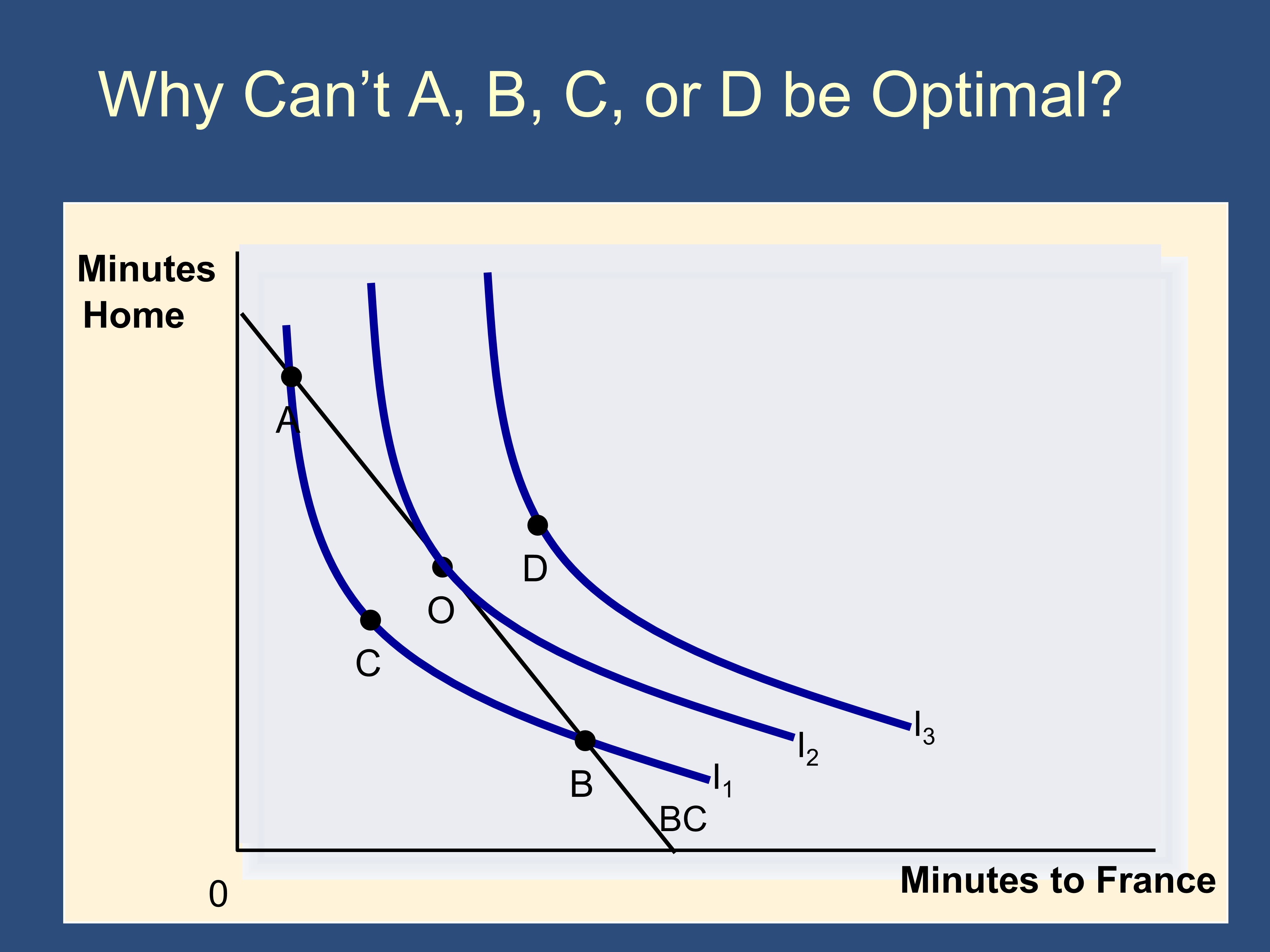
Mathematically, if you buy X units of good X and each unit costs , then your total cost is . Therefore, you spend your entire budget, B, when .
Second Optimization Condition
Section titled “Second Optimization Condition”While points A and B on the following slide satisfy the first optimization condition, they are not optimal because they do not satisfy the second optimization condition.
For any point like A, the consumer could increase their utility by “sliding down” the budget constraint toward point O. For example, at point A, they are on indifference curve , whereas at point O, they are on indifference curve . is preferred to because each indifference curve is based on a different level of utility. has a higher level of utility because it generally involves consuming “more”. For example, comparing point C (on ) and point O (on ), one consumes more of both goods at point O.
For any point like point B, the consumer could increase their utility by “sliding up” the budget constraint toward point O. The logic is identical to the paragraph above.
We conclude that whenever the consumer is optimizing, it will be at a point like point O. At points like point O, the indifference curve and the budget constraint have exactly the same slope. This observation is known as the second optimization condition.
Second optimization condition: the slope of the budget constraint must equal the slope of the indifference curve when the consumer chooses the optimal consumption bundle.
The second optimization condition explains why we focus so much on slope during this lecture:
| Concept | Diagram | How slope fits in |
|---|---|---|
| 1.) What do I want? (i.e. preferences, utility and indifference curves) | | Slope of Indifference Curves = (“Type equation here.”) Absolutel value of slope of the IC |
| 2.) What can I afford? (i.e. my budget constraint) | | |
| 3.) Optimization = Given my budget and preferences, what is optimal to buy? | 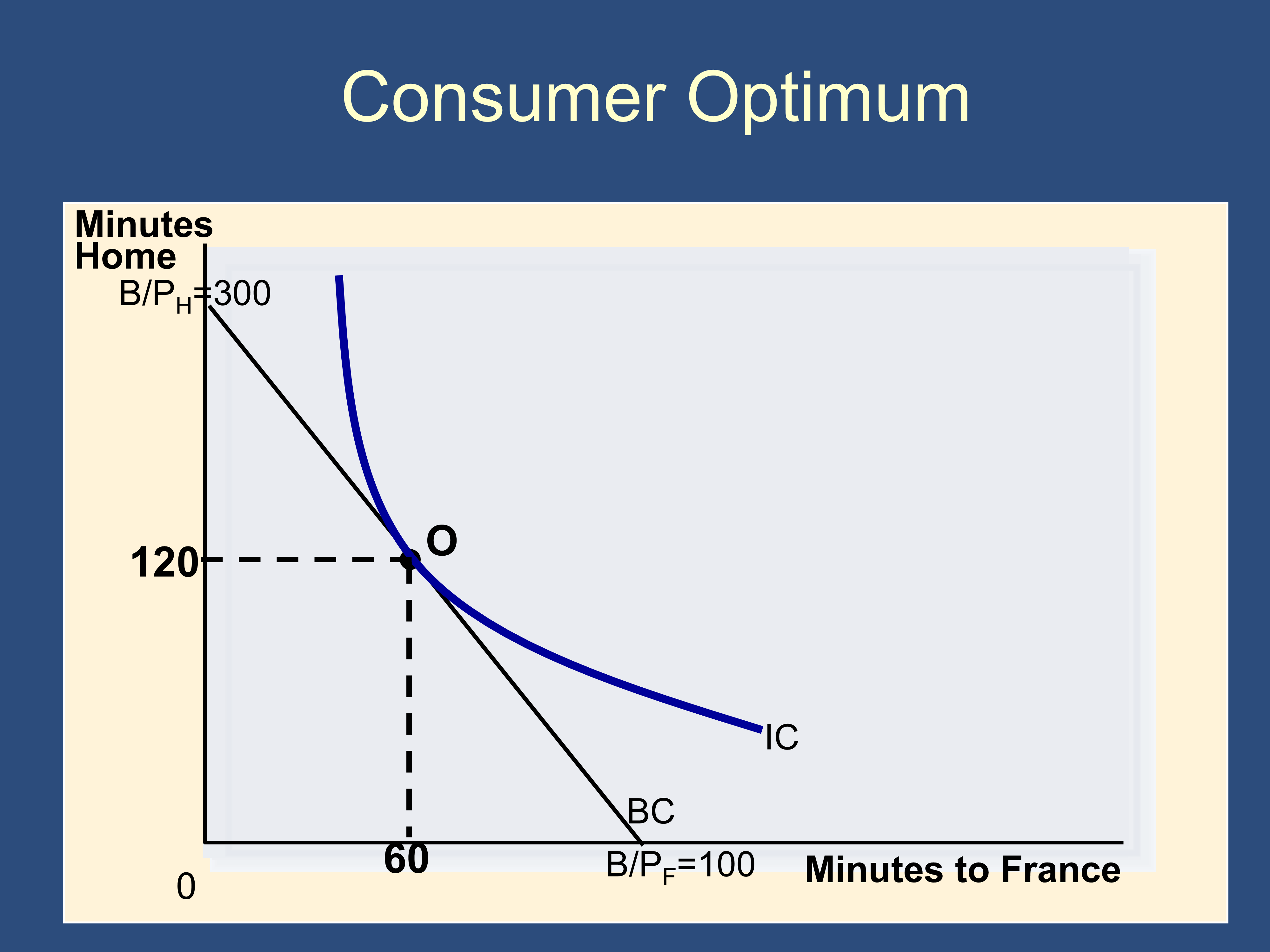 | When optimizing: Slope of Indiff Curve = Slope of Budget Constraint |
Feedback? Email munger.e1010@gmail.com 📧. Be sure to mention the page you are responding to.