🔎 Ron and Cathy break up
Previously, we analyzed the following game:
| Cathy → Ravel | Cathy → Chopin | |
|---|---|---|
| Ron → Ravel | , | , |
| Ron → Chopin | , | , |
🙋♂️ Hey Rob, how did you conclude that Ron prefers Ravel?
See answer
✔ When Ron is alone at a concert, his payoff is 0.
When Ron is with Cathy at Ravel, he gets a payoff of 2.
When Ron is with Cathy at Chopin, he gets a payoff of 1.
⇨ “Rob concludes” that Ron likes being with Cathy and that he prefers watching Ravel with Cathy to watching Chopin with Cathy.
🙋♂️ Who moves first?
See answer
✔ These are “simultaneous move games.” Both parties choose their actions/moves without knowing what the other is doing.
A good example of a simultaneous move game is “Split or Steal”:
£40,015 Split or Steal?
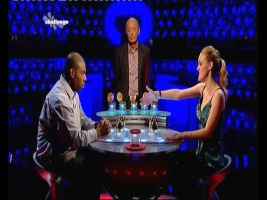
Large investment decisions are often made without the benefit of seeing what your competitors are doing.
Now let’s adjust it. We will assume that Ron and Cathy have broken up. They no longer enjoy being together, but Ron still likes Ravel and Cathy still likes Chopin.
| Cathy → Ravel | Cathy → Chopin | |
|---|---|---|
| Ron → Ravel | , | , |
| Ron → Chopin | , | , |
Side note: you can verify, to practice, that the NE and Dominant strategies will be identical if you add any number (like 5) to each payoff.
| Cathy → Ravel | Cathy → Chopin | |
|---|---|---|
| Ron → Ravel | , | , |
| Ron → Chopin | , | , |
Roleplaying as Ron to find Ron’s underlines (best responses)
If Cathy plays Ravel, what is Ron’s best response?
| Cathy → Ravel | Cathy → Chopin | |
|---|---|---|
| Ron → Ravel | , | , |
| Ron → Chopin | , | , |
If Cathy plays Chopin, what is Ron’s best response?
| Cathy → Ravel | Cathy → Chopin | |
|---|---|---|
| Ron → Ravel | , | , |
| Ron → Chopin | , | , |
Roleplaying as Cathy to find Cathy’s underlines (best responses)
If Ron plays Ravel, what is Cathy’s best response?
| Cathy → Ravel | Cathy → Chopin | |
|---|---|---|
| Ron → Ravel | , | , |
| Ron → Chopin | , | , |
If Ron plays Chopin, what is Cathy’s best response?
| Cathy → Ravel | Cathy → Chopin | |
|---|---|---|
| Ron → Ravel | , | , |
| Ron → Chopin | , | , |
| Cathy → Ravel | Cathy → Chopin | |
|---|---|---|
| Ron → Ravel | , | , |
| Ron → Chopin | , | , |
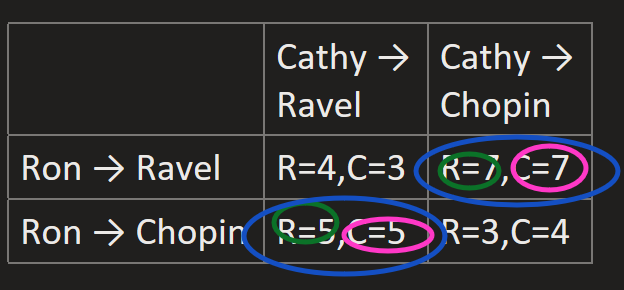
One equilibrium is when Ron goes to Chopin and Cathy goes to Ravel.
Another equilibrium is when Ron goes to Ravel and Cathy goes to Chopin.
Does Cathy have a dominant strategy?
Does Ron have a dominant strategy?
If both have a dominant strategy, it is a dominant strategy equilibrium.
Is there a Nash Equilibrium?
Feedback? Email munger.e1010@gmail.com 📧. Be sure to mention the page you are responding to.