👨🏫 Notes on E-1000 Lecture 7
Gross Domestic Product (GDP)
Section titled “Gross Domestic Product (GDP)”GDP: Definition and Components
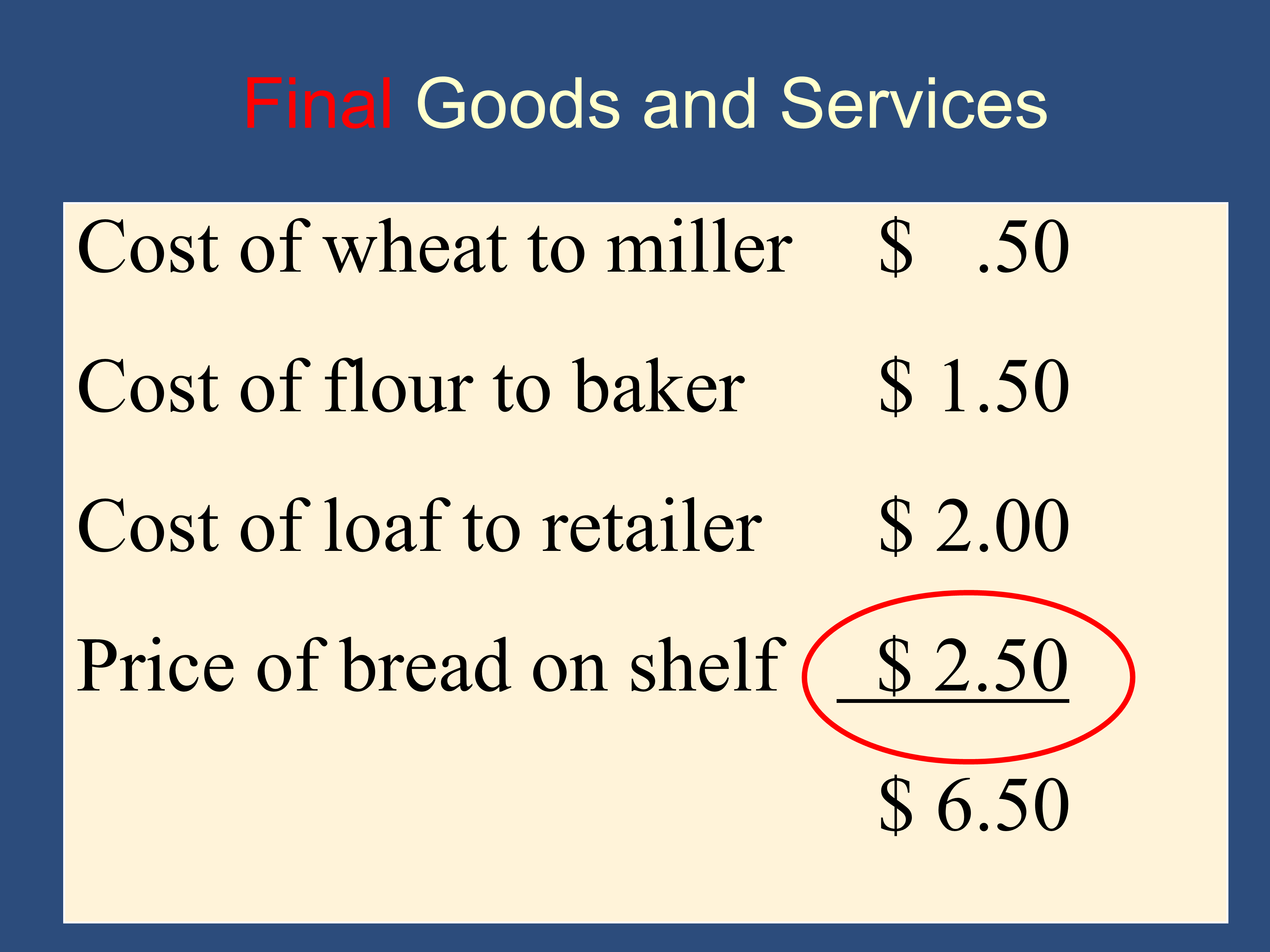
Section titled “GDP: Definition and Components”GDP is the market value of all final goods and services produced within a country in a year.
GDP is also National Income:
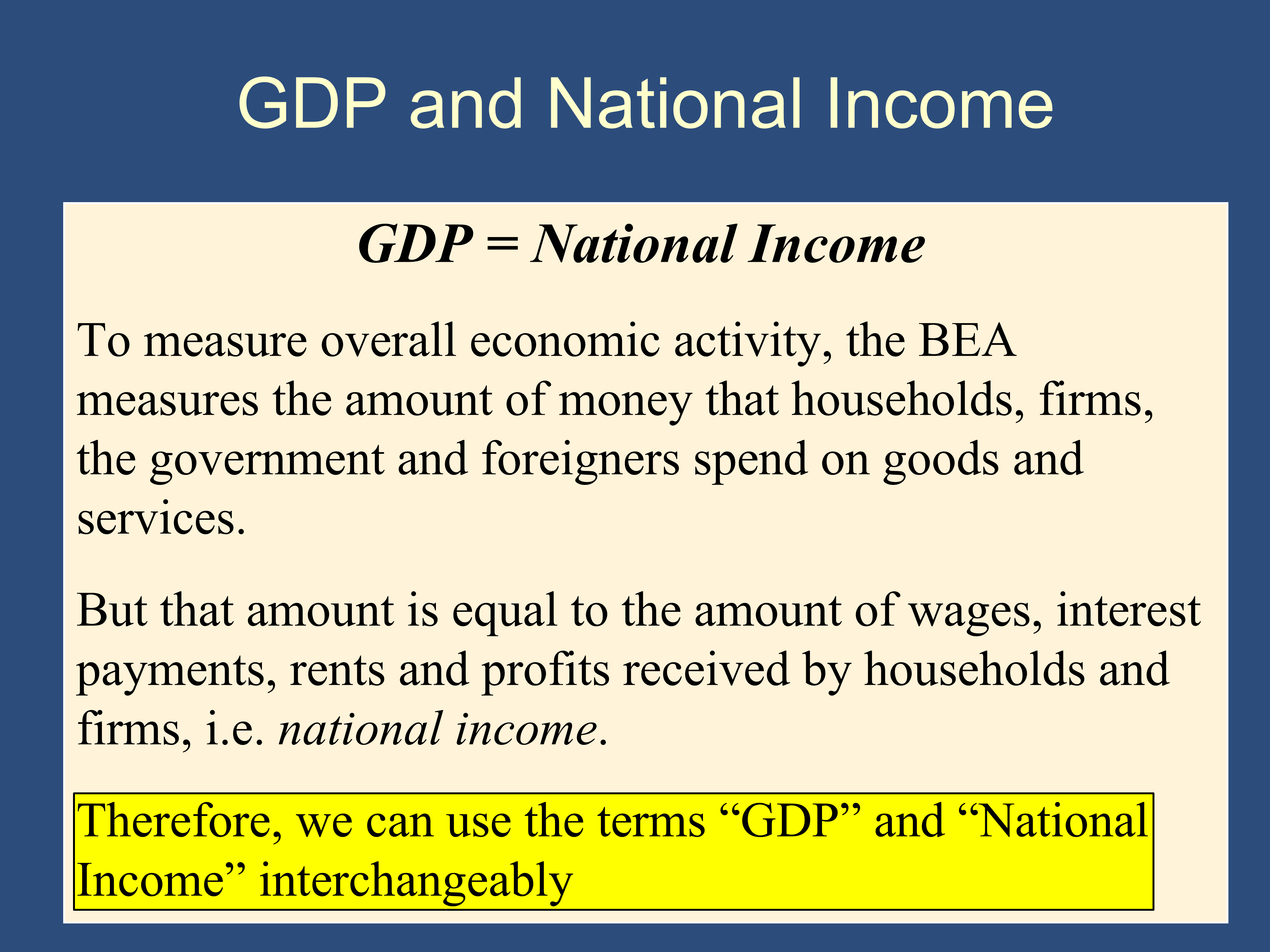
- Calculated by the Bureau of Economic Analysis (BEA)—a division of the Dept. of Commerce in a process called “National Income Accounting.”
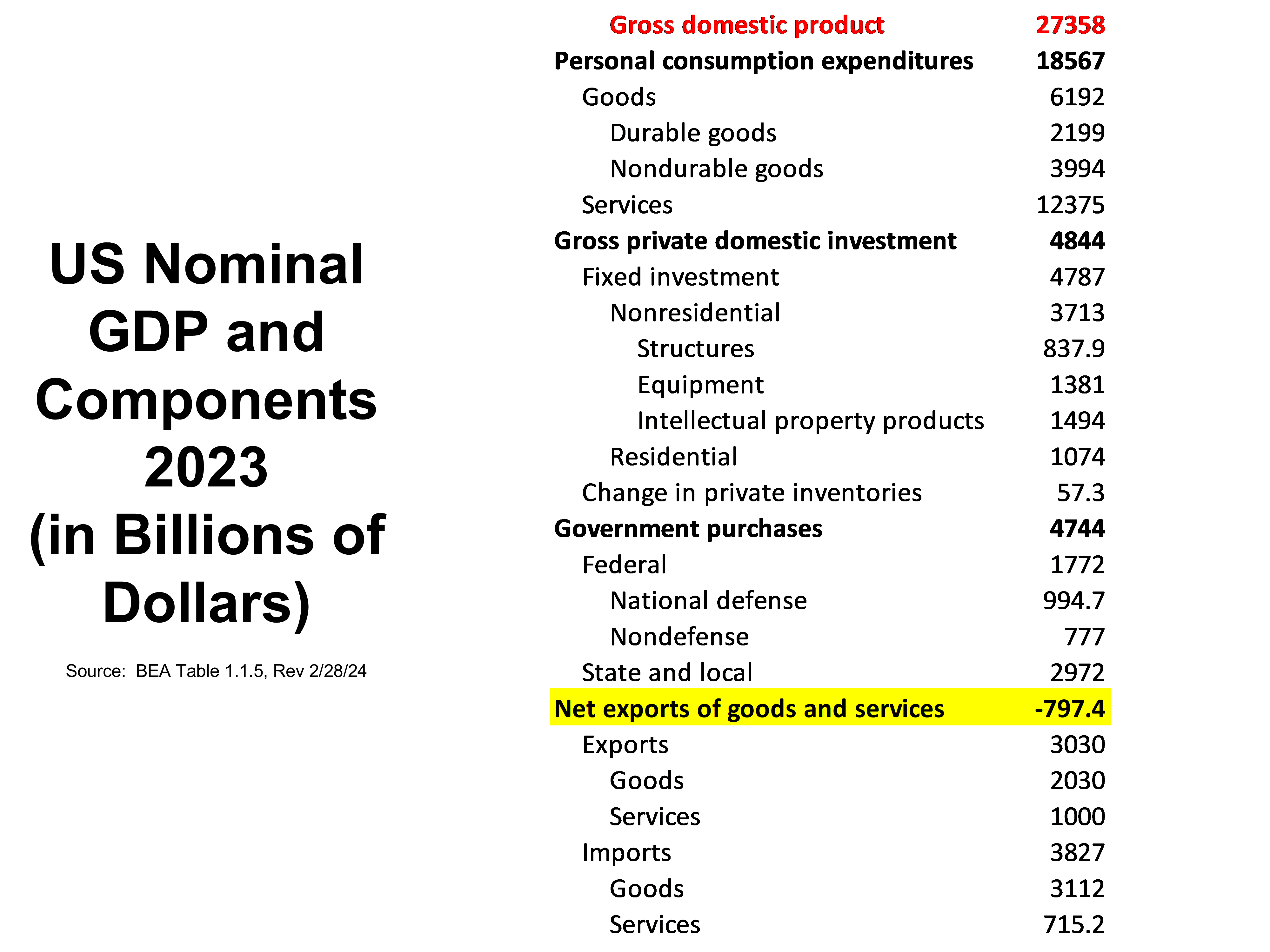
- 2019 US Nominal GDP was $21.4 Trillion.
- Per capita GDP = GDP/Population. In 2019, Per Capita GDP = $21.4T/328M = $65,244
- There are several ways to calculate GDP. We use the Expenditure Method:
- Calculates GDP by adding up the value of expenditures on all final goods and services in the economy.
- BEA adds up the expenditures in four categories: C, I, G, NX to calculate GDP. See 2019 values for each category below:
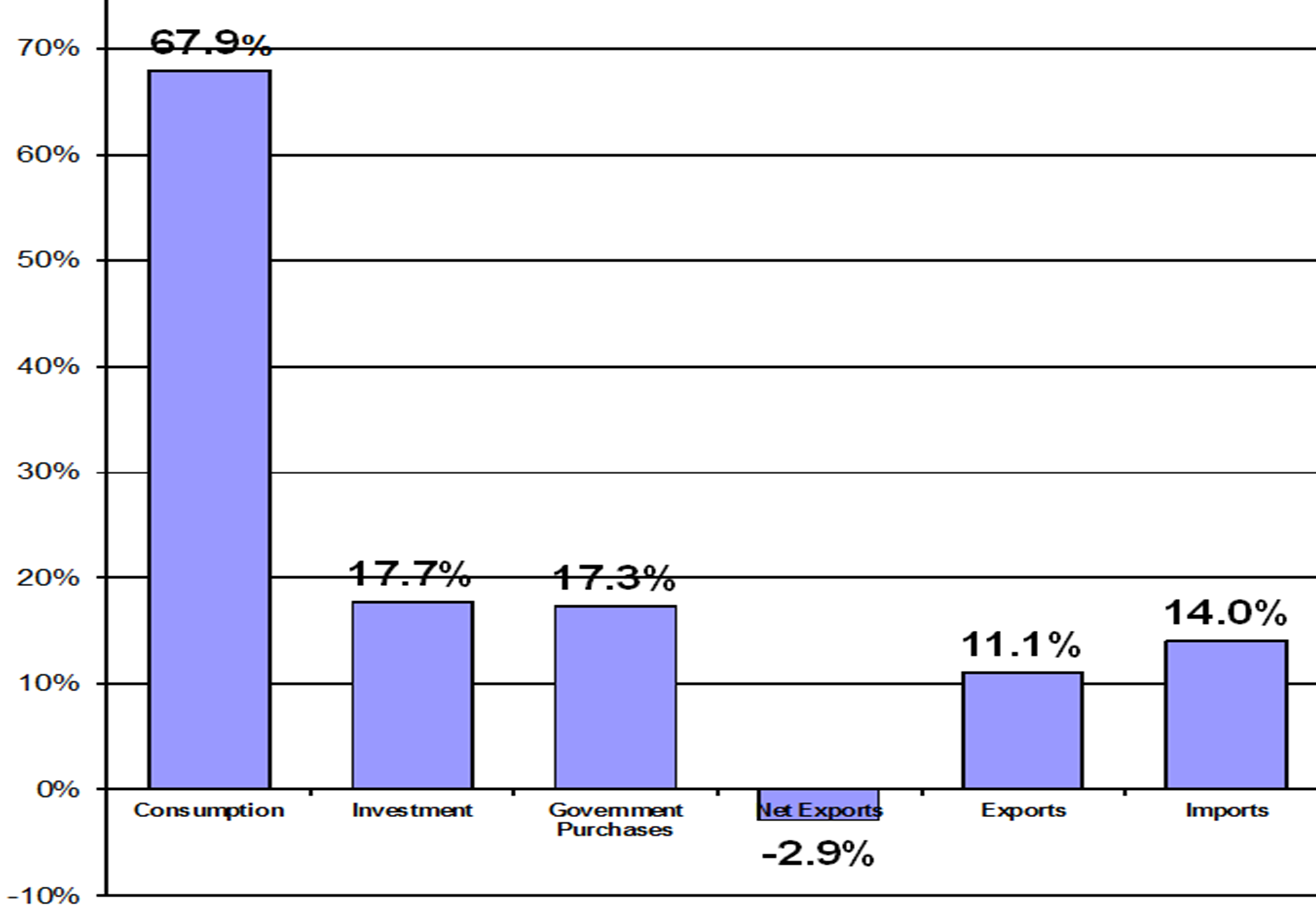
Components of GDP as a proportion of GDP:
Potential GDP vs Actual GDP
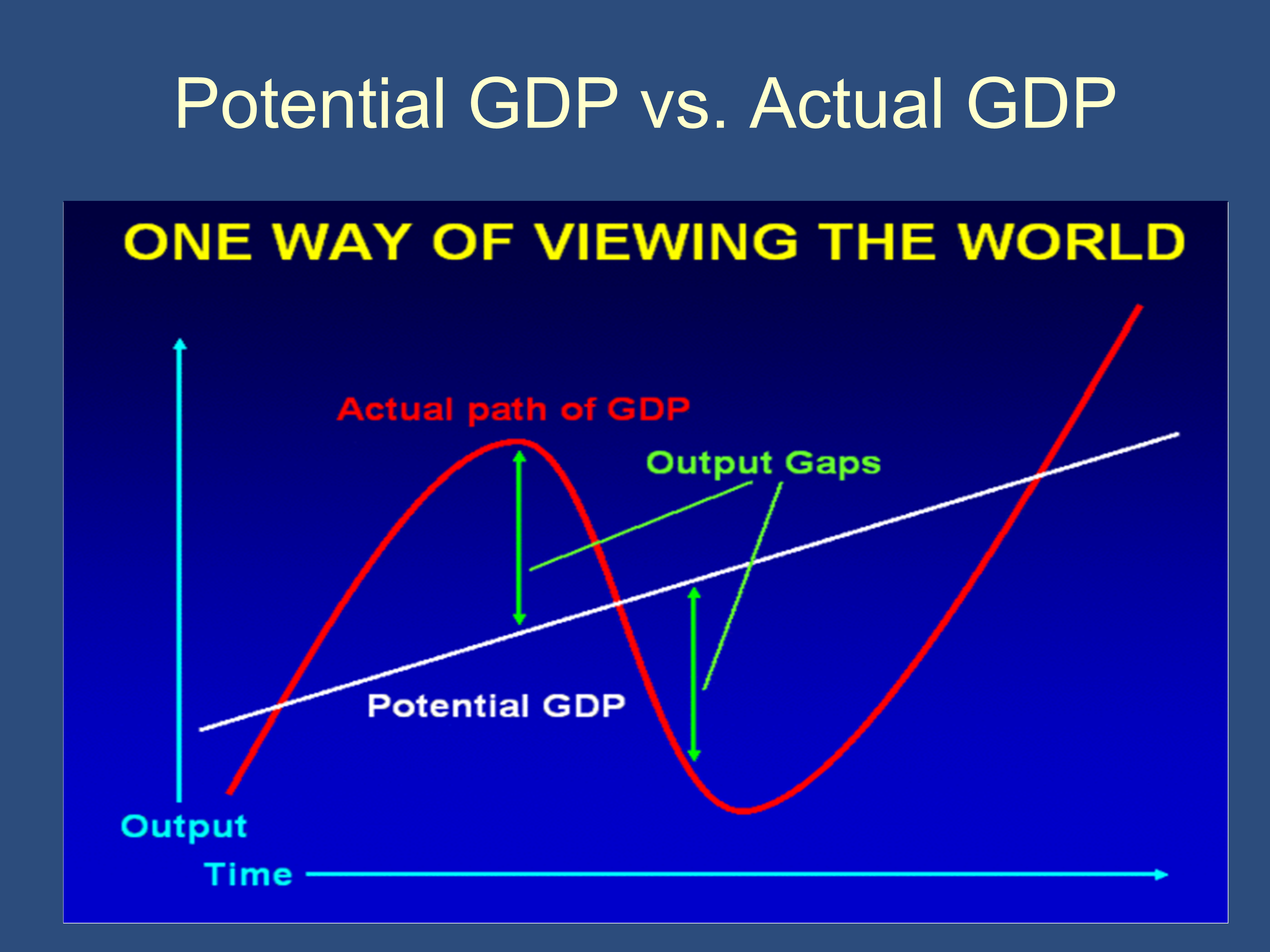
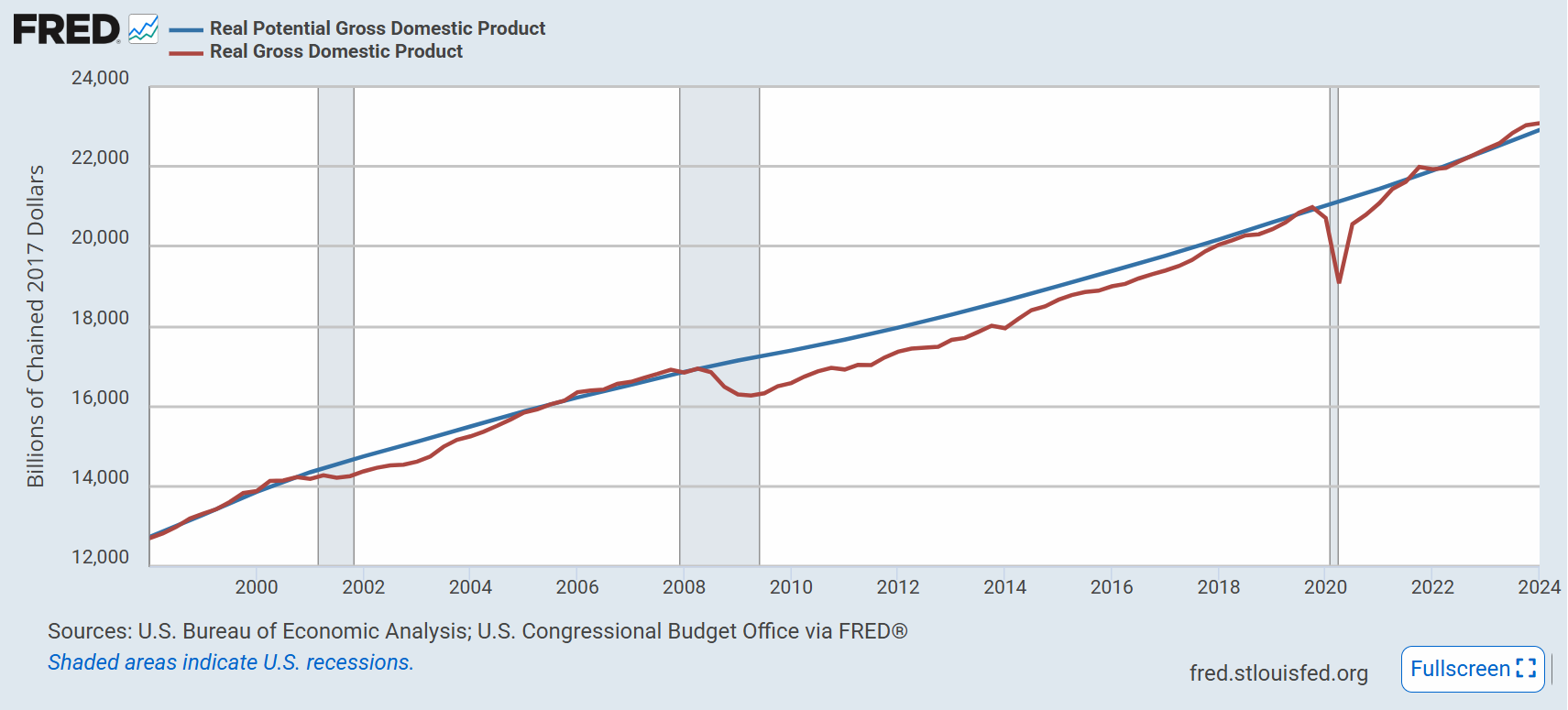
Section titled “Potential GDP vs Actual GDP”Potential GDP is an estimate of what GDP would have been if all factors of production (e.g. labor and capital) had been used at their “normal” rates. It is a measure of the economy’s capacity to produce, not its actual production
Actual GDP is the actual GDP measured in the country.
Potential GDP is determined through the process of Long Run Growth, as described in the second half of lecture 8. Actual GDP is determined by AD and SRAS, as described in lecture 10 and the following lectures. Just remember: Potential GDP is primarily determined in the Long Run . Actual GDP is primarily determined by AD and SRAS in the Short Run .
The difference between them is the Output Gap, aka the GDP Gap. You can have either an inflationary (Actual Y>Potential Y) or a recessionary GDP (Actual Y < Potential Y) Gap. A recessionary gap is typically associated with layoffs and unemployment.
Nominal vs. Real GDP
Section titled “Nominal vs. Real GDP”Nominal GDP is the value of all goods and services measured at current prices
2019 Nominal GDP =
Real GDP is the value of all goods and services measured using the prices from the base year
Note: the only difference between nominal and real GDP is which prices you use (just look at the formulas). In the base year, you use the same prices in both formulas, so in the base year, Nominal GDP = Real GDP.
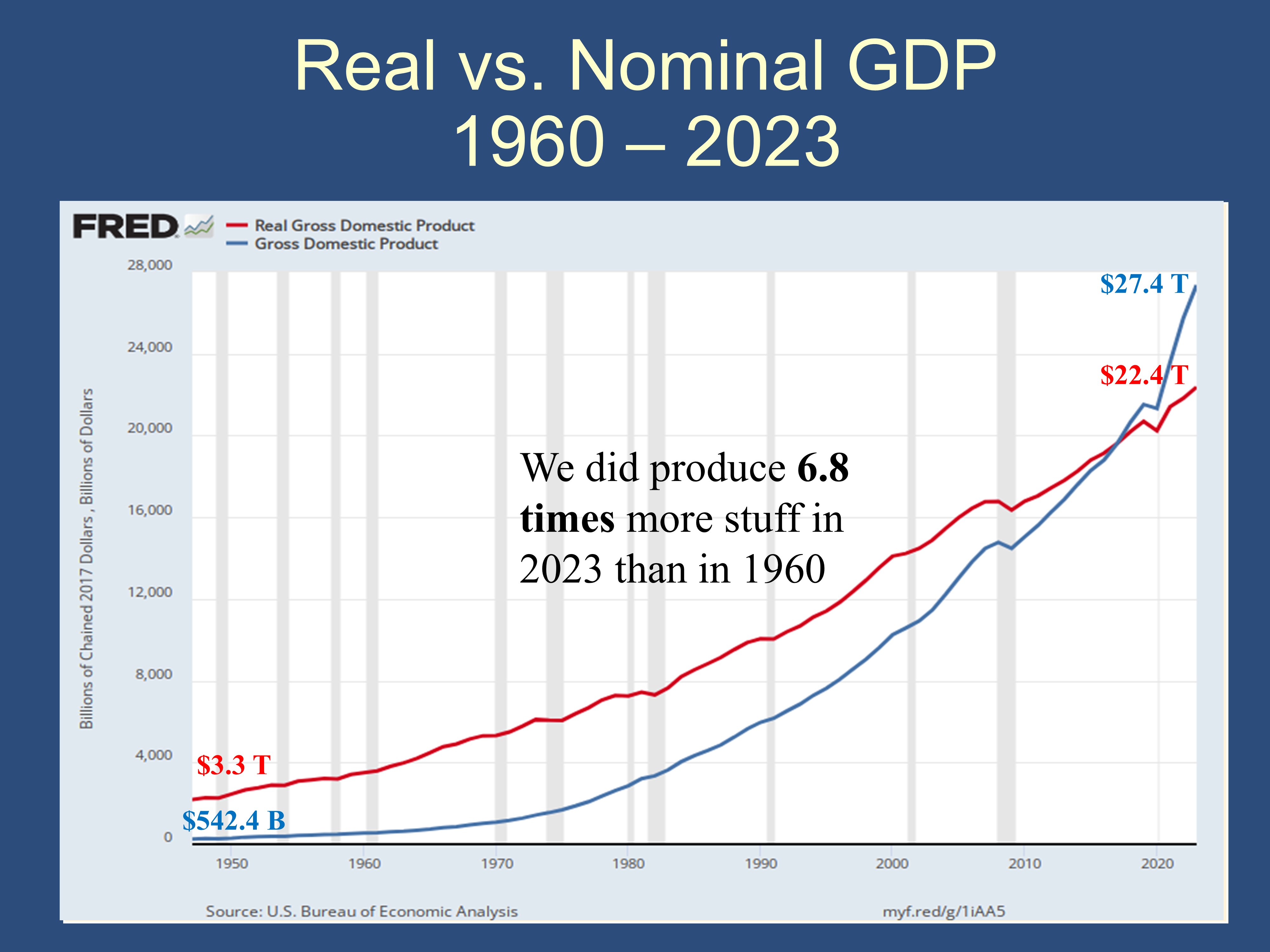
Because prices generally rise, nominal GDP typically rises faster than real GDP:
CPI and Inflation
Section titled “CPI and Inflation”Inflation =
Notation for the Rest of the Course: Y = Real GDP P = Price Level P×Y = Nominal GDP
The Consumer Price Index (CPI)
Section titled “The Consumer Price Index (CPI)”- Measures changes in the prices of things that an average consumer buys
- The most closely watched price index.
Can have a big impact on financial markets - Includes only goods typically bought by consumers
- Includes imported goods
- Uses a fixed basket of goods
The CPI is Calculated and published by the Bureau of Labor Statistics (BLS). Released in the middle of each month
Uses:
- Tracks changes in the typical household’s cost of living
- Used to adjust many contracts for inflation (“COLAs”)
- Allows comparisons of dollar amounts over time
How it is constructed:
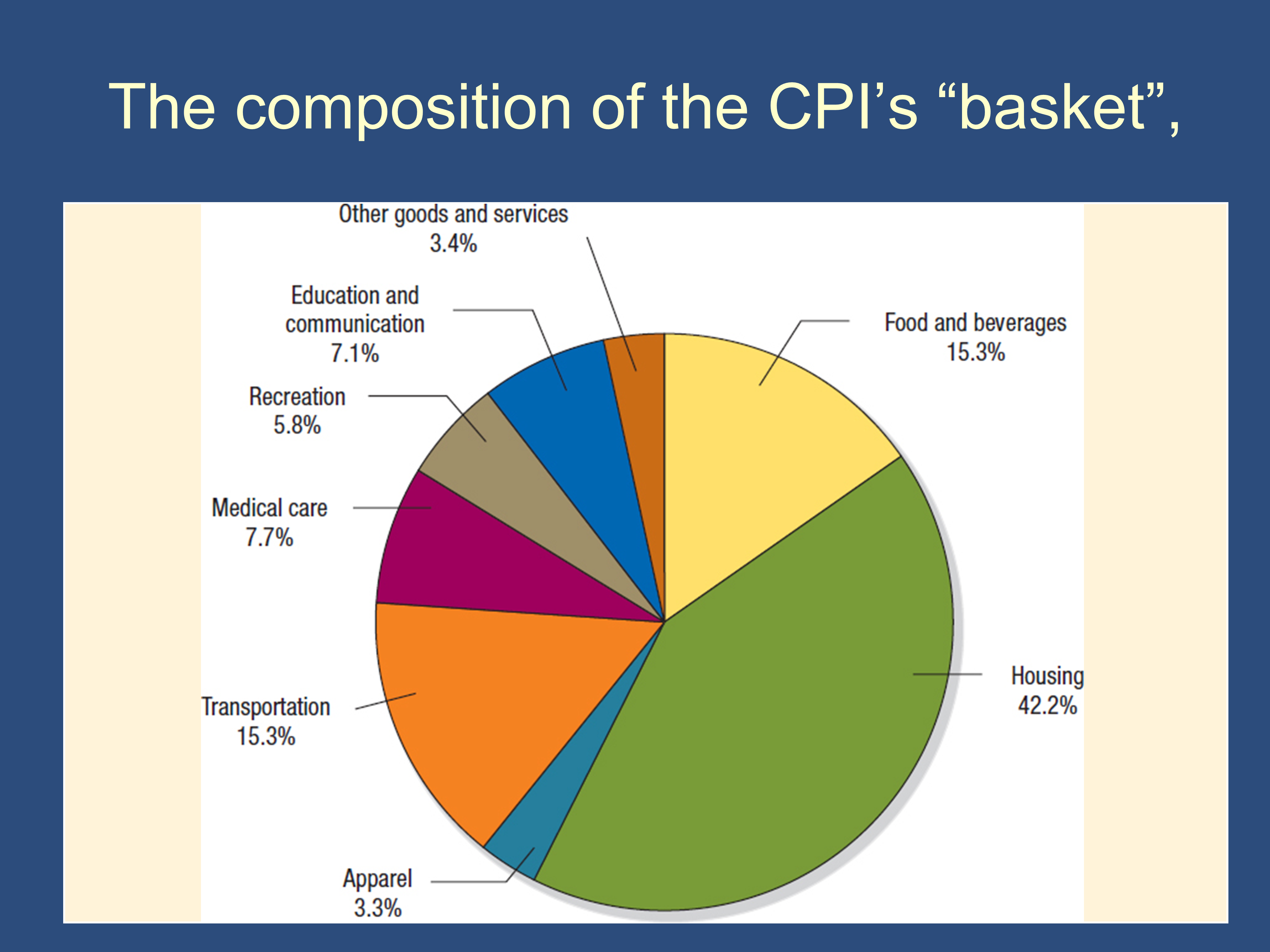
- Survey consumers to determine composition of the typical consumer’s “basket” of goods. Think of it as the goods in your grocery cart, but with everything you need to buy:
- Every month, collect data on prices of all items in the basket; compute cost of basket
- Choose a base period (currently an avg. of prices from 1982 – 1984)
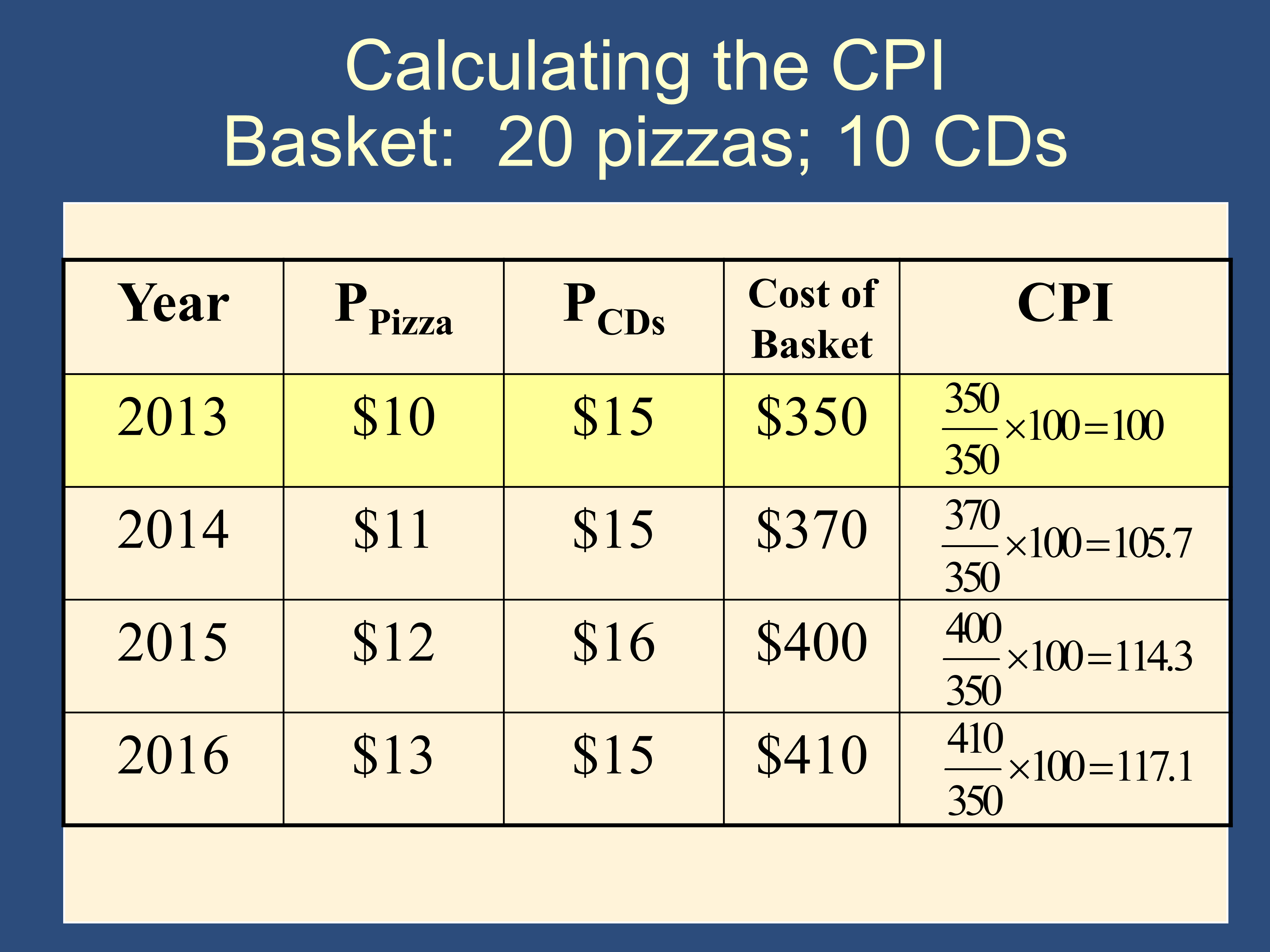
- Calculate the CPI in a given month as follows:
What would the basket have to cost to lead to a specific CPI?
Cost of basket in that month = × Cost of basket in a base period
Example
Inflation
Section titled “Inflation”What would the future Price Index need to be to lead to a certain level of inflation?
Unemployment
Section titled “Unemployment”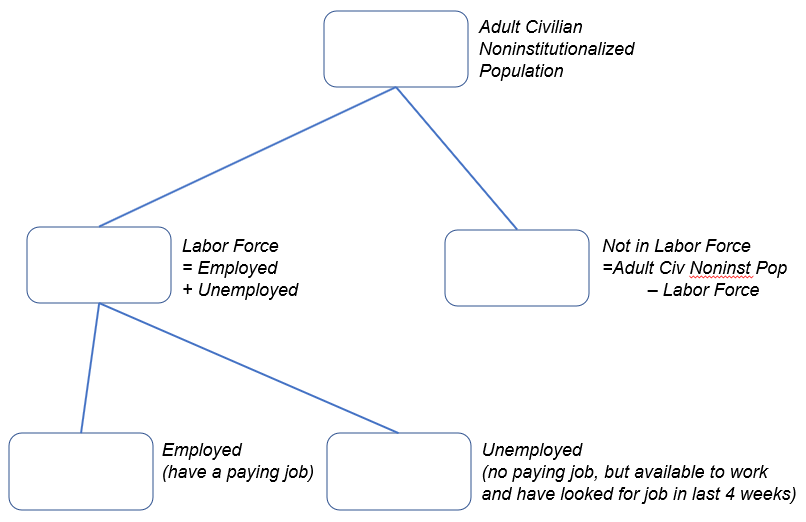
Unemployment rate:
Labor Force Participation Rate:
Formulas from algebra:
When in doubt, use plug and chug
✏️ Suppose that there are 2M unemployed people, 25M employed people, and 15M people not in the labor force. What are the unemployment and labor force participation rates?
✔ Click here to view answer
Labor Force = 2+25 = 27
Unemployment Rate = 2/(2+25) = 7.41%
Adult Civilian Noninstitutional Pop = 2+25+15 = 42
Labor Force Participation Rate = 27/42 = 64.29% ✅
✏️ Suppose that there are 5M unemployed people and the unemployment rate is 4.5%. How many employed people are there?
✔ Click here to view answer
Plug and chug: (help)
- Equation:
For this, we need to use algebra:
Unemployment Rate =
- Plug:🔌
🔌 4.5% = 5M / (5M + #Emp)
- Solve: 🚂
(recopying…)
- Reflect: 🧠
Let’s check our work by plugging our answer back into the unemployment rate formula:
Unemployment Rate = #Unemp / (#Unemp + #Emp) = 5/(5+106)=4.5%
We got the number we started with, confirming that we didn’t make an algebra error.We can also solve this with ratios:
If 5M is 4.5% of the labor force, then what number is 100% of the labor force?
5M/4.5% = x/100%
LF = x = 5/4.5% = 111M
employed = 111-5 = 106 ✅
✏️ Detroit was experiencing higher levels of unemployment than the rest of the country in 2018, due to a long-term weakening in the US automobile industry. What type of unemployment would this be:
- frictional unemployment
- structural unemployment
- cyclical unemployment
- none of the above
✔ Click here to view answer
✔ I would call this structural unemployment, which means that there is a mismatch between the skills that workers have and the skills demanded by employers. Because there are a very large number of people in Detroit with skills related to auto manufacturing, and because US manufacturing has been losing market share, there are many highly trained workers in Detroit who are unemployed. They are highly trained, but there is a mismatch between their skills and the jobs that are available.
B. ✅
✏️ The company that Orion works for was recently shut down by the government for some form of scandalous malfeasance. He is now unemployed. Recently interest rates have been rising and many companies are laying off workers, fearing that demand will decrease. As part of this general slowdown, Kirsten was just laid off by her employer and is now looking for a job. Which categories of unemployment do Kirsten and Orion fall into?
- Orion is structural and Kirsten is Frictional.
- Orion is cyclical and Kirsten is structural.
- Orion is frictional and Kirsten is cyclical.
- Orion is cyclical and Kirsten is frictional.
✔ Click here to view answer
C.
Orion’s unemployment is frictional because he is simply “between jobs” and his state of unemployment isn’t due either to a recession or a mismatch between his skills and what employers want.
Kirsten’s umemployment is cyclical because her unemployment is a result of a recession. ✅
🙋 If a company just wants to cut costs, independent of any recession, what form of unemployment would that be?
See answer
✔ That would be frictional. Basically, if it’s not due to a skills mismatch or a recession, it’s frictional. ✅
✏️ Suppose that in Sealand, the population is growing at 10% per year. Per capita GDP is growing at 5% per year. What is approximate GDP growth in Sealand?
✔ Click here to view answer
Plug and chug: (help)
- Equation:
%ΔPerCapitaGDP = %ΔGDP - %ΔPopulation
- Plug:🔌
5% = %ΔGDP - 10%
- Solve: 🚂
%ΔGDP = 15%
- Reflect: 🧠
People are flocking to Sealand at 10% per year, (essentially giving a 10% boost to GDP). Also, the productivity of individual workers is increasing at 5% per year (essentially giving a 5% boost to GDP). Putting these together, GDP is growing at 15%. ✅
✏️ Suppose China’s economy grows at 7% per year. How long does it take for China’s economy to double in size?
✔ Click here to view answer
Using the rule of 70, it takes 70/7=10 years. ✅
✏️ You are really hoping that your 401K will at least double in 15 years. What growth rate would ensure that this happens?
✔ Click here to view answer
Plug and chug: (help)
- Equation:
The rule of 70 says:
Doubling time = 70 / growth rate - Plug:🔌
15 = 70 / growth rate
- Solve: 🚂
growth rate × 15 = 70
growth rate = 70 /15 = 4.6667 - Reflect: 🧠
Great news! If you can lock in a growth rate of your money of 4.67%, then you can achieve your goal! ✅
Feedback? Email munger.e1010@gmail.com 📧. Be sure to mention the page you are responding to.