🔎 Nash Equilibrium Examples
A good starting point for Nash equilibrium is the following slide:
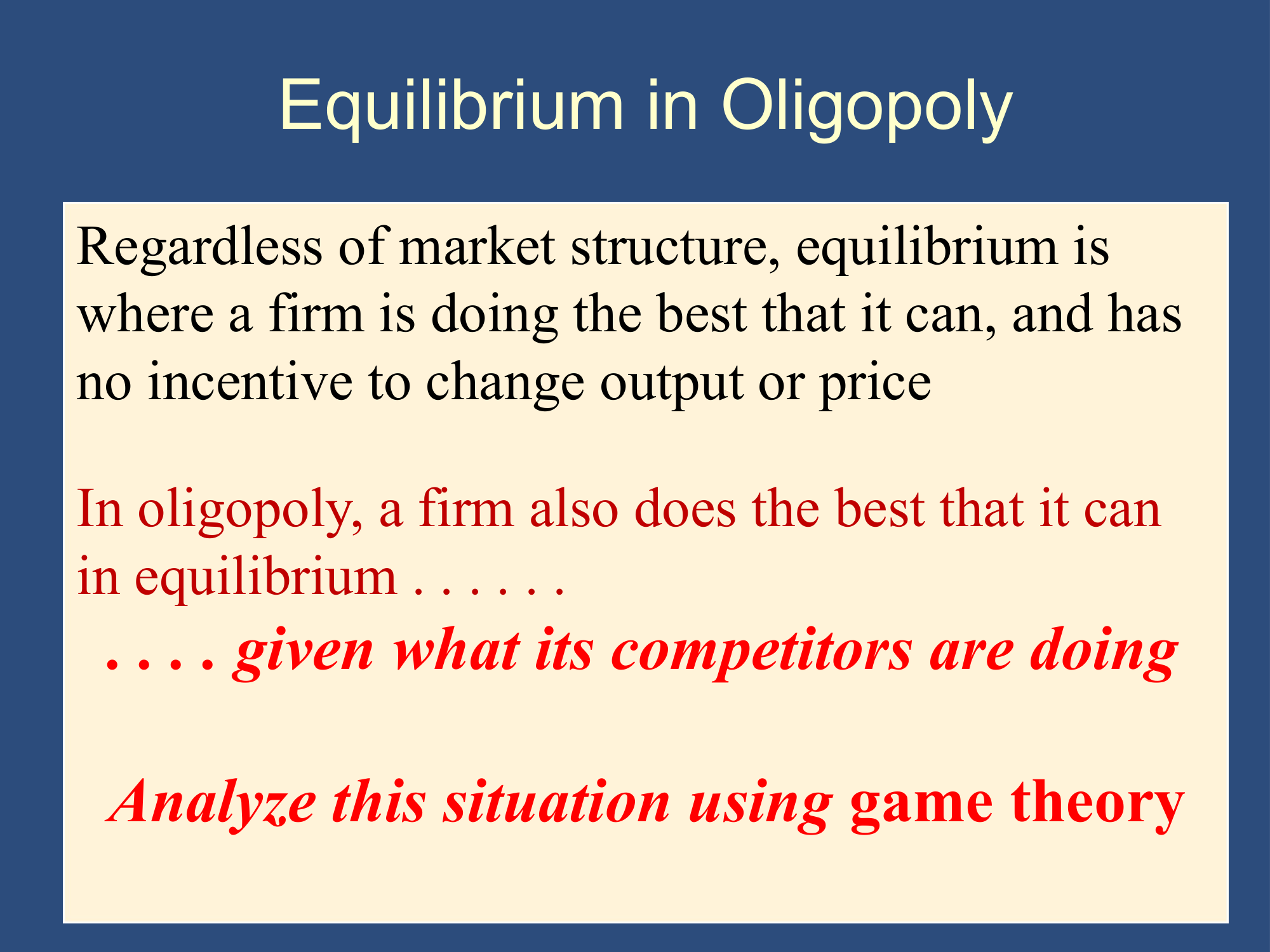
In a strategic game or strategic competition (evolutionary biology, internation relations, economics (industrial organization)), you need to know what your opponents are doing.
The definition of strategic interdependence is that the optimal “move” for you depends on the move chosen by the other players.
When we analyze NE, we always start with some belief about what the other player will do.
Row player is Ron, and Column player is Cathy.
Ron (Row) like Ravel, and Cathy (Column) likes Chopin. However, what is most important is spending time together. Their payoffs are as follows:
| Cathy → Ravel | Cathy → Chopin | |
|---|---|---|
| Ron → Ravel | 2,1 | 0,0 |
| Ron → Chopin | 0,0 | 1,2 |
As is typical, the payoff to the row player is listed first.
(This game is an example of a class of games called “Battle of the Sexes”)
Ron wants to be with Cathy, so clearly his optimal choice depends on what she chooses. He must form beliefs about what she will do.
Let’s start by analyzing the row player, Ron.
Section titled “Let’s start by analyzing the row player, Ron.”Suppose Ron believes that Cathy will go to the Ravel concert:
| Cathy → Ravel | Cathy → Chopin | |
|---|---|---|
| Ron → Ravel | 2,1 | 0,0 |
| Ron → Chopin | 0,0 | 1,2 |
We underline the two to indicate that if Ron goes to Ravel and Cathy goes to Ravel, that Ron is playing optimally.
Next, suppose that Ron believes Cathy will go to Chopin:
| Cathy → Ravel | Cathy → Chopin | |
|---|---|---|
| Ron → Ravel | 2,1 | 0,0 |
| Ron → Chopin | 0,0 | 1,2 |
We underline the 1 to indicate that this cell is also an optimal choice for Ron.
Now we analyze the Column player, Cathy
Section titled “Now we analyze the Column player, Cathy”Now, we will underline the second number in the cell if it is optimal.
Suppose Cathy believes that Ron will be at Ravel.
| Cathy → Ravel | Cathy → Chopin | |
|---|---|---|
| Ron → Ravel | 2,1 | 0,0 |
| Ron → Chopin | 0,0 | 1,2 |
We underline the 1 in the upper left cell where they go to (Ravel, Ravel)
Suppose Cathy believes that Ron will be at Chopin
| Cathy → Ravel | Cathy → Chopin | |
|---|---|---|
| Ron → Ravel | 2,1 | 0,0 |
| Ron → Chopin | 0,0 | 1,2 |
What conclusions can we draw?
Section titled “What conclusions can we draw?”| Cathy → Ravel | Cathy → Chopin | |
|---|---|---|
| Ron → Ravel | 2,1 | 0,0 |
| Ron → Chopin | 0,0 | 1,2 |
Let’s consider the possibility that Ron→Chopin (0) and Cathy→Ravel (0).
Is this realistic?
No. Here is how I want you to think about it.
Ron and Cathy are both smart. They both have some idea of what the other player is doing. Ron believes that Cathy is going to Ravel and Cathy believes that Ron is going to Chopin , so either Cathy or Ron can profitably unilaterally deviate.
Profitably = they could get a higher payoff
Deviate = if they changed their strategy
Unilaterally = all that they need to do is change their own strategy
(NOTE: checking whether someone can profitably unilaterally deviate is a way to check if something is a Nash equilibrium.)
In a Nash Equilibrium, both players are optimizing given their beliefs about what the other player is doing. If you can profitably unilaterally deviate, you are not optimizing based on what the other player is doing.
Nash said that when both players want to win, they will both do their best to choose something that is optimal given what the other player is doing.
This is where our underlines come in. The underline means that that player is playing optimally given what the other player is doing. For example, in the upper left, we have Ron→Ravel and Cathy→Ravel. 2 is underlined because it is optimal for Ron→Ravel when Cathy→Ravel. Likewise, it is optimal for Cathy→Ravel when Ron→Ravel. In other words, neither of them can profitably unilaterally deviate. Both are optimizing.
| Cathy → Ravel | Cathy → Chopin | |
|---|---|---|
| Ron → Ravel | 2,1 | 0,0 |
| Ron → Chopin | 0,0 | 1,2 |
The only assumption behind NE is that everyone will do their best.
Clearly, in the upper left, both are optimizing. Also in the bottom right!
| Cathy → Ravel | Cathy → Chopin | |
|---|---|---|
| Ron → Ravel | 2,1 | 0,0 |
| Ron → Chopin | 0,0 | 1,2 |
In the battle of the sexes game, there are two Nash Equilibria.
A second example
Section titled “A second example”Let’s do another example…
| Cathy → Ravel | Cathy → Chopin | |
|---|---|---|
| Ron → Ravel | 2,1 | 0,0 |
| Ron → Chopin | 0,0 | 300,500 |
Is Ron→Ravel and Cathy→Ravel still Nash Equilibrium?
Think of this like long division. Simply follow the instructions.
Suppose Ron→Ravel and Cathy→Ravel. They are probably both quite disappointed, because they would both much rather be at Chopin. However, both are optimizing given what the other player is doing. 👈 and that is the definition of Nash Equilibrium.
If you are Ron and Cathy is at Ravel, you should go to Ravel. Likewise, if you are Cathy, and Ron is at Ravel, you should go to Ravel.
Neither player can profitably deviate from (Ravel, Ravel), so (Ravel, Ravel) is a NE.
NE isn’t a great solution concept for this game. The Two NE are (Ravel, Ravel) and (Chopin, Chopin). Having calculated that, we can turn our brains back on and say that we believe that (Chopin, Chopin) is more likely BUT, DON’T EVER TURN YOUR BRAIN BACK ON LIKE THAT ON THE HOMEWORK. JUST CALCULATE THE NE. There is no judgement; either something is a NE or not.
A third example
Section titled “A third example”I will fill in all of the payoffs randomly. We will see if there are NE.
| Cathy → Left | Cathy → Right | |
|---|---|---|
| Ron → Up | 8,6 | 7,5 |
| Ron → Down | 3,0 | 9,9 |
First, we look to see when Ron is optimizing. Suppose Cathy plays left:
| Cathy → Left | Cathy → Right | |
|---|---|---|
| Ron → Up | 8,6 | 7,5 |
| Ron → Down | 3,0 | 9,9 |
If Cathy plays right:
| Cathy → Left | Cathy → Right | |
|---|---|---|
| Ron → Up | 8,6 | 7,5 |
| Ron → Down | 3,0 | 9,9 |
Likewise, let’s look at when Cathy is optimizing. Suppose Ron plays up:
| Cathy → Left | Cathy → Right | |
|---|---|---|
| Ron → Up | 8,6 | 7,5 |
| Ron → Down | 3,0 | 9,9 |
Suppose Ron plays down:
| Cathy → Left | Cathy → Right | |
|---|---|---|
| Ron → Up | 8,6 | 7,5 |
| Ron → Down | 3,0 | 9,9 |
There are two cells with “double underlines,” ie two NE:
| Cathy → Left | Cathy → Right | |
|---|---|---|
| Ron → Up | 8,6 | 7,5 |
| Ron → Down | 3,0 | 9,9 |
The tension in the concept of Nash Equilibrium.
Section titled “The tension in the concept of Nash Equilibrium.”Nash Equilibrium is designed for simultaneous move games. In a simultaneous move game, you don’t know what your opponent is doing.
HOWEVER the concept of Nash Equilibrium is based on the idea that you look for a box in the game grid where BOTH parties are playing a best response.
Nash equilibrium is like a “rut” that you get into in a simultaneous move game. Imagine that Ron and Cathy have broken up and are both going to the concert that they don’t like. They are stuck in that rut because neither of them can profitably deviate without running into their ex at the concert. Therefore, this unhappy equilibrium is indeed a Nash Equilibrium. It is a “stable” rut.
When you are trying to understand Nash Equilibrium, look at a specific cell in the game grid and imagine that each player can see what the other player is doing. Ask whether each player is playing a best response to the other player. In other words, ask whether you have put down the “best response underlines” on the payoffs for both players in that box. Alternatively, is ask yourself whether each player can profitably deviate.
Feedback? Email munger.e1010@gmail.com 📧. Be sure to mention the page you are responding to.