✏ Accept the risky sales job?
This example is adapted from an example in section 5.2 of the textbook.
The following figure shows how we can describe one woman’s preferences toward risk: (let’s call her Sally)
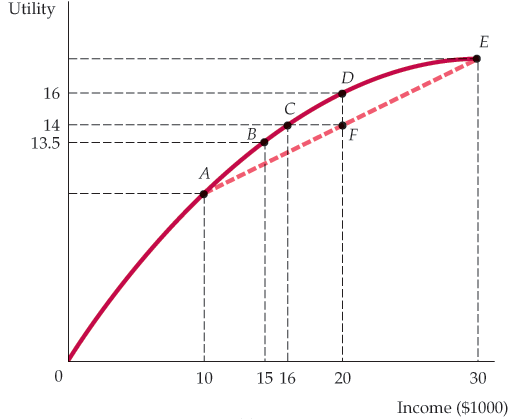
Each point on the dotted line represents a gamble in which you have a chance of getting $10K and a chance of getting $30K. Each point represents a different probability of getting the $30K. The points are amazing in that if you draw a line to the left, you get the EU of that gamble. If you draw a line down, you get the EV of that gamble. Each point does double duty.
✏ Suppose she is currently making $20,000. What is her utility? What is her expected utility?
✔ Click here to view answer
Using the curved line, we can see that her utility is 16 utils.
The curved line says that the expected utility of 20k is 16 utils. If she gets 20k for sure, then she has a 100% chance of getting a utility of 16 utils. Therefore, her EU is: ✅
✏ Suppose she has the chance to take a new job that offers her a 50% chance of making an additional $10,000 and a 50% chance of making $10,000 less. In other words, in the new job, she has a 50% chance of making a total of $10,000 and a 50% chance of making a total of $30,000.
Using the diagram above, what is the Expected Utility of taking the new job? Note that the Expected Value of her income with the new job is $20,000.
✔ Click here to view answer
We’ll need to use the technique listed here: 🔎 How do I find the Certainty Equivalent?
First, we calculate the EV of her risky job:
Therefore, point F must represent the new job, because if you draw a line down from the correct point, you get the EV, and $20,000 is the correct EV.
If F is correct, then we can draw a line horizontally to find that the EU is 14 utils. ✅
✏ Using only the data in the following table, calculate the Expected Utility of the new job.
| Income | Utility |
|---|---|
| $10K | 10 utils |
| $15K | 13.5 utils |
| $16K | 14 utils |
| $20K | 16 utils |
| $30K | 18 utils |
✔ Click here to view answer
✅
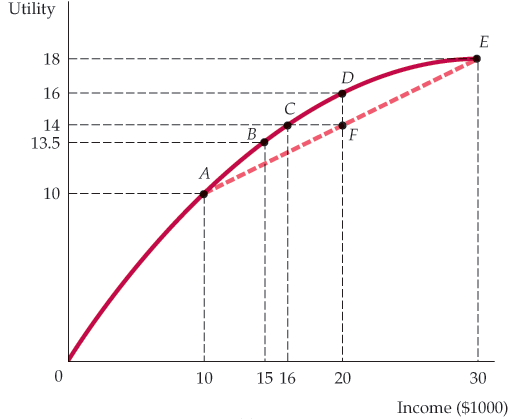
✏ Using the following diagram, what is the Certainty Equivalent of the new job?
✔ Click here to view answer
Above, we saw the new job has an EU of 14. What level of certain income also gives us a utility of 14? Getting $16,000 for sure gives us a utility of 14 utils. Therefore, we view the new risky job and getting $16,000 for sure as equivalent.
The curved line tells us the utility we get from We need to find a point on the curved line with an EU of 14 ✅
✏ Given that she is currently making $20K, would she take the new job? Why?
As a challenge, see if you can answer this question two ways:
-
Answer it using expected utility of the old and new jobs, calculated above.
-
Answer it using the certainty equivalent you calculated above.
✔ Click here to view answer
She will reject the job. We can arrive at this conclusion in two ways:
1.) For $20K, she has a utility (and an Expected Utility) of 16 utils.
The new job only has an EU of 14 utils, so it’s not as good.
2.) She currently has $20K, in a certain job. The new job is equivalent to a job where she is only making $16K, because that is the new job’s CE. Clearly she prefers something where she gets $20K for sure vs something which is equivalent to getting only $16K for sure. ✅
✏ Now suppose that our consumer has an income of $15,000 and is considering a new but risky sales job that will either double her income to $30,000 or cause it to fall to $10,000. As before, each possibility has a probability of 50%. Would she take the new job?
✔ Click here to view answer
Yes, she’ll take the new job. B represents her current job, because it is on the curved line (representing something certain) and it shows that she’s getting $15,000 for sure. It has a utility of 13.5 utils. That is lower than her EU if she were to take the new job. The new job is represented by point F. We can see that it has an EU of 14. 14 is higher than 13.5, so she will take the job now!!
Another way to think of it is using Certainty Equivalents. Right now, she only is getting $15K. However, at least for her, the new job is equivalent to getting $16K. That’s clearly better. ✅
✏ This extended example illustrates the complexity of human decision making. Our example decision maker may be risk averse, but she is still willing to take on risk if the expected value is high enough.
In general, we know that she would accept the new job if her starting income was below ____ and wouldn’t accept it if her starting income was above ____.
✔ Click here to view answer
The new risky job is considered equivalent to $16K. Therefore, if she is making less than $16K, it is considered an upgrade (like if she’s making $15K, in the later problems, above). If she’s making more than $16K, then it is considered a downgrade and she will reject it (like when she was making $20k, in the earlier problems, above.) ✅
✏ Suppose that the certain job she used to have is eliminated, so she takes the risky job. It’s her only option, now. However, there is an insurance company that will guarantee that she makes $30K. In other words, she still has a 50% chance of only earning $10K and a 50% chance of earning $30K. HOWEVER, if she only earns $10K, the insurance company will pay her $20,000, so that she effectively walks away with $30K.
But not really, because no matter what happens, she will have paid the insurance company’s premium.
Suppose they charge $10K. How much money would she end up with, and would she purchase the insurance.
✔ Click here to view answer
If she purchased the insurance, she would be guaranteed to get $30K of effective income - $10K premium. Therefore, she would have $20K.
[Answer the question using EU:] This would put her at point D, so she would have 16 utils. This is more than her expected utility in her current job of 14 utils.
[Answer the question using premium:] The maximum she would pay for insurance is . They only charge her $10K, so she will buy.
[Answer the question using CE:] Her current risky job is equivalent to have $16K for sure. With the insurance, she is guaranteed $20K for sure. , so she will buy. ✅
Feedback? Email munger.e1010@gmail.com 📧. Be sure to mention the page you are responding to.