🔎 Two Conditions for a Consumer Optimum
This is probably the most important slide of these two lectures:
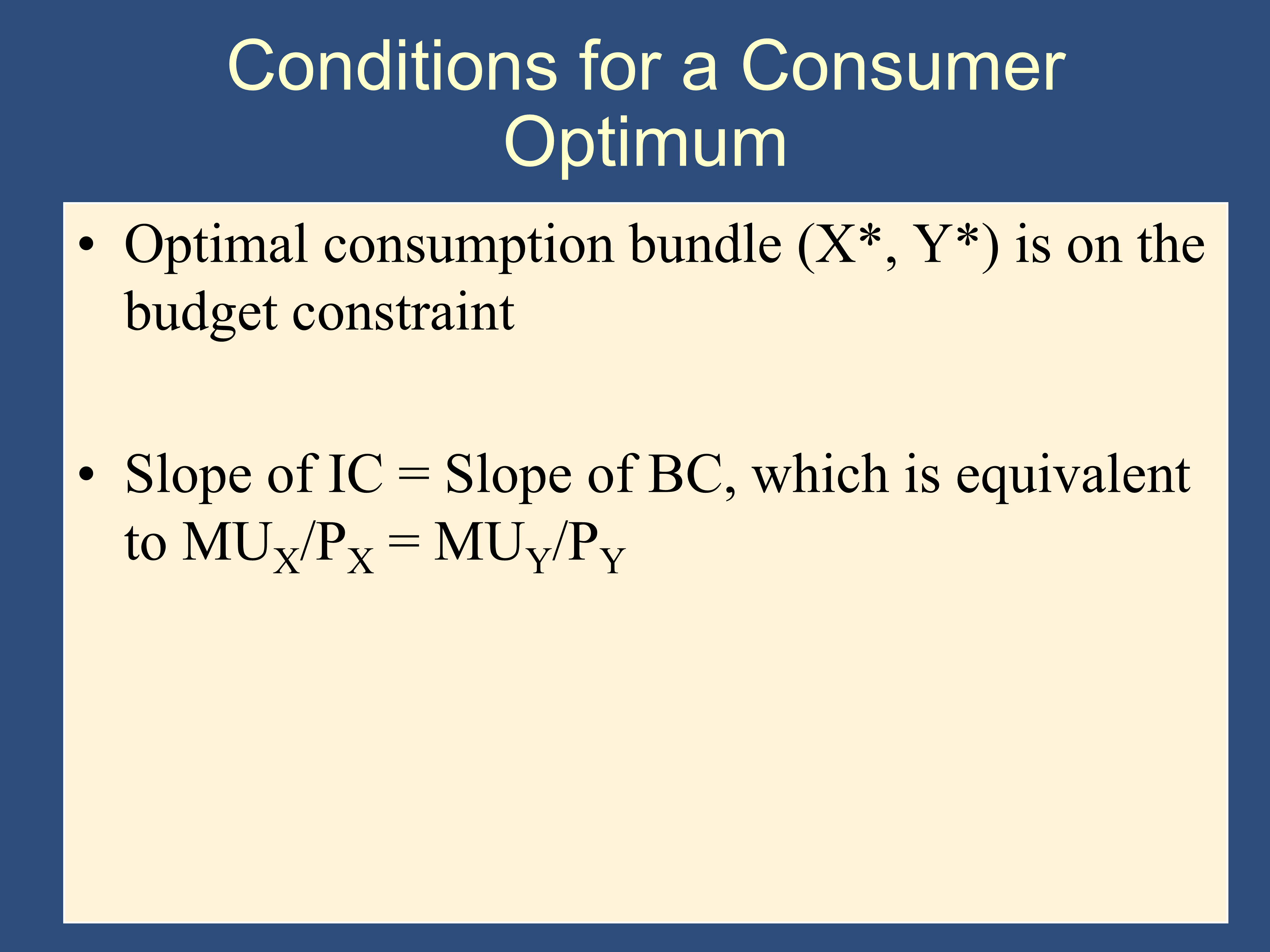
These two “optimization conditions” ensure that the consumer purchase the goods that they can afford and that maximizes their utility.
In the remainder of this page, we introduce the following “cheatsheet” summary of everything you need to know about the two conditions in the slide above.
| First Condition for a Consumer Optimum: a) Your optimal consumption bundle (X*,Y*) should be on the Budget Constraint. In other words, you must use all of your money. Alternate Version: b) |
| Second Condition for a Consumer Optimum: a) Slope of IC = Slope of BC b) ("Bang for the buck" formulation) This ensures that you spend your money on the things that bring you the most utility per dollar. Alternate versions: c) d) Ratio of MUs: |
🙋 Are these 4 separate checks we must do to ensure optimization, or are you saying if one of these is true the other 3 will be, and we will use whichever one is most convenient for the data available in a problem set?
See answer
✔ If 1 is true they are all true. ✅
🙋 Whoah, there’s a lot on this page… Do we need to know it all?
See answer
✔ Yes, I’ve definitely seen questions where each of these has been required to solve a question. Knowing the derivations I included in the previous section aren’t precisely required, but they do help you remember and practice the various formulas. Plus it can be nice to see how things fit together. ✅
First Condition of a Consumer Optimum: Use All Your Money
Section titled “First Condition of a Consumer Optimum: Use All Your Money”The first Condition for a Consumer Optimum is that the “Optimal consumption bundle (X*,Y*) is on the budget constraint.” This is equivalent to saying the consumer must use all of their money. If they “leave money on the table,” they are missing out.
🙋 But what if the consumer wants to save some money for later?
See answer
✔ Then we think of them “spending” the money on savings. In other words, this model is flexible enough that we can think of their savings as another good. If we do this, then they need to spend all of their money. (We will only look at the case when there are two goods, but this model can be applied when there are thousands of goods, including savings.)
The amount of money they spend on good X is and the amount of money they spend on good Y is . Therefore, their total spend is . If , then they use all of their money. ✅
In summary:
First Condition for a Consumer Optimum:
a) Your optimal consumption bundle (X*,Y*) should be on the Budget Constraint.
In other words, you must use all of your money.
Alternate Version:
b)
The top version, version a, is the version found directly on the slide. I added the “Alternate Version,” version b, because it can be helpful when solving problems.
The Second Condition of a Consumer Optimum: Use Your Money Efficiently
Section titled “The Second Condition of a Consumer Optimum: Use Your Money Efficiently”Bruce Provides two versions of the Second Condition for a Consumer Optimum in his slide:
a) Slope of IC = Slope of BC
b) (“Bang for the buck” formulation)
However, in previous slides, he also lists two alternate versions that can also be helpful when solving problems:
c)
d) Ratio of MUs:
These all ensure that you spend your money on the things that bring you the most utility per dollar. Note that they only have to apply to the optimal consumption bundle - not for other consumption bundles.
Where do the four versions of the Second Optimization Condition Come from?
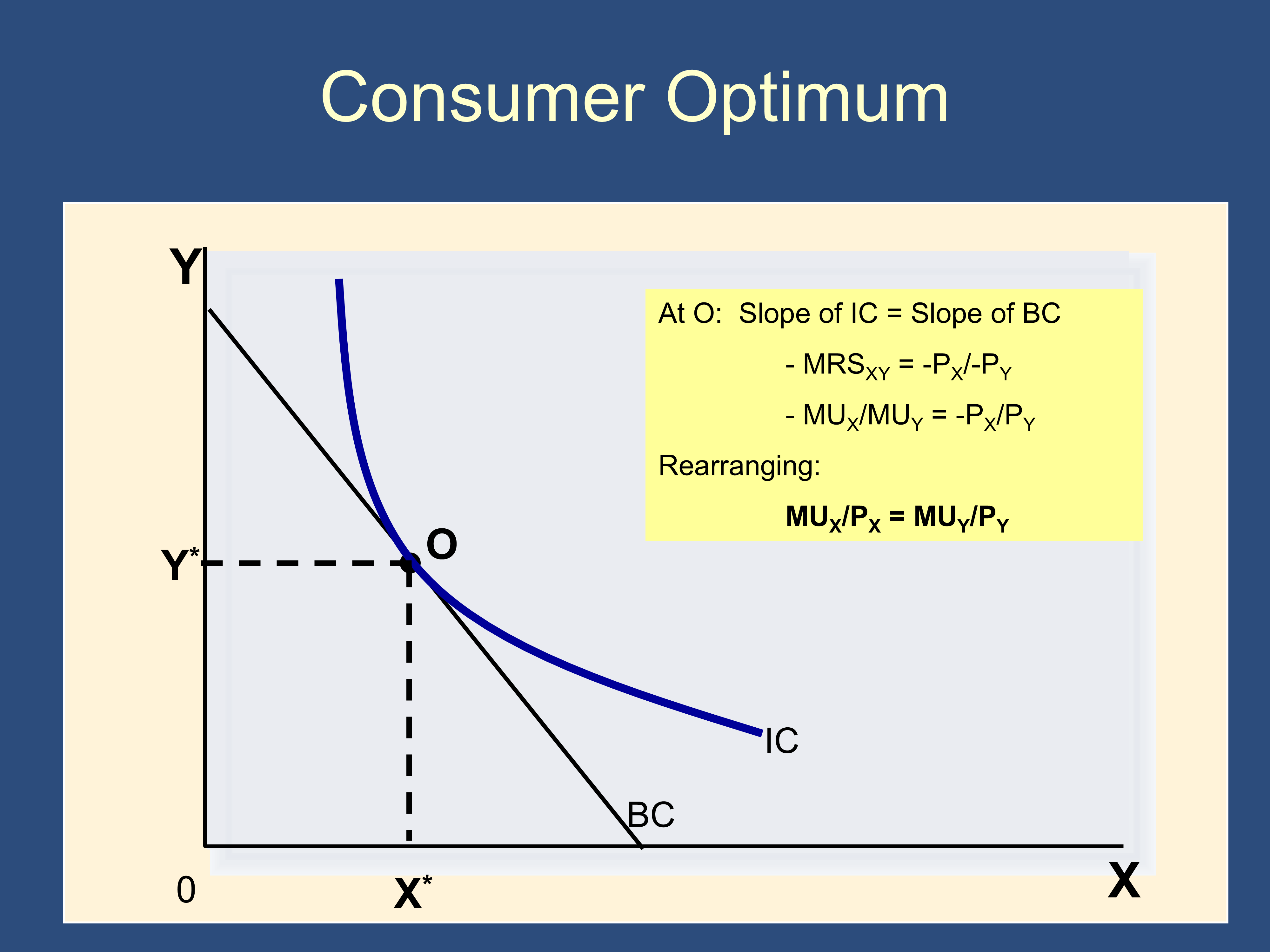
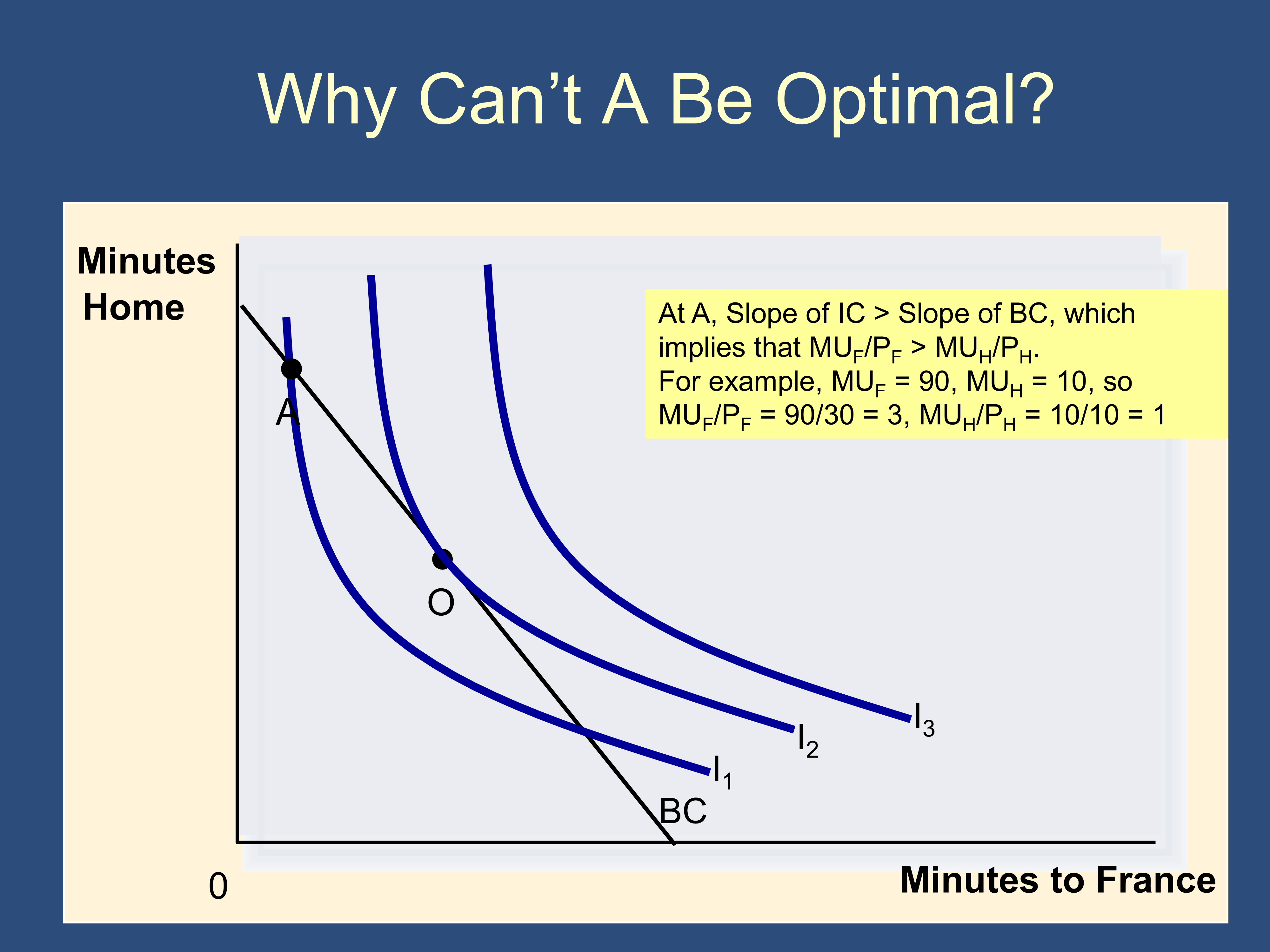
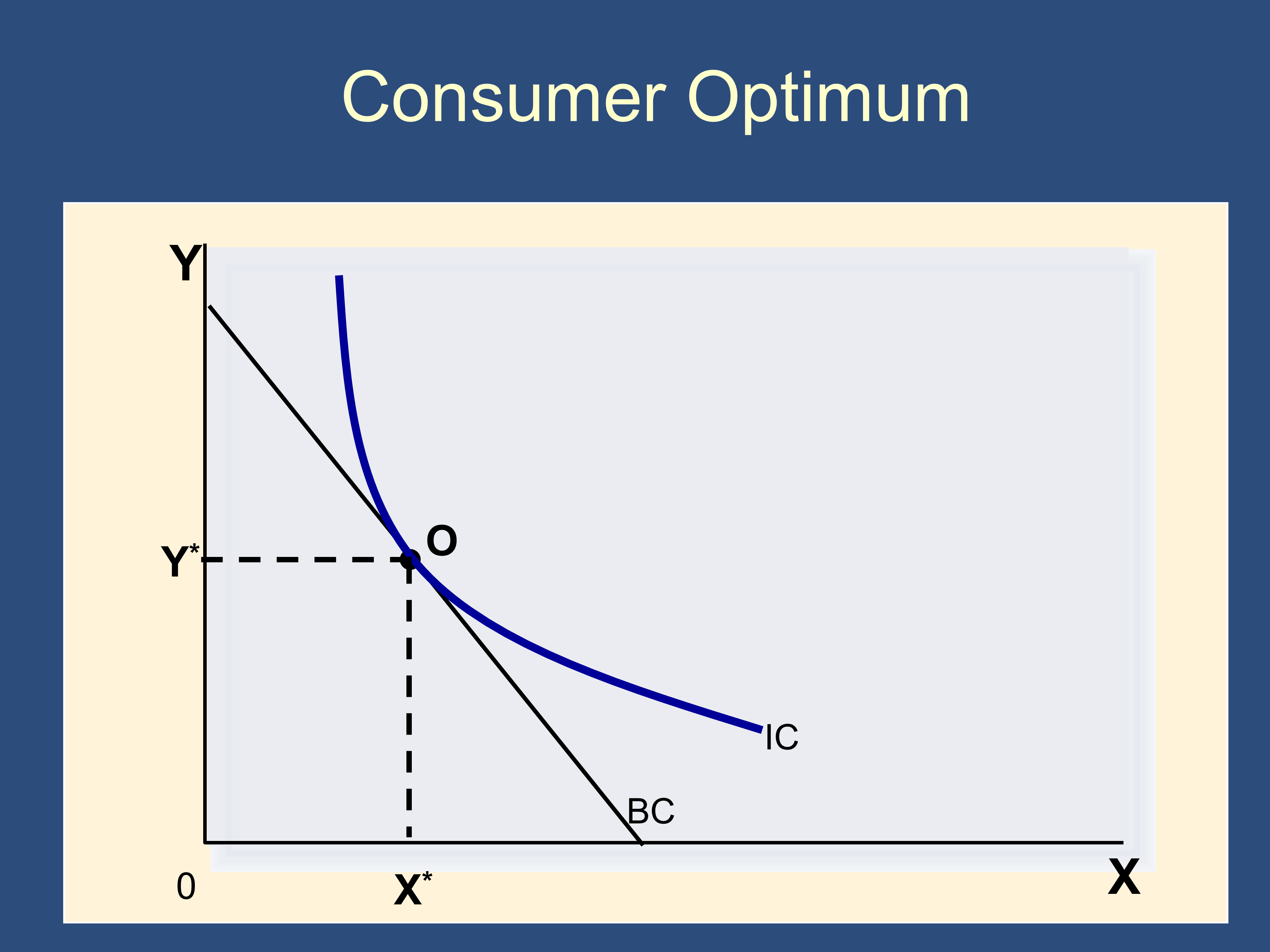
Section titled “Where do the four versions of the Second Optimization Condition Come from?”In the following slides, we noted that to reach the highest IC, the consumer must consume where the IC and BC are tangent:
| Too Much Y at point A | Just Right | Too Much X at point B |
|---|---|---|
 |  IC and BC are tangent | 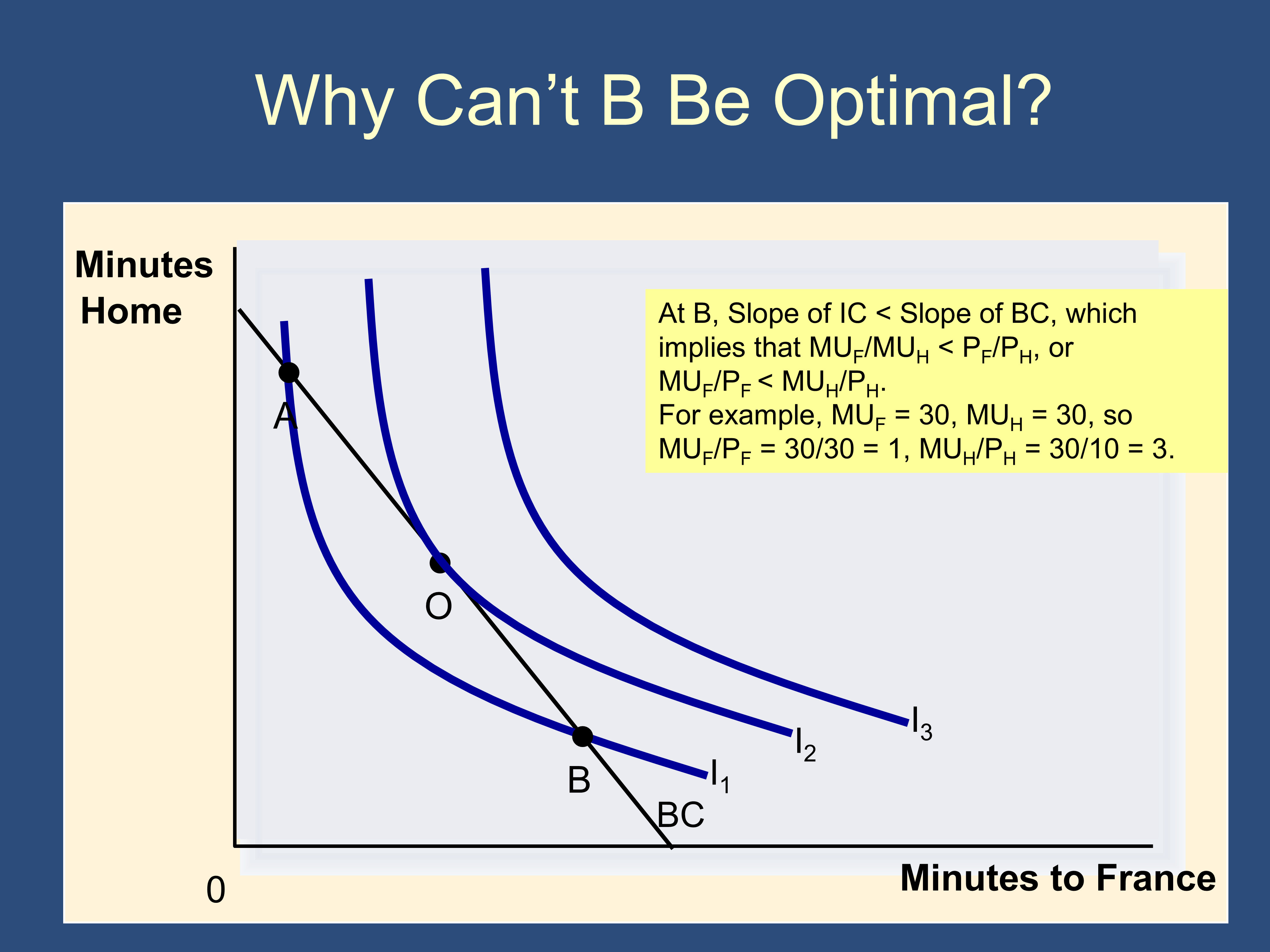 |
When two curves are tangent, they have the same slope. This establishes the version a above: “Slope of IC = Slope of BC”
To get the other versions, we need three important results about slope from earlier in the lecture:
slope of the BC =
slope of an IC =
MRS =
Next, we just substitute the two slope formulas into version a. It becomes:
slope of an IC = -MRS = slope of the BC =
Simplifying, we get version c of the second condition of a consumer optimum:
c)
Next, he substituted in , from above, to get version d :
d) Ratio of MUs:
Finally, we multiply both sides by Muy and divide both sides by Px to get version b :
b) (“Bang for the buck” formulation)
Feedback? Email munger.e1010@gmail.com 📧. Be sure to mention the page you are responding to.