✏️ Consumer Choice Q and A
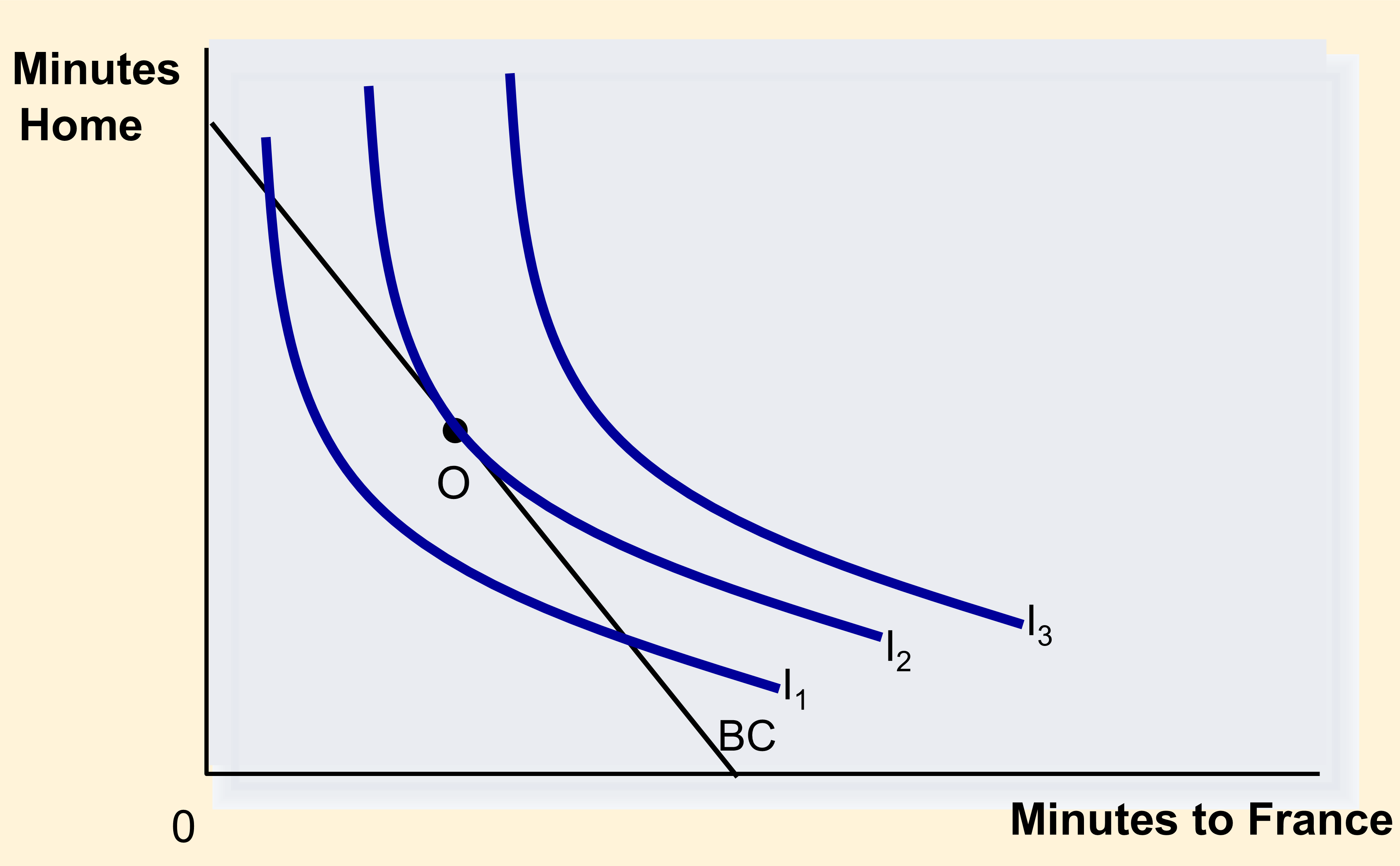
✏️ Professor Watson mentioned that the slope of the indifference curve is equal to the negative Marginal Rate of Substitution. Is that only at point O? Or is that throughout the curve?
✔ Click here to view answer
The slope of the everywhere, and not just point O. It is only at point O where the slope of the IC is also equal to the slope of the budget constraint. ✅
✏️ True/False. Is the slope of the indifference curve equal to the MRS? [Hint: Be sure to answer this question with pedantic literalness.]
✔ Click here to view answer
False. The slope of the IC is equal to negative the MRS. This question is inspired by an occasional error students make. Don’t let it happen to you! ✅
✏️ True/False. Is the slope of the indifference curve equal to the slope of the budget constraint? [This question is inspired by a way that students sometimes misspeak. Can you catch it? As with the previous question, be very precise with your language.]
✔ Click here to view answer
False. The slope of the indifference curve is not generally equal to the slope of the budget constraint. This only holds at the optimum consumption bundle and a relatively small number of other points.
✅
✏️ I am stuck at, looking at my notes,
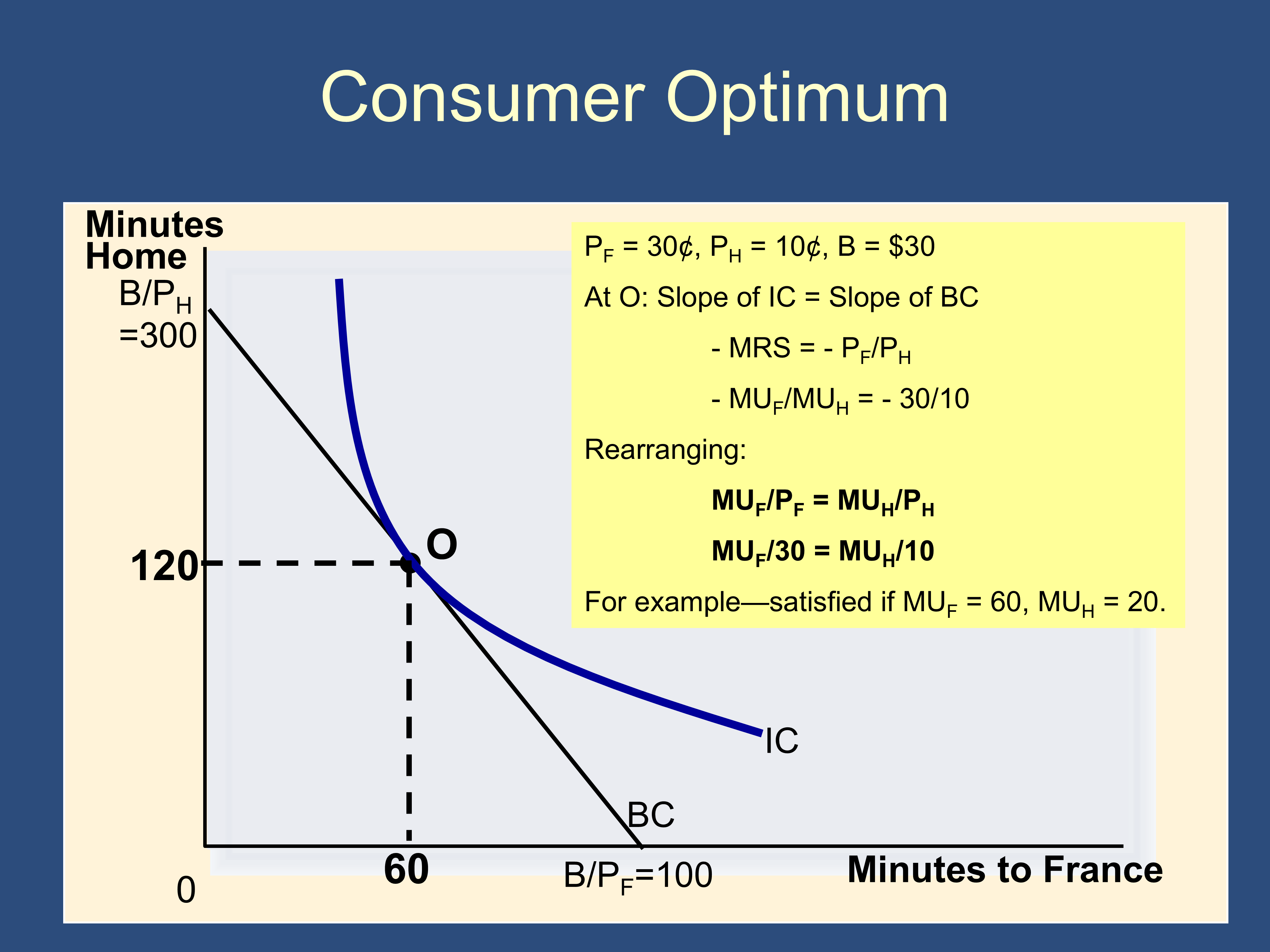
“At O, Slope of Indifference Curve = Slope of Budget Constraint →
negative of Price Ratio
”
And how Bruce rearranged
Also the bang of the buck condition is the O.
✔ Click here to view answer
See the following: The second optimization condition and slope ✅
✏️ How do you get the slope from the budget constraint?
✔ Click here to view answer
Slope of BC
He also used something called “point slope form,” as a second way of finding this equation. I can explain that if you want, but if you get the one we did in section, you’re ahead of the game. ✅
✏️ Do people ever maximize marginal utility or do they always maximize total utility?
✔ Click here to view answer
People maximize total utility because total utility is their total happiness. Marginal utility is the utility you get from consuming one more unit of the good. For example, if you were dying of thirst in a desert, the marginal utility of a glass of water would be maximized because they would be so thirsty!
No one would ever want to maximize the marginal utility of a glass of water. Rather, they would want to maximize their total utility by being transported to a beautiful, lush oasis, where they can drink all the free water they want, driving the marginal utility of water down to zero. ✅
✏️ When the question refers to “maximizing the utility” is that an equivalent way to talk about the consumer optimum or is that a separate concept? In other words, when asked about the maximized utility, do we need to take into consideration the budget as well?
✔ Click here to view answer
Maximizing utility = consumer optimum in that generally, when we say maximizing utility, we assume that we are maximizing it with respect to some budget constraint. ✅
✏️ For example - satisfied if , . Could you kindly clarify where we get 20 if we assume 60?
✔ Click here to view answer
Bruce just assumed that the , and . The marginal numbers could be anything. It was just an example that he used for illustrative purposes. Note that MUF refers to the additional happiness you get from consuming another unit of calls to France, so it is not equal to the number of minutes you spend talking to France. It’s not equal to your total happiness either. There are many different numbers floating around. This is necessary because human preferences can be so complex. ✅
✏️ Why does ?
✔ Click here to view answer
This is a challenging proof, so you may choose to skip it. However, Bruce does mention that people can ask me about it and it is an interesting argument, so here it is… (You are not responsible for learning it.)
Imagine you are moving between two points on the same IC. For example, suppose you are moving from point A to point B, below. We start by breaking the movement from A to B down into a vertical and horizontal movement:
- a movement downward by ΔY (Y is amount of Good Y consumed)
- a movement rightward by ΔX (X is amount of Good X consumed)
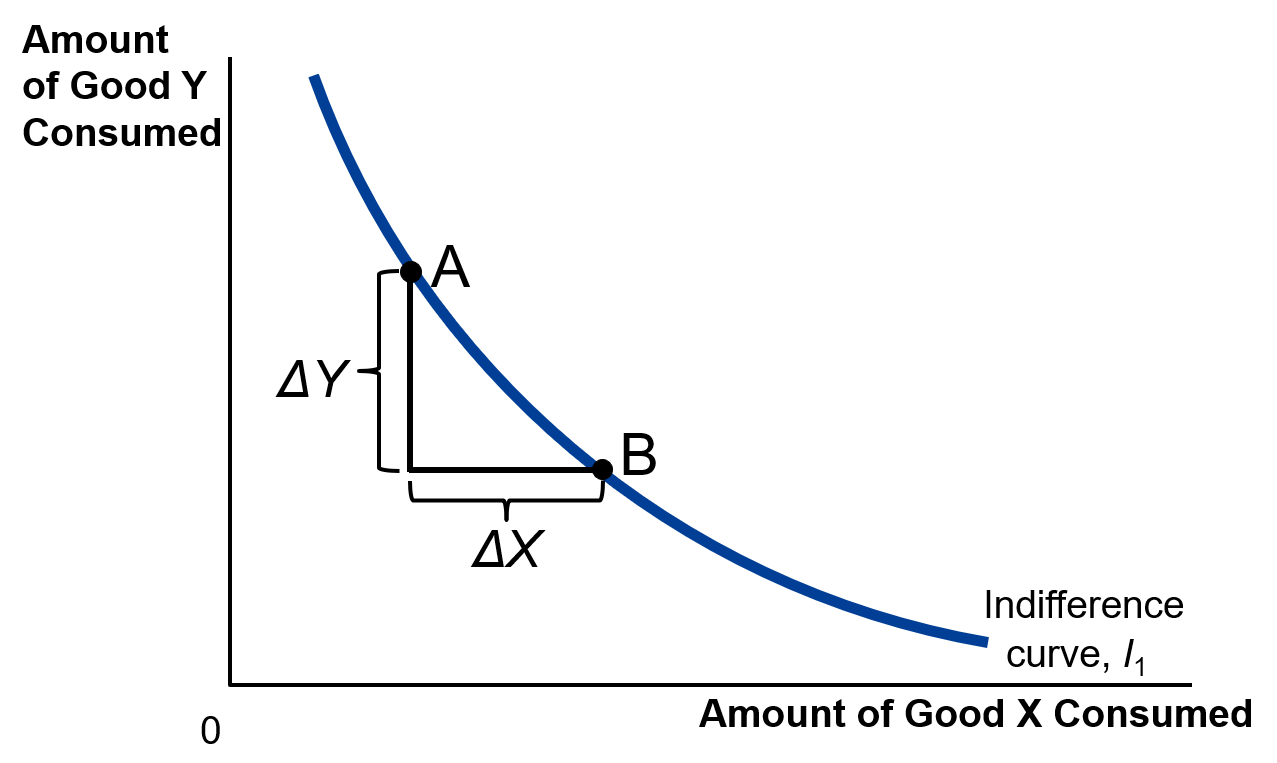
We can look at the impact of these two movements on total utility. Let’s consider the horizontal movement first.
- Impact on Utility of consuming more of good X: If we are increasing our consumption of X by ΔX and each unit of X gives us MUX of utility, then moving right by ΔX should increase our utility by approximately ΔX×MUX. Multiplying like this increases our utility by MUX for each additional unit of X in ΔX.
- Impact on Utility of decreasing our consumption of good Y: If we are changing our consumption of good Y by ΔY and each additional unit of Good Y gives us MUY of utility, then our utility should change by approximately ΔY×MUY. (Note that ΔY is negative, so consuming less of Good Y will decrease our utility.) Multiplying like this decreases our utility by MUY for each unit of good Y that we are no longer consuming.
The total change in utility from A to B will be approximately equal to the sum of the change in utility from the horizontal movement (ΔX×MUX) and the vertical movement (ΔY×MUY):
(The symbol ≈ indicates that two things are approximately equal.)
However, because A and B are both on the same indifference curve, the change in utility as you move from A to B must be ΔU = 0:
Next, we rearranging terms to solve for the slope of the IC, . First, we subtract from both sides:
Then we divide both sides by ΔX and ΔMUY:
The equation can also be derived using calculus, as shown at the bottom of this page: http://www.sfu.ca/~akaraiva/mrsnotes.pdf
Feedback? Email munger.e1010@gmail.com 📧. Be sure to mention the page you are responding to.