🔎 Productive vs. Allocative Efficiency
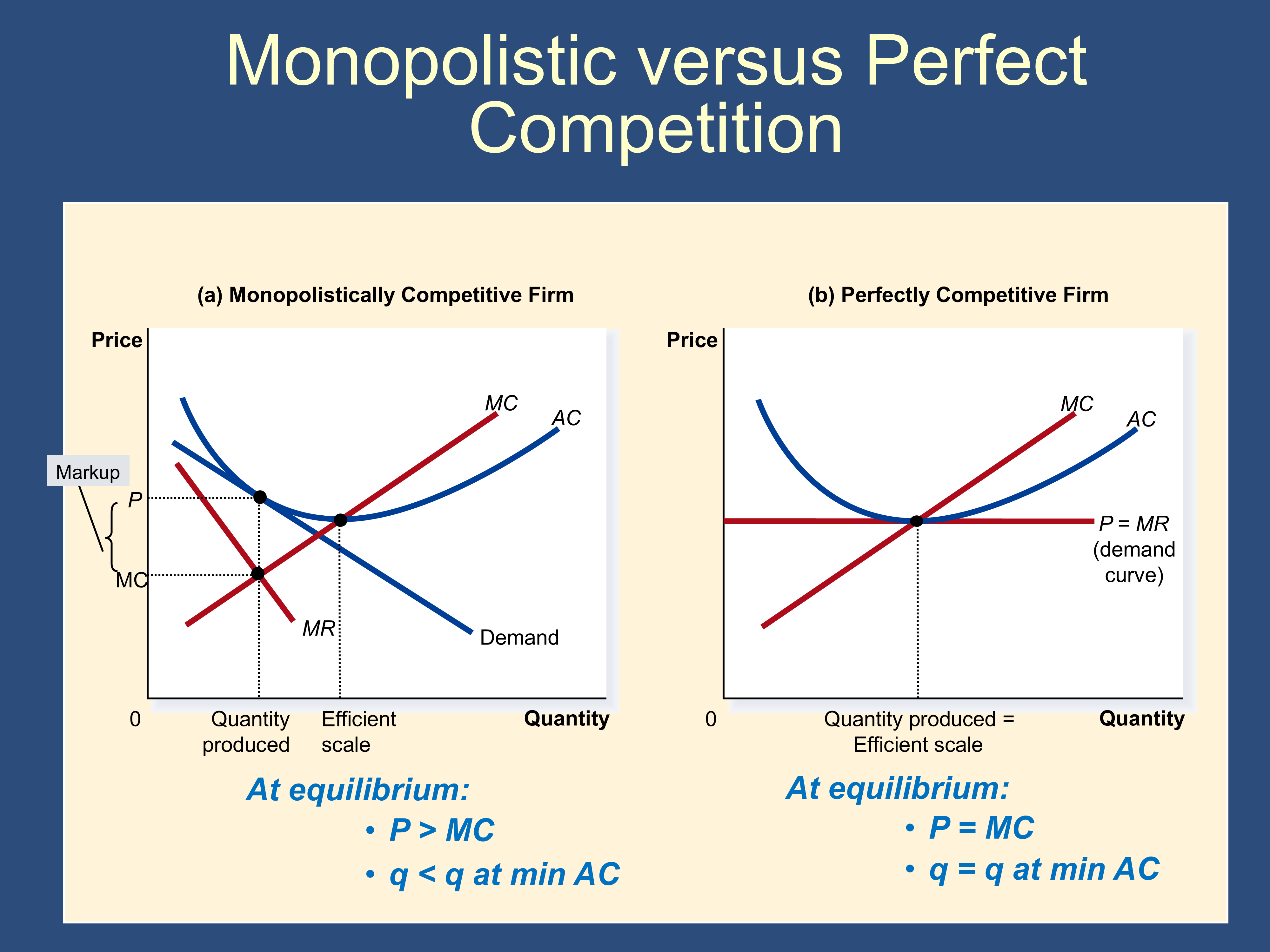
The above slide makes two points:
- P vs MC: In Monopolistic competition, the firm reduces production so they can raise (ie so they can have monopoly power). In perfect competition, firms can’t raise the price by cutting production, so they just produce until . You can verify this by looking up P and MC at the “quantity produced” in both diagrams.
- q vs q at min AC: The quantity at which a firm has the lowest AC is called the “efficient scale” because it is a scale of production that minimizes cost per unit. Producing at this scale and minimizing average cost is known as Productive Efficiency. Monpolistically competitive firms lower production below the efficient scale to drive up prices, so they are not productively efficient. Perfectly competitive firms can’t raise prices by cutting production, so they produce at the efficient scale and are productively efficient.
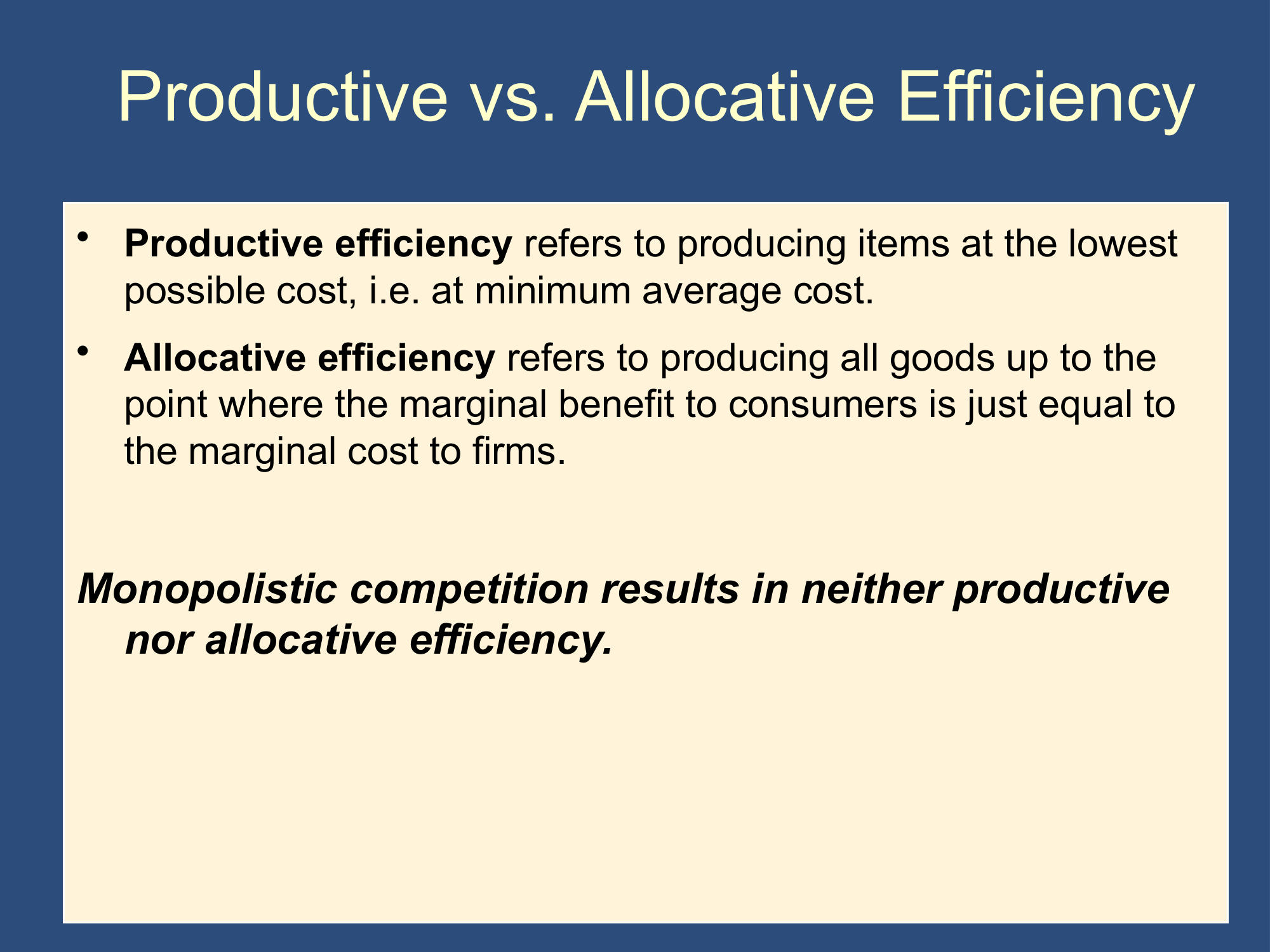
We assess Allocative Efficiency by comparing P and MC. If people are willing to pay $5 for a hot dog, their marginal benefit form the hot dog must have been at a least $5. Therefore, when society produces goods up to the point where P=MC, we are also producing goods at the point where there marginal benefit to consumer equals MC (ie where MB=MC). When the benfits and the costs are equal, it means that you’ve produced the right amount.
Feedback? Email munger.e1010@gmail.com 📧. Be sure to mention the page you are responding to.