🔎 MSC = MPC + Additional Costs - Additional Benefits
🙋 Can you explain the following slides?
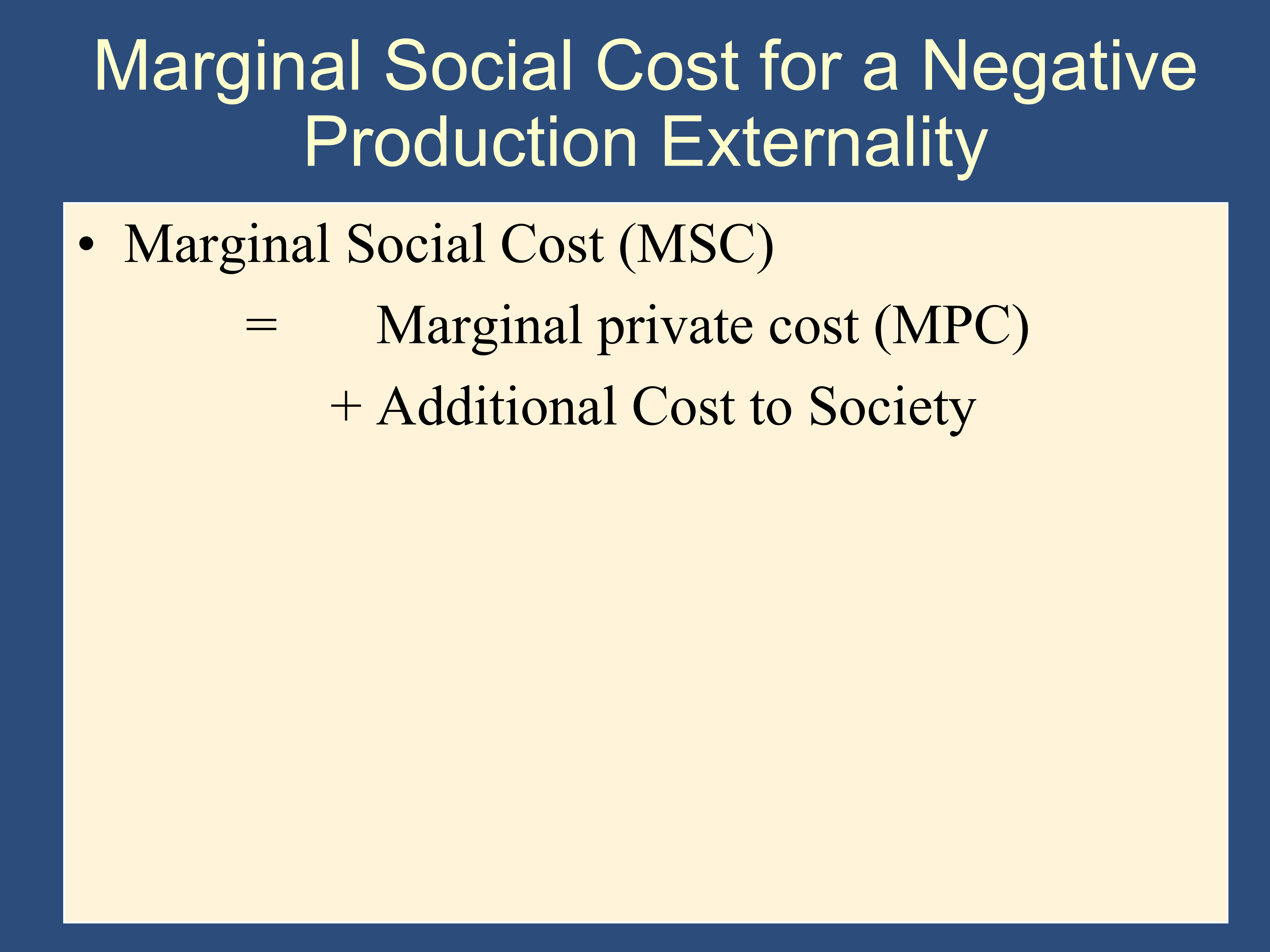
✔ When a good is produced, all costs are either costs for the firm that produced the good or costs for someone else. The vast majority of costs in producing something are costs for the firm that produces the good.
For example, what are the costs of making a loaf of artisan bread? Ingredients, Labor, Energy, Kitchen Rental, etc. All of these costs are paid by the individual or firm that produced the loaf of bread. In this case, I can’t think of any costs that anyone else has to pay if someone bakes a loaf of artisan bread.
We refer to the costs that are paid by the producer as “private costs,” because they are a private issue for the producer and no one else is involved.
Occasionally, there may be additional, external costs. For example, if the baker makes a great deal of noise, then that would affect the baker’s neighbors. We refer to the cost that impacts someone else as an “external cost” or “additional cost.”
When we want to decide the optimal amount of bread to be produced, we want to take into account ALL costs. Therefore, we define “Social Costs,” which include both the private costs to the baker and the additional costs to everyone else.
It’s very clear that we can talk about Social costs for ANY good, because, for any good, we can add up the private costs to the firm that produces the good + the external costs to other people.
To calculate the optimal amount of artisanal bread in our society, we need to calculate the additional social cost of producing another loaf of bread.
If
What do you think marginal social costs are from producing another loaf of bread?
Clearly,
That is exactly what this slide is saying:
The above slide is specifically about a negative production externality.
The above slide makes it clear that we can always measure the MSC, whether there is an externality or not. However, if there is no additional cost (or benefit) to society, then:
Becomes
Ie
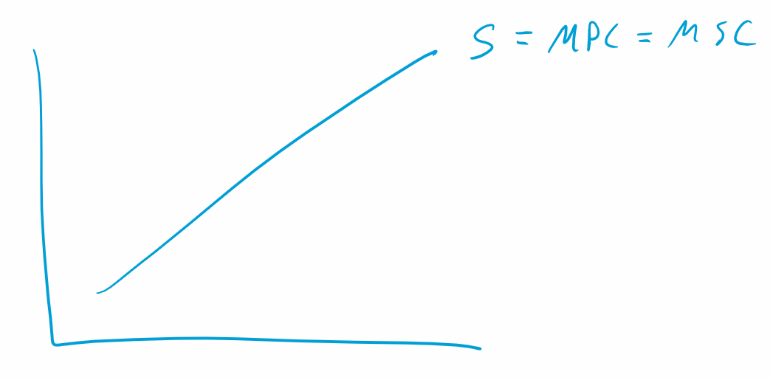
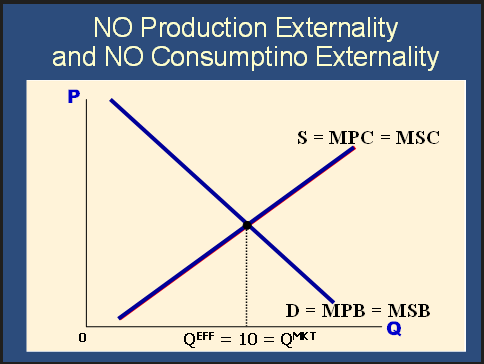
We draw this as in the following diagram:
Positive Externality
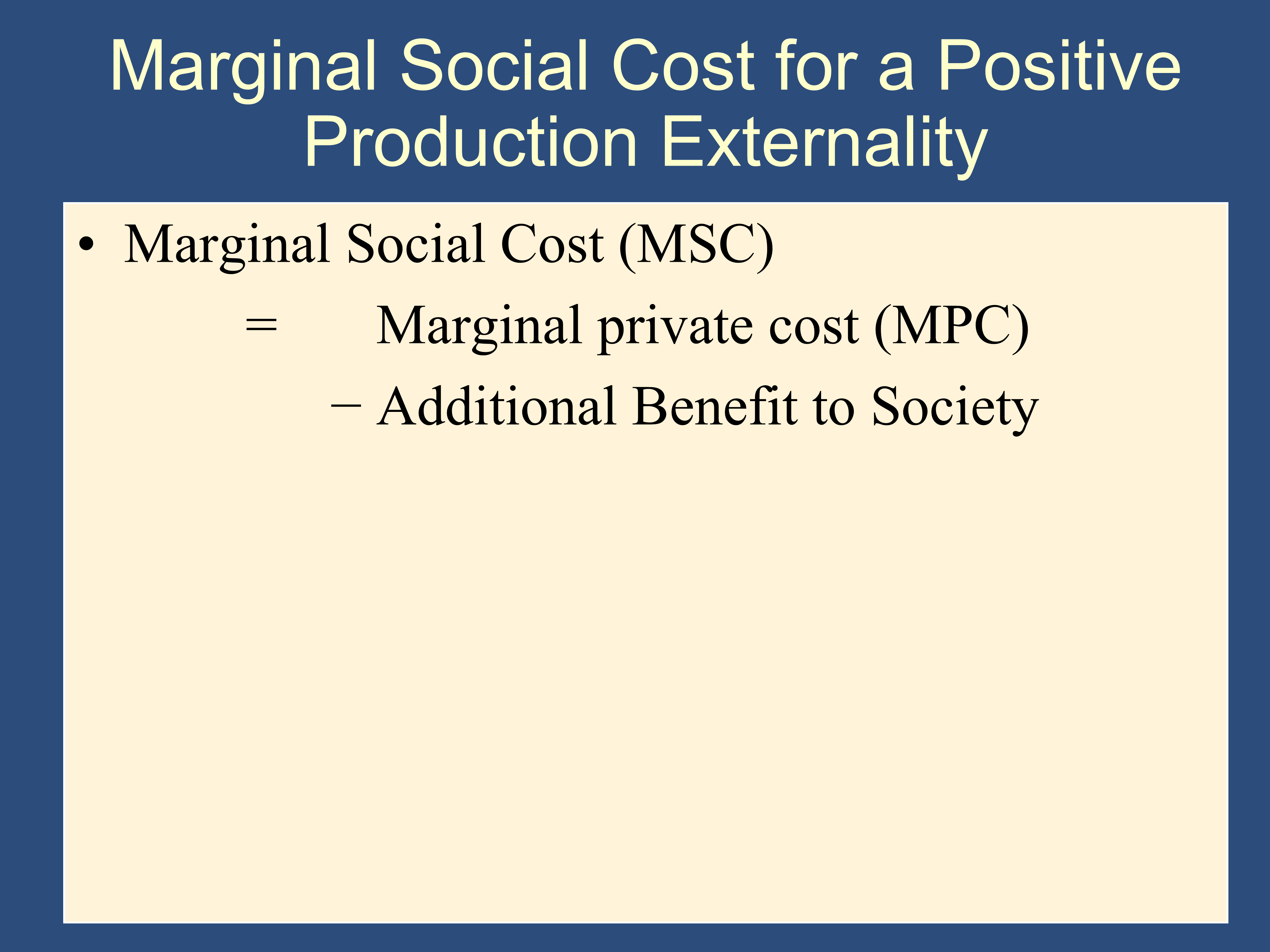
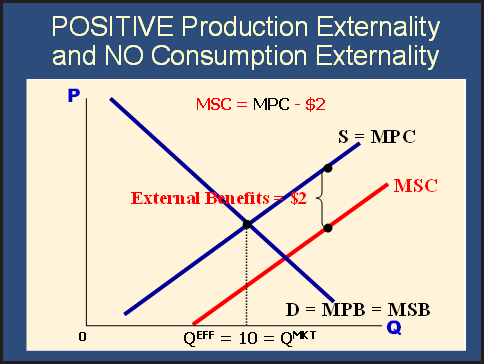
Section titled “Positive Externality”With a Positive Production Externality we get the following slide:
As before, the Social Cost is made up of the Private Cost to the producer, plus any additional costs or benefits to other members of society:
Usually, when someone produces a good, there are no additional costs/benefits to any other member of society, other than the firm that produced the good. However, let’s suppose that there is an additional benefit to the neighbors of a wonderful smell of baking bread. What would the marginal social cost be in this case?
This is because the additional benefits from the wonderful smell of baking bread cancels out some of the costs of baking the bread (at least when we are looking at the total impacts on all of society).
For example, suppose that an additional loaf of bread, is noticed by 4 people, and each of those people would pay exactly $.50 each to enjoy that aroma (they wouldn’t pay more than $.50 each). We quantify their benefit as each of these four people receiving a benefit of $.50 each. In this case, the total additional benefit to society would be
.
In the absence of this wonderful aroma, we would calculate the optimal amount of bread that should be produced as follows:
With the wonderful aroma
Marginal Social Benefit
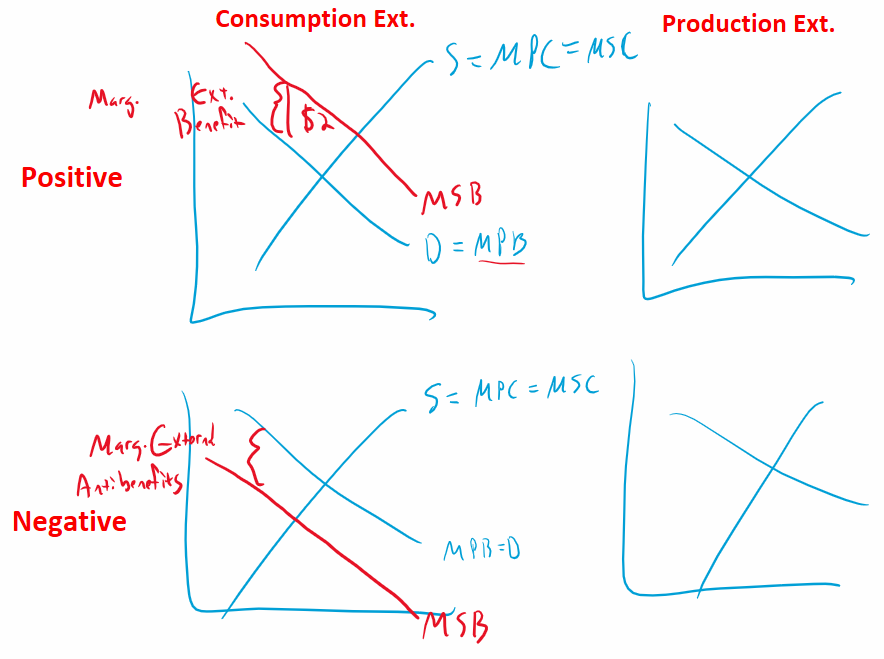
Section titled “Marginal Social Benefit”Can we also apply this to Marginal Social Benefit?
Absolutely!
When a good is consumed, all benefits are either benefits for the person that consumed the good or benefits for someone else. The vast majority of benefits in consuming something are benefits for the person that consumes the good.
For example, what are the benefits of consuming a loaf of artisan bread? Taste, nutrition, health benefits. Perhaps there will also be health costs to the person consuming the bread. As economists, we must subtract these costs from the benefits of the good when calculating the private benefits of the good. All of these costs and benefits in this paragraph accrue to the person eating the bread. In this case, I can’t think of any external costs or benefits that accrue to someone else if I eat a loaf of artisan bread.
We refer to the benefits that the consumer receives as “private benefits,” because they are a private issue for the consumer and no one else is involved.
Occasionally, there may be additional, external benefits or costs when the consumer consumes the good. For example, perhaps consuming the bread puts the person in a wonderful mood and they are nice to their neighbors and coworkers.
In this case, we would refer to these benefits to the neighbors and coworkers as external benefits.
.
We can then calculate:
If, on the other hand, the person consuming the bread is a hipster and goes around talking about how superior their bread is to other people’s bread, then that might be a negative external affect because it may annoy their neighbors if done to extremes.
.
Feedback? Email munger.e1010@gmail.com 📧. Be sure to mention the page you are responding to.