❔ Questions and Answers
Can you explain ?
There is a lot of intuition behind this formula.
1.) You can use this formula to calculate profit using the area of a rectangle. The height of the rectangle in the following slide is and its width is , so it’s area is . This implies that the area of the rectangle. represents the total profit of the firm.
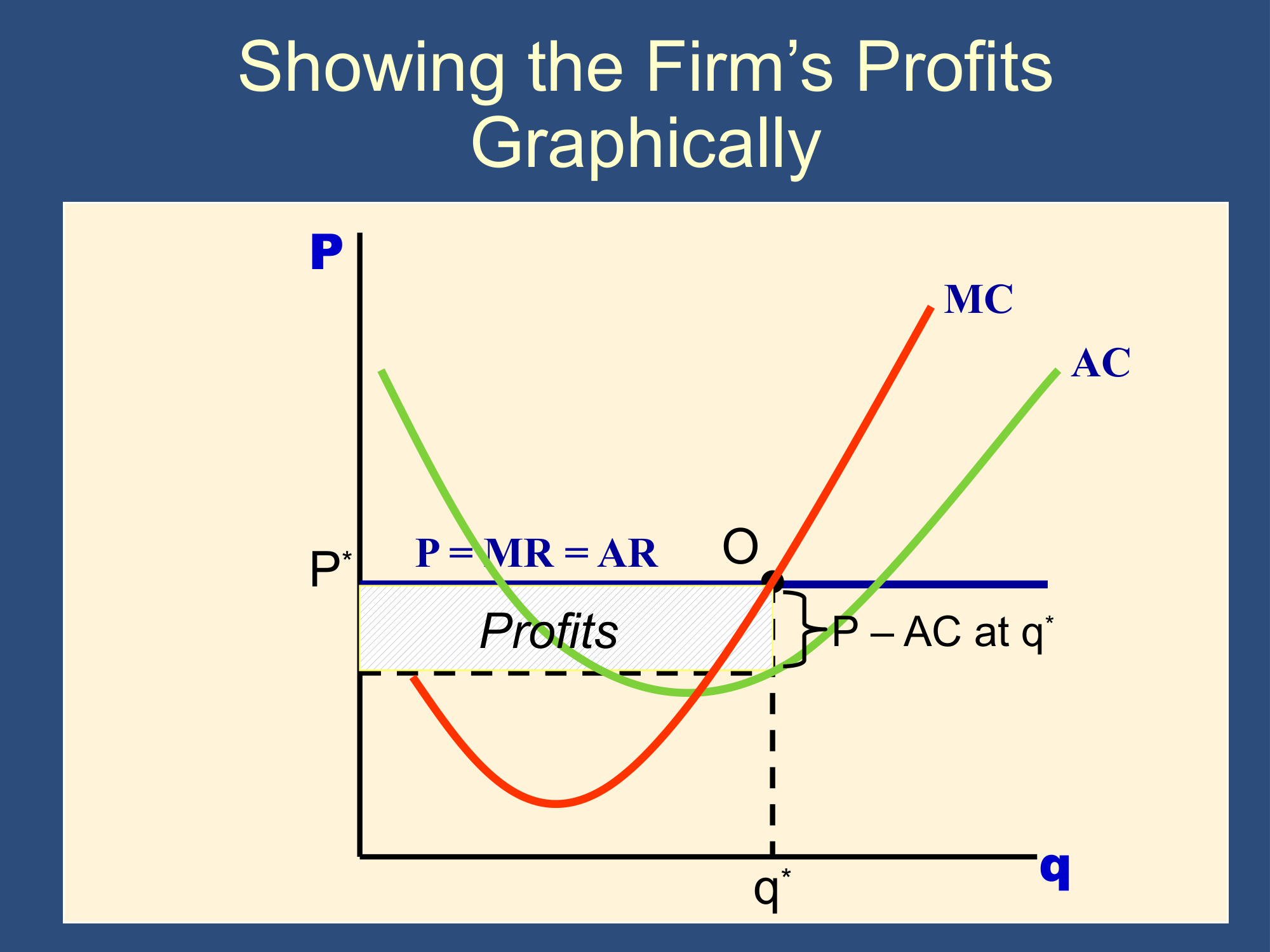
2.) You can think of as the average “per-unit-profit” for the good you are selling. For example, suppose you sell widgets for $10 and the average cost to make the widgets is $7. What is the average per-unit-profit that you make from selling widgets? Clearly, it is , because, for every widget you sell, on average, you have $7 of expenses and you are paid $10. The profit for selling the widgets will then be $3 per widget (on average). Therefore, whenever you see in a formula, think of it as the “average per-unit-profit.”
It’s not surprising, then, that total profit will be the per-unit profit times the number of units: . For example, in the previous example, if we sell 100 units, and our average per-unit-profit is $3, then our total profit will be
What do variable costs have to do with shutting down?
The answer to this shows up on one of Bruce’s slides. It illustrates how you can get insights from following how he derives results (the 4 versions of the second optimization condition also came from carefully examining a slide)
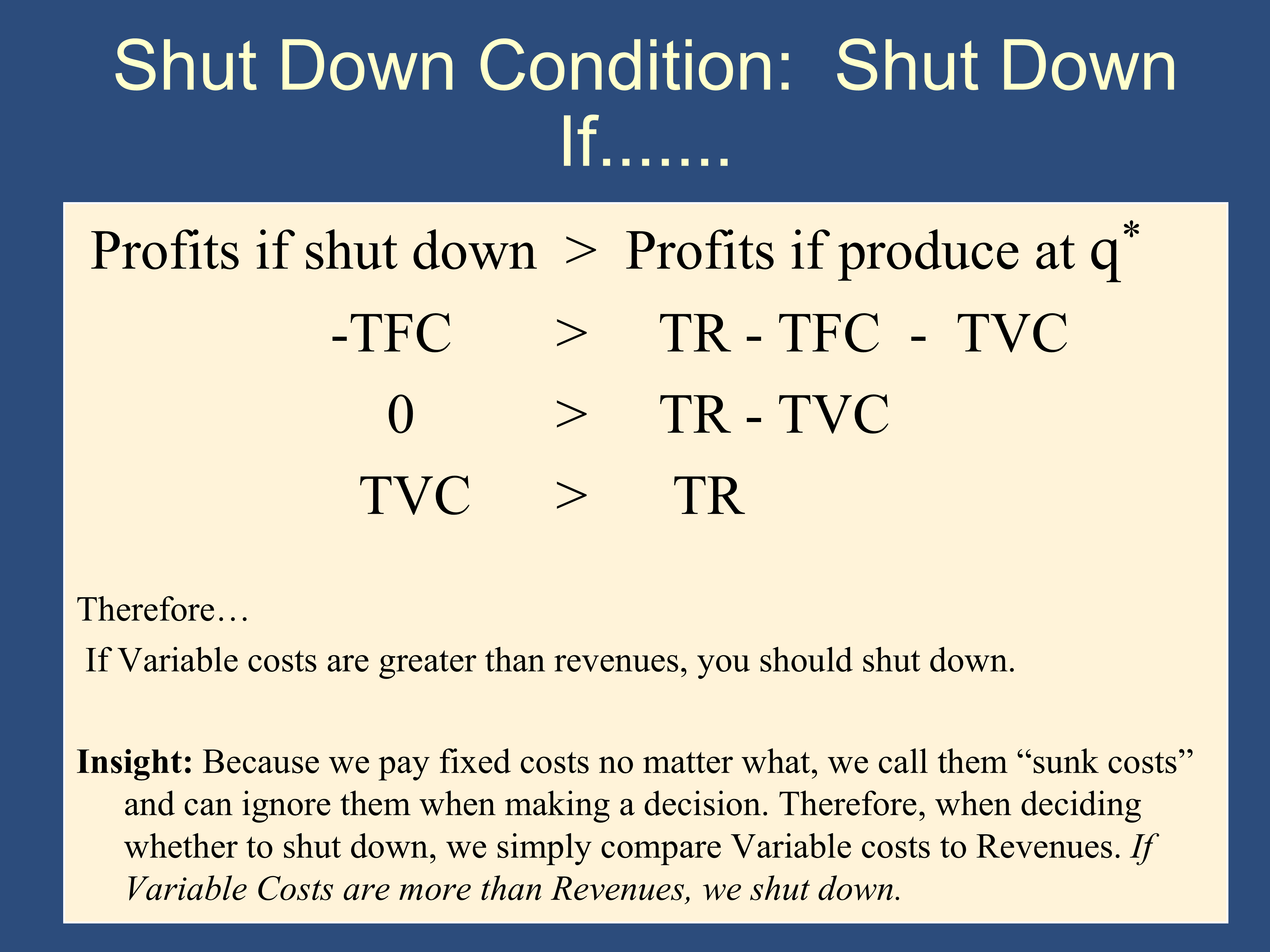
Don’t shut down if
Do shut down if
Feedback? Email munger.e1010@gmail.com 📧. Be sure to mention the page you are responding to.