👨🏫 Notes on Lecture 3
Pindyck and Rubinfeld: Sections 4.1 - 4.3
Budget Constraint Movements
Section titled “Budget Constraint Movements”The slope of the budget constraint is . Therefore, if B changes, the budget constraint won’t have a different slope. It will just shift inward or outward:
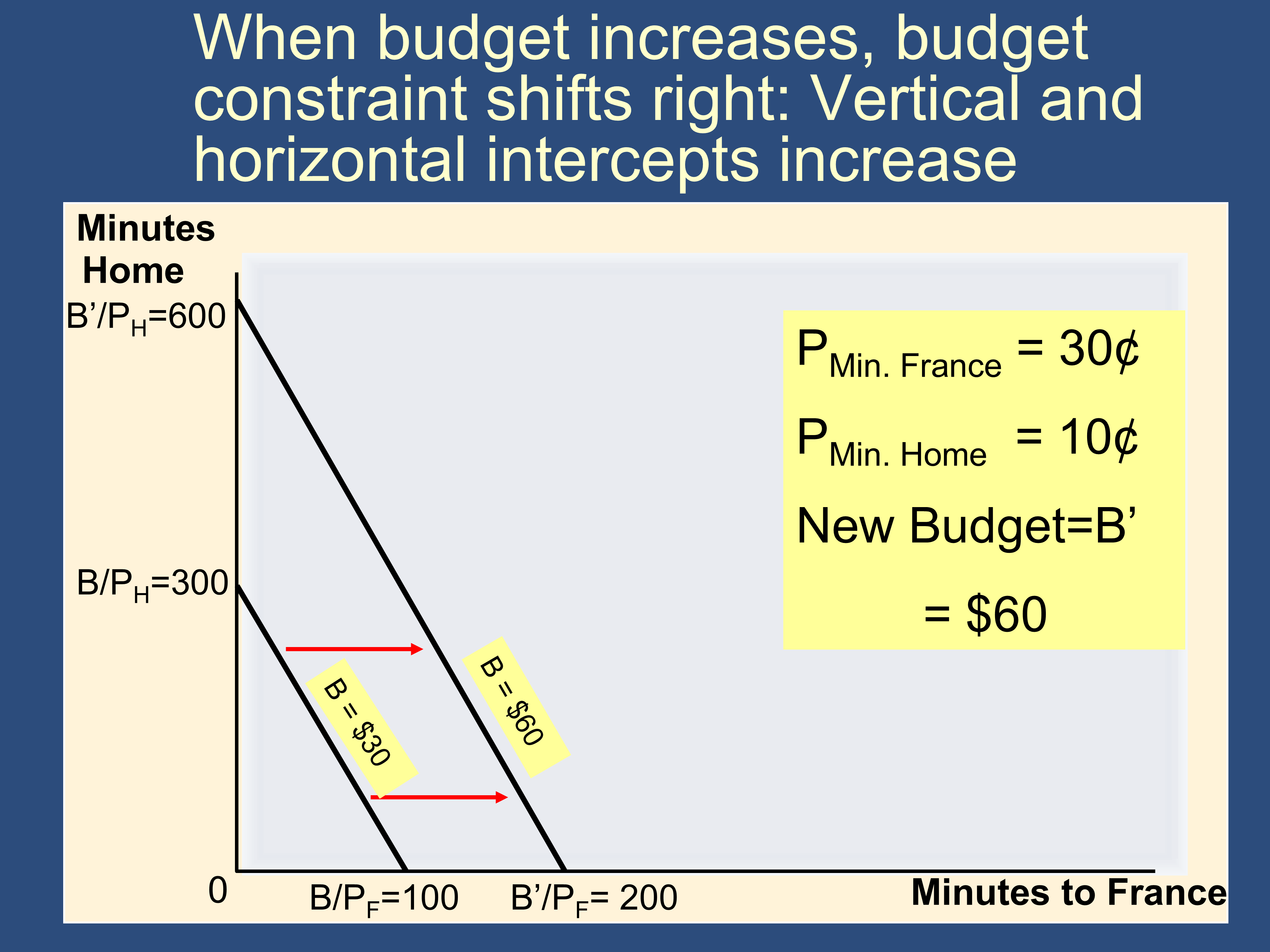
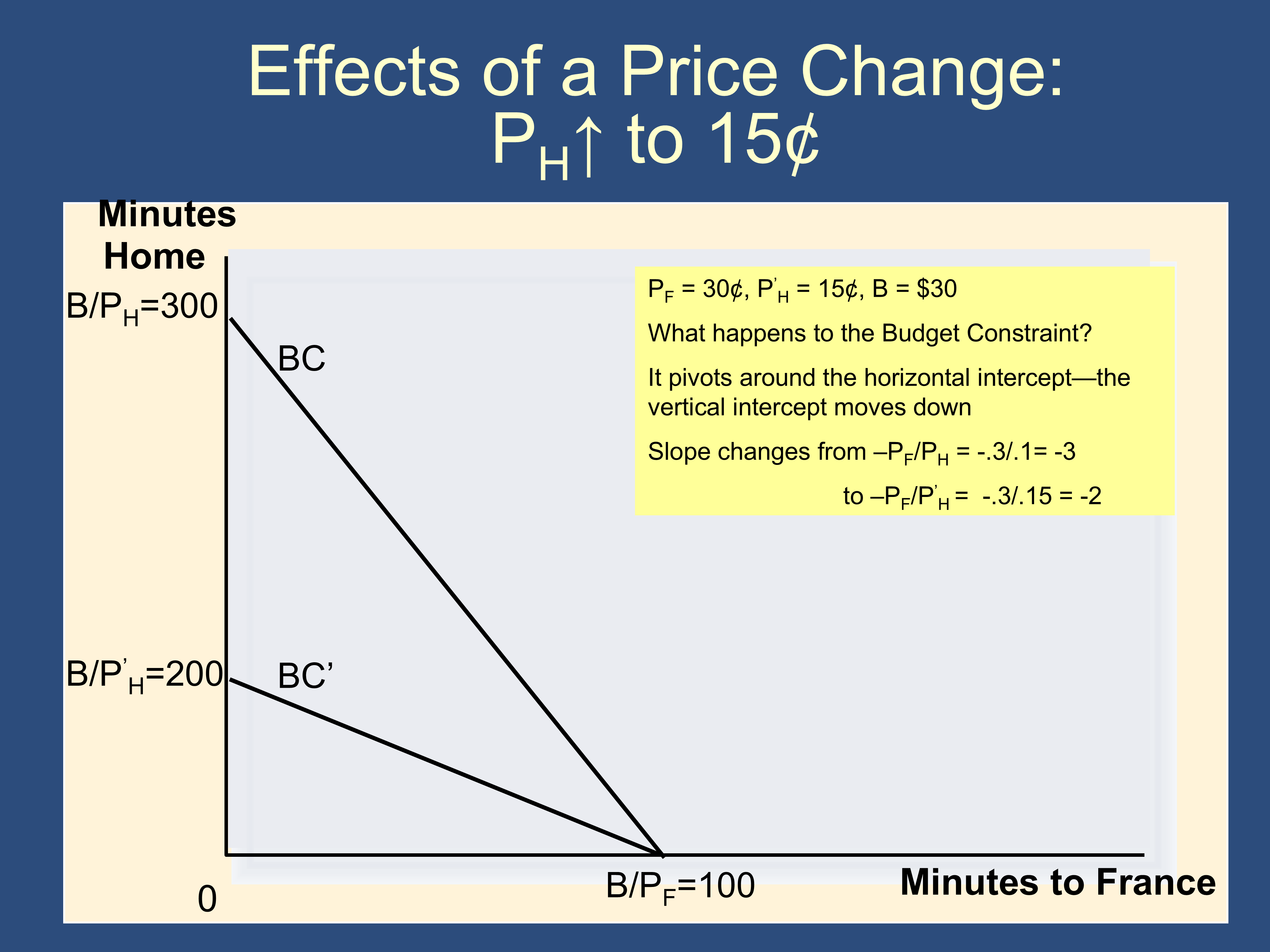
However, when a price changes, that will generally change the slope ( ). In this case, the BC will pivot.
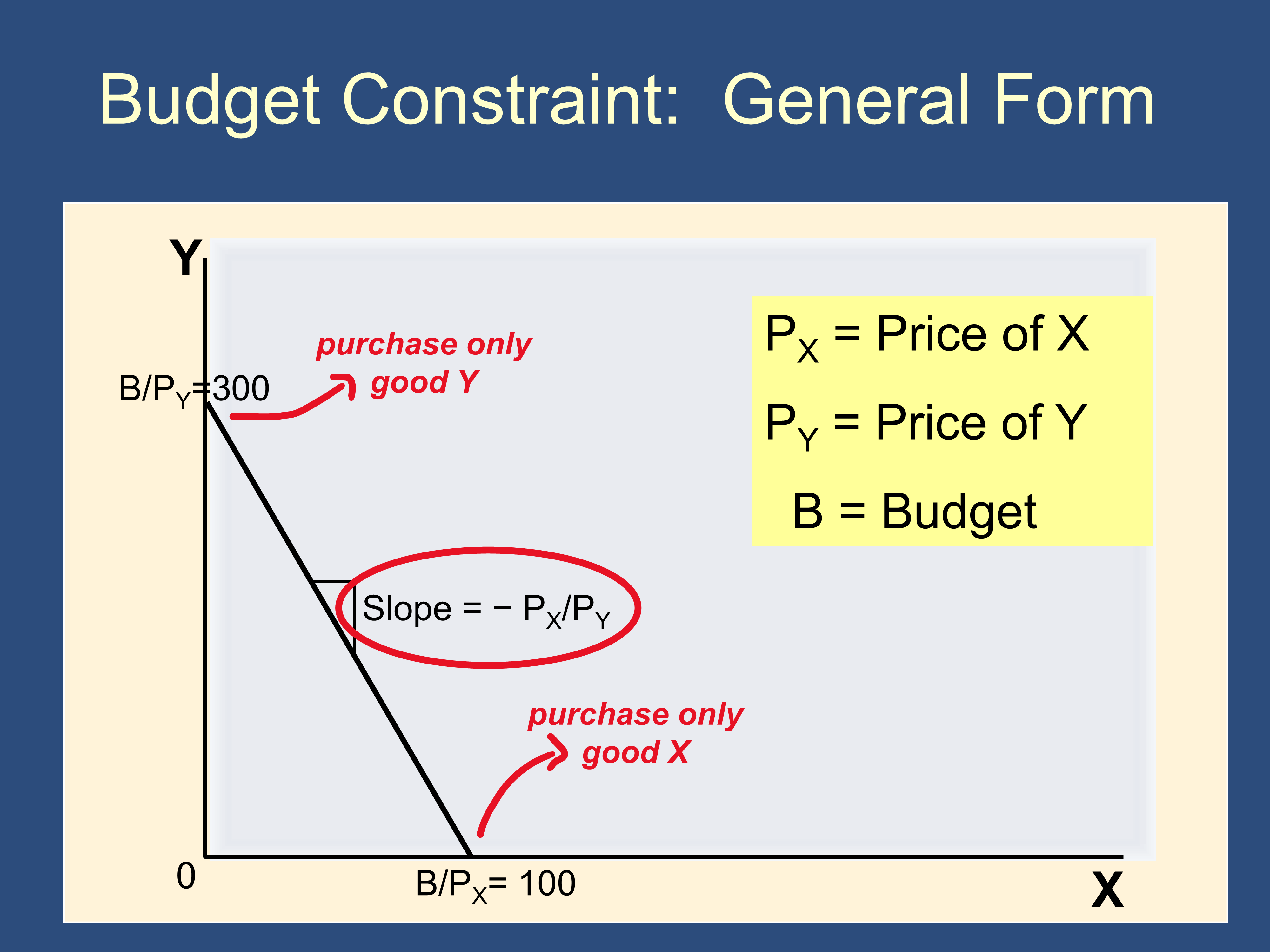
✏️ (Advanced) Explain the effect on the BC of an increase in budget or a price change (in the two slides above) using the diagram below. Specifically, explain them using the formulas for the Y-Intercept (ie ), X-Intercept (ie ), and slope (). It’s okay to reproduce portions of the language I used, above. You just want to confirm that you have independent mastery of these important concepts.
✔ Click here to view answer
In the diagram on the first slide, the budget changed, but neither price changed. Therefore:
- The slope of the of the budget line can’t change because it’s slope doesn’t have B in it: .
- Both intercepts will become larger numbers because the formulas for both of them have in the numerators: and . This will cause the budget line to move outward.
In the diagram on the second slide, the Price of a minute home changed, but the Budget and the price of a minute to France didn’t change.
- The X-intercept can’t change because the formula for it is and neither B nor have changed.
- Because has risen and it is in the denominator of the formula for the Y-Intercept, the Y-Intercept will fall lower.
- Together, both of these effects cause the budget line to rotate around the X-Intercept.
Two conditions for a Consumer Optimum
Section titled “Two conditions for a Consumer Optimum”The following slide gives us multiple conditions for a consumer optimum:
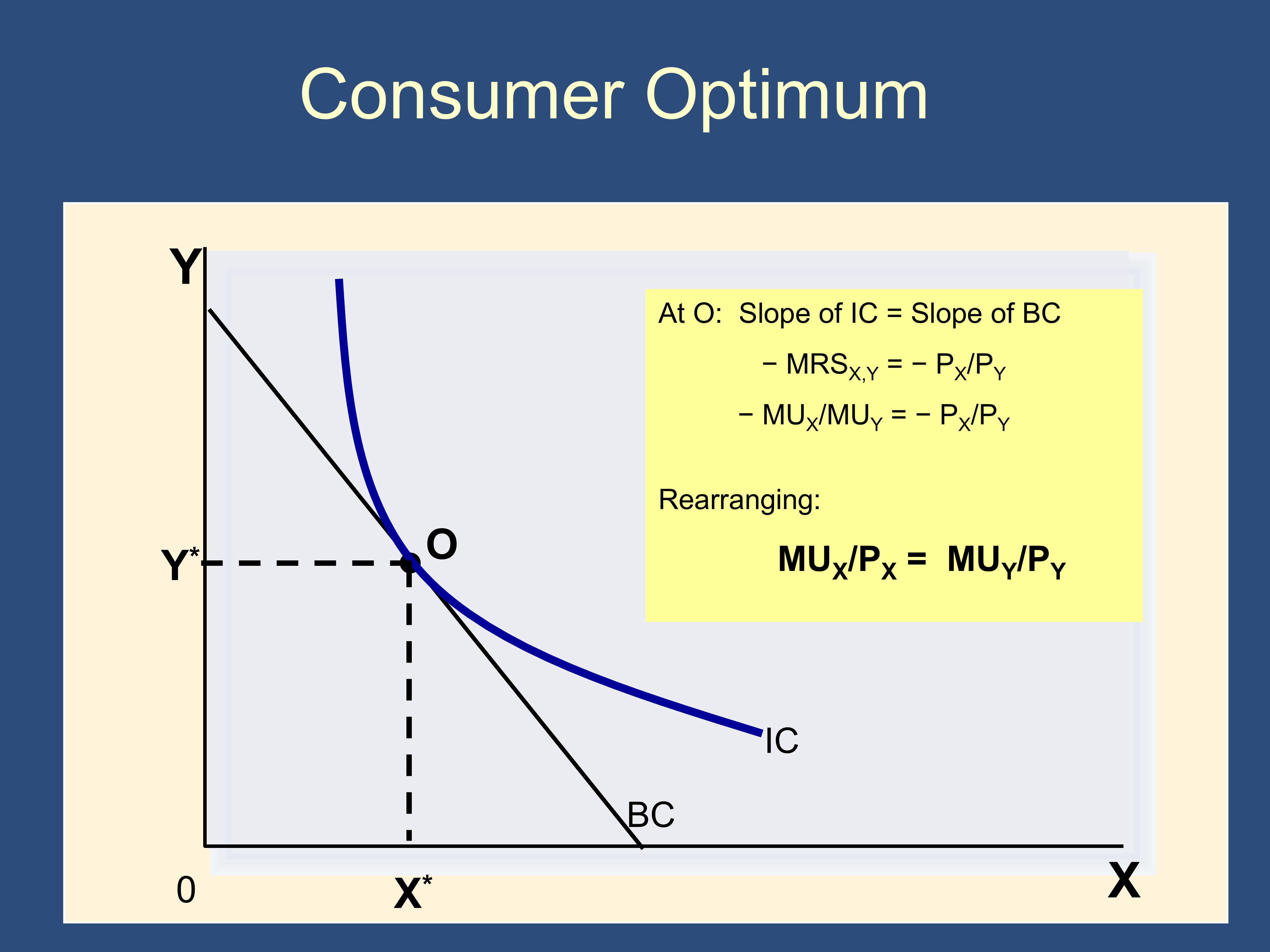
| First Condition for a Consumer Optimum: a) Your optimal consumption bundle (X*,Y*) should be on the Budget Constraint. In other words, you must use all of your money. Alternate Version: b) |
| Second Condition for a Consumer Optimum: a) Slope of IC = Slope of BC b) ("Bang for the buck" formulation) This ensures that you spend your money on the things that bring you the most utility per dollar. Alternate versions: c) d) Ratio of MUs: |
Deriving the Demand Curve
Section titled “Deriving the Demand Curve”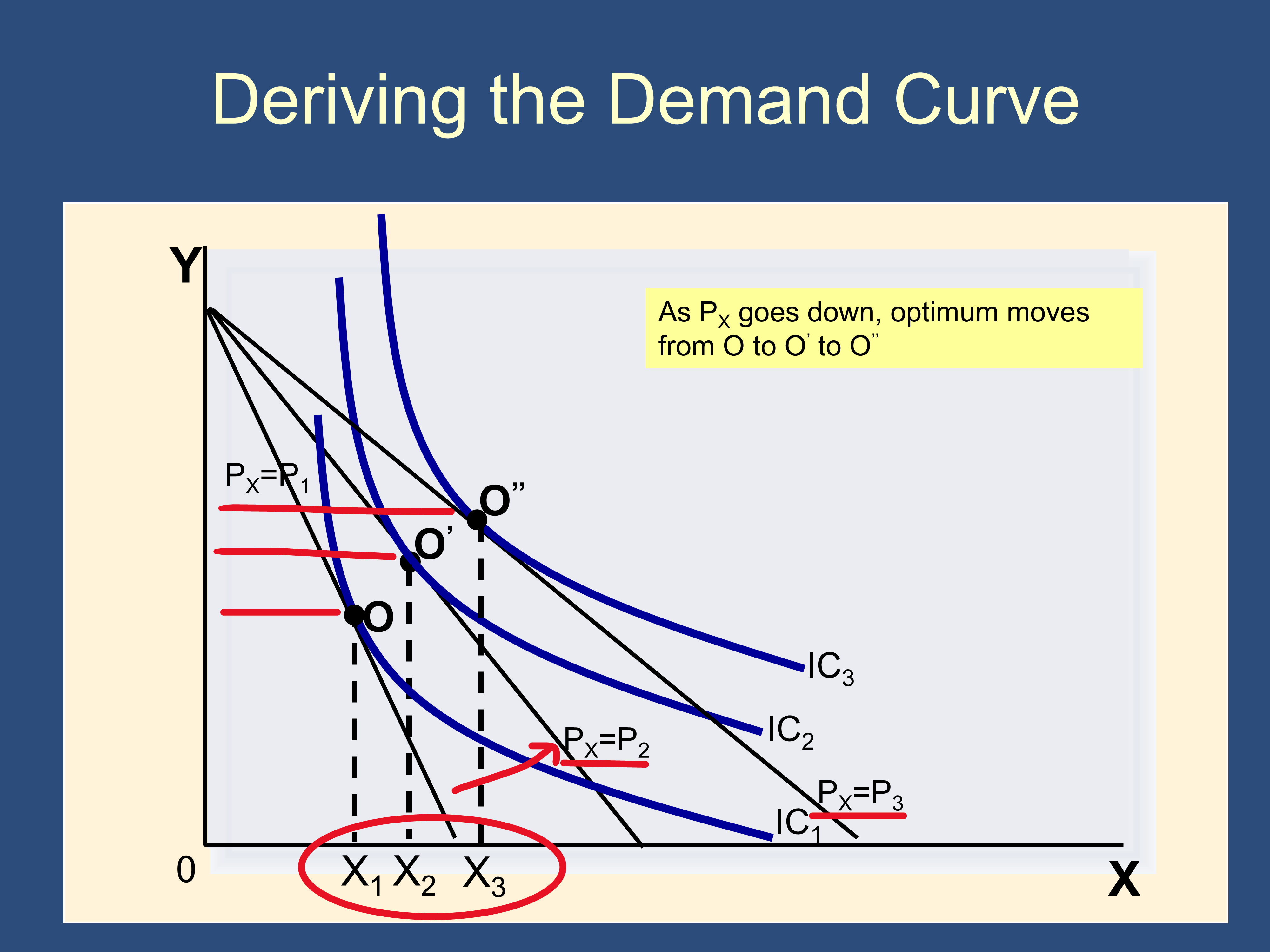
Plots different BCs with different Prices.
Identifies the optimal quantity demanded.
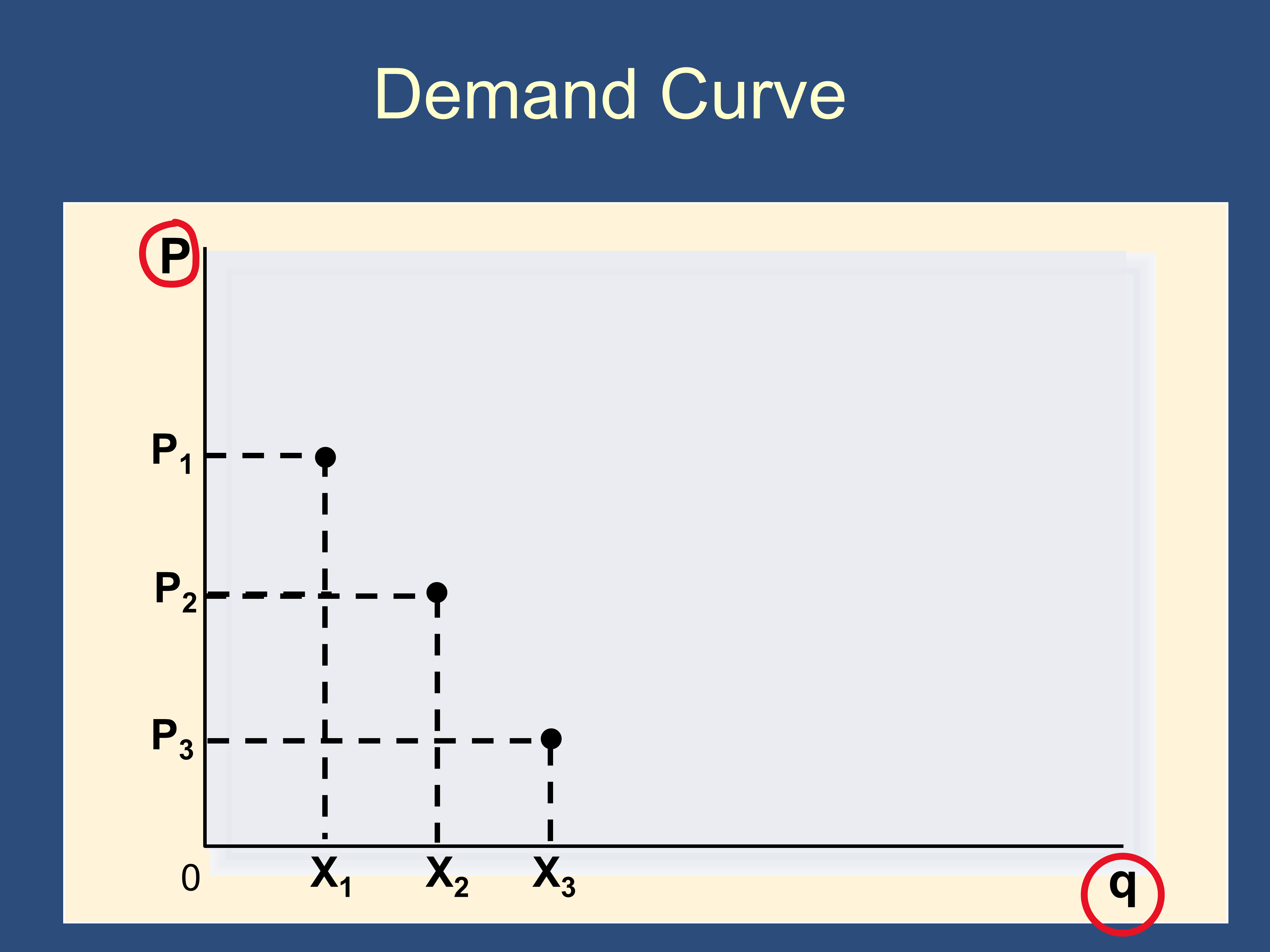
Plot the Prices and the Quantities.
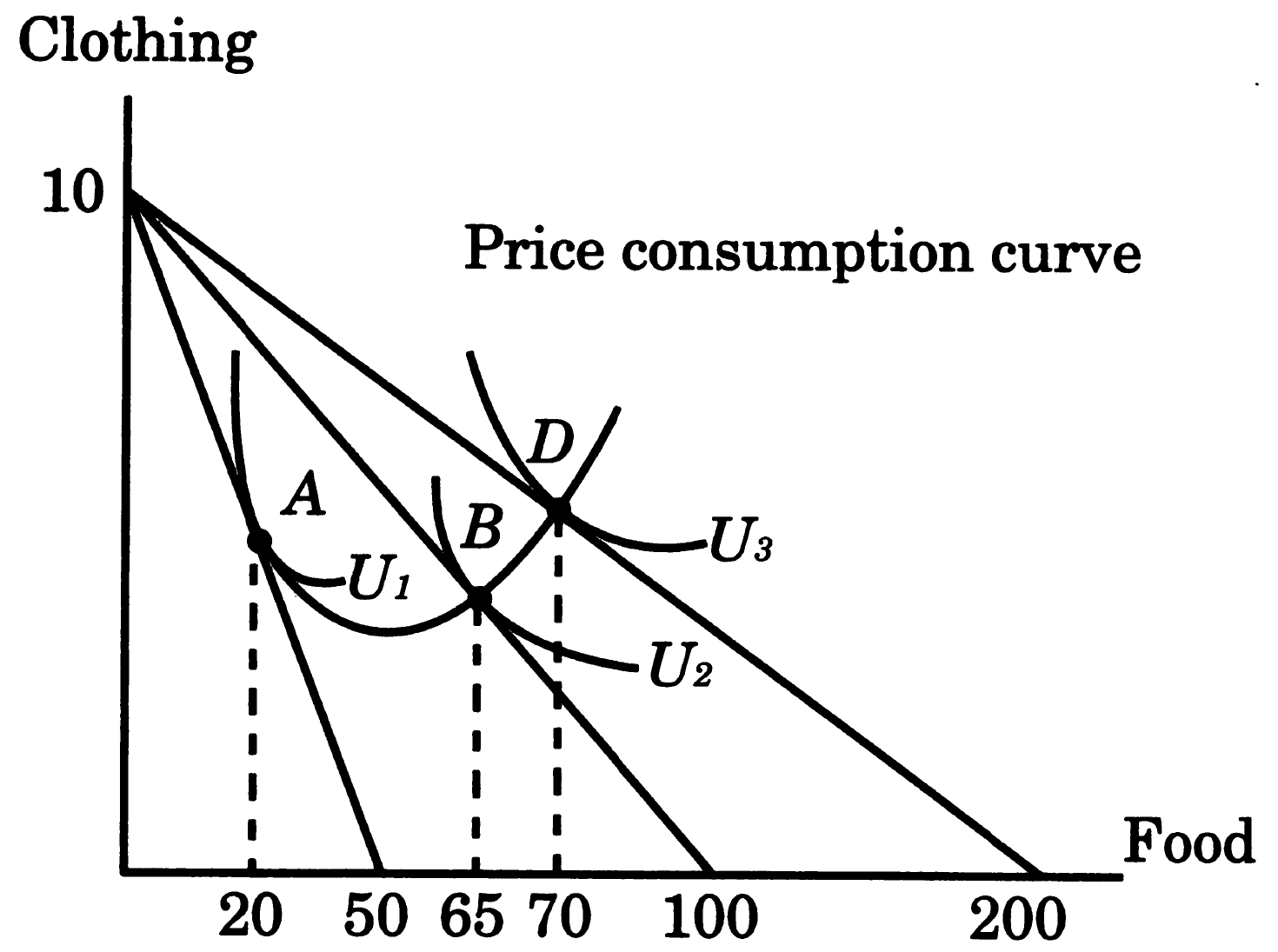
✏️ Assume you have a budget of $100. Using the diagram below, fill in the demand schedule.
✔ Click here to view answer
We have three optimal consumption bundles at points A, B, and D. The dotted lines originating at those points allow us to see the quantity of food demanded.
To figure out the prices, we have to use what we know about the end point of the budget constraint. For example, the leftmost budget constraint ends at 50 Food (and 0 Clothing). With this bundle, we know that the maximum amount of food that a person can purchase is 50 units. If their budget is $100 and the most food they can purchase is 50 units, then the price of food must be $2 per unit. Therefore, we conclude that when the price of food is $2 per unit, we use the leftmost budget constraint, our optimal consumption bundle is bundle A, and we consume 20 units of food.
Likewise, in the rightmost budget constraint, the person can consume up to 200 units of food. If your budget is $100, then the price of food must be 50 cents per unit. Thus, when the price of food is 50 cents per unit, you consume bundle/basket D, which includes 70 units of food.
In general, you can figure out the price of each good if you know the budget and the two endpoints of the budget constraint. Just use the formulas on the following slide:
Demand schedule for Food:
| Price | QD |
|---|---|
| $0.50 | 70 |
| $1.00 | 65 |
| $2.00 | 20 |
✅
Substitution Effect
Section titled “Substitution Effect”Recipe:
Section titled “Recipe:”- When one price changes, suddenly one good becomes relatively more expensive and the other becomes relatively cheaper. Did this good get relatively more expensive or relatively cheaper?
- For the good that is cheaper, you will substitute (buy) more, so put a ↑. For the good that is more expensive, you will substitute (i.e. buy) less, so put a ↓.
THAT’S IT.
One arrow goes up and one goes down because one good is relatively cheaper and the other good is relatively more expensive.
✏️ You can think of the substitution effect as the “Deal-Hunter’s effect.” For example, suppose that Dell Computer lowered the price of their laptops. What would be the effect of the substitution Effect on both Dell Computers and HP Computers?
✔ Click here to view answer
What do you think the deal hunters will do when Dell cuts its prices?
- PD↓ SE: 1.) Dell computers became relatively Cheaper. 2.) People buy more Dell Computers
- PD↓ SE: 2.) HP computer became relatively more expensive. 2.) People buy fewer HP Computers
Note that the price of HP computers never changed at all. However, in comparison to Dell computers, they became more relatively expensive, because Dell lowered their prices. ✅
✏️ Suppose that Dell Computer raised the price of their laptops. What would be the effect of the substitution Effect on both Dell Computers and HP Computers?
✔ Click here to view answer
- PD↑ SE: People buy fewer Dell Computers
- PD↑ SE: People buy more HP Computers
| PDell ↑ | Dell Laptops | HP Laptops |
|---|---|---|
| Substitution Effect | ↓ | ↑ |
✅
Income Effect
Section titled “Income Effect”- Assuming you purchase both goods, when one price changes, either
a. you become effectively poorer (your purchasing power falls because a price rose)
b. you become effectively richer (your purchasing power rises because a price fell)
Decide which. (Hint: If P↓, you are richer. If P↑, you are poorer.)
- If you are effectively richer, you will buy more of normal goods and less of inferior goods. The opposite is true if you are poorer. See the following table:
| Normal Goods | Inferior Goods | |
|---|---|---|
| Richer | ↑ | ↓ |
| Poorer | ↓ | ↑ |
✏️ Suppose that the price of gas rises. What does the income effect say about spending on gas and streaming. Assume that both gas and streaming services are normal goods.
✔ Click here to view answer
When the price of gas rises, people feel poorer, because their “purchasing power” falls. We assume they purchase gas and it takes a larger bite out of their budget. Because both gas and streaming are normal goods, when purchasing power drops, we buy less of both goods.
| PGas ↑ | Gas | Premium Streaming Video |
|---|---|---|
| Income Effect | ↓ | ↓ |
With gas and pay per view, only gas price rose but BOTH ended with less demand. This is because this is NOT an example of substitution?
Advice: you won’t have time to review the notes, so understand the ideas behind the rules and you will remember them.
Combined Effect:
- CE=IE + SE. You just add them up.
- ↓ + ↓ = ↓
- ↑ + ↑ = ↑
- If the two effects go in different directions, then “the stronger one wins”
- For example, suppose IE↑ and SE↓. If IE↑>SE↓, CE↑. If IE↑<SE↓, CE↓.
| If both goods are normal | If one good is inferior |
|---|---|
 | 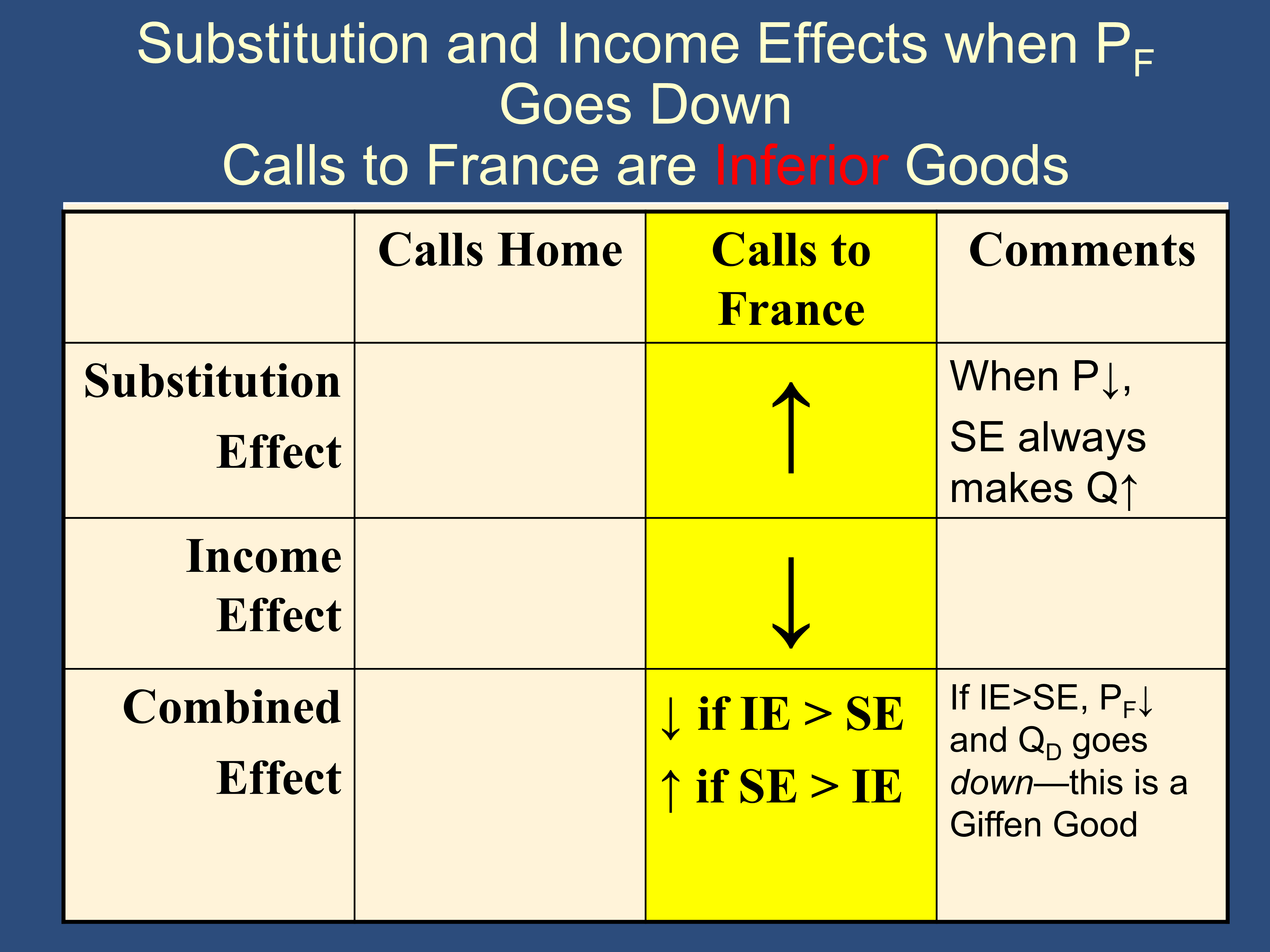 |
(it’s impossible for both goods to be inferior if there are only two goods) ✅
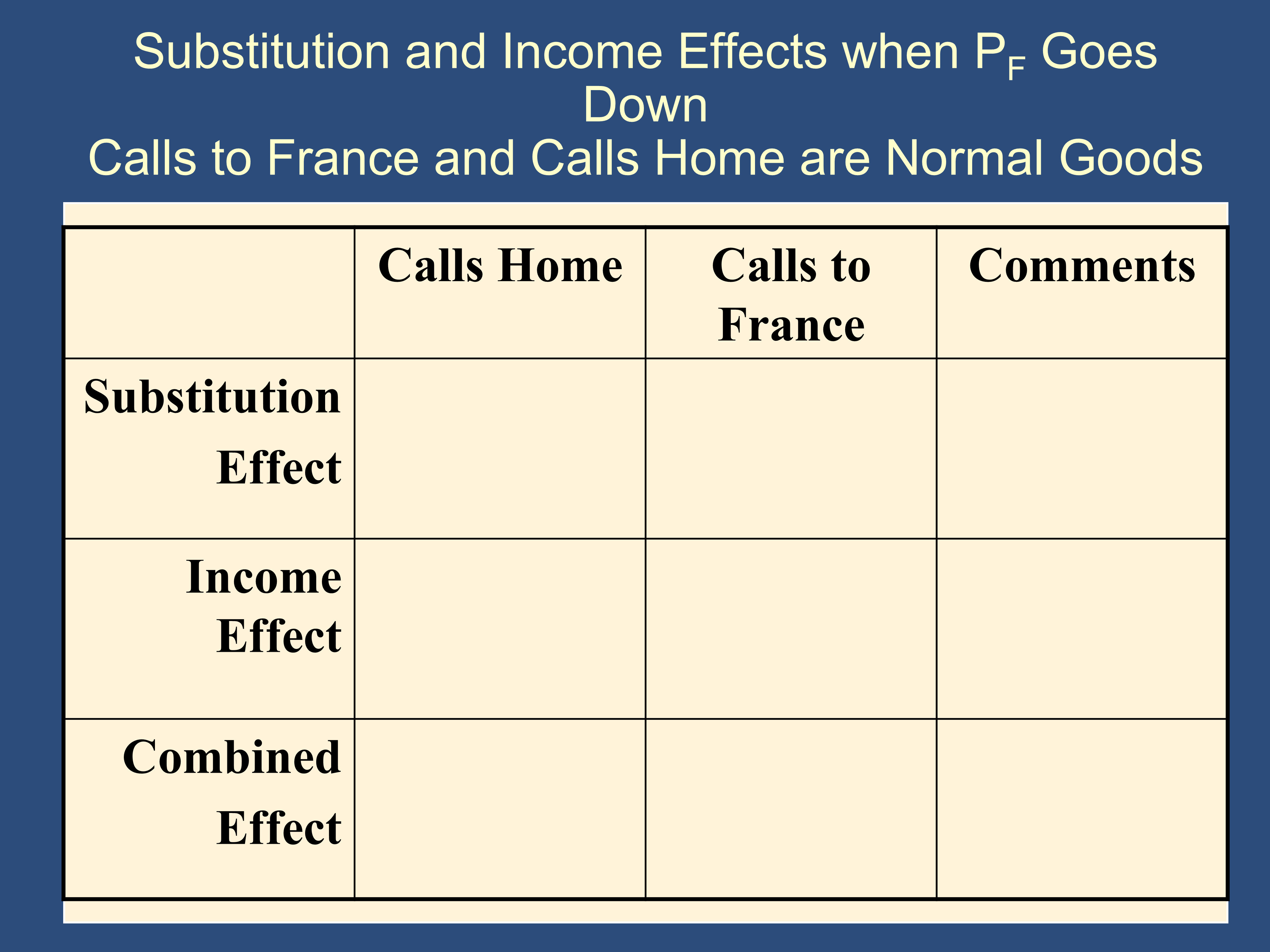
✏️ Fill in the following table:
✔ Click here to view answer
✅
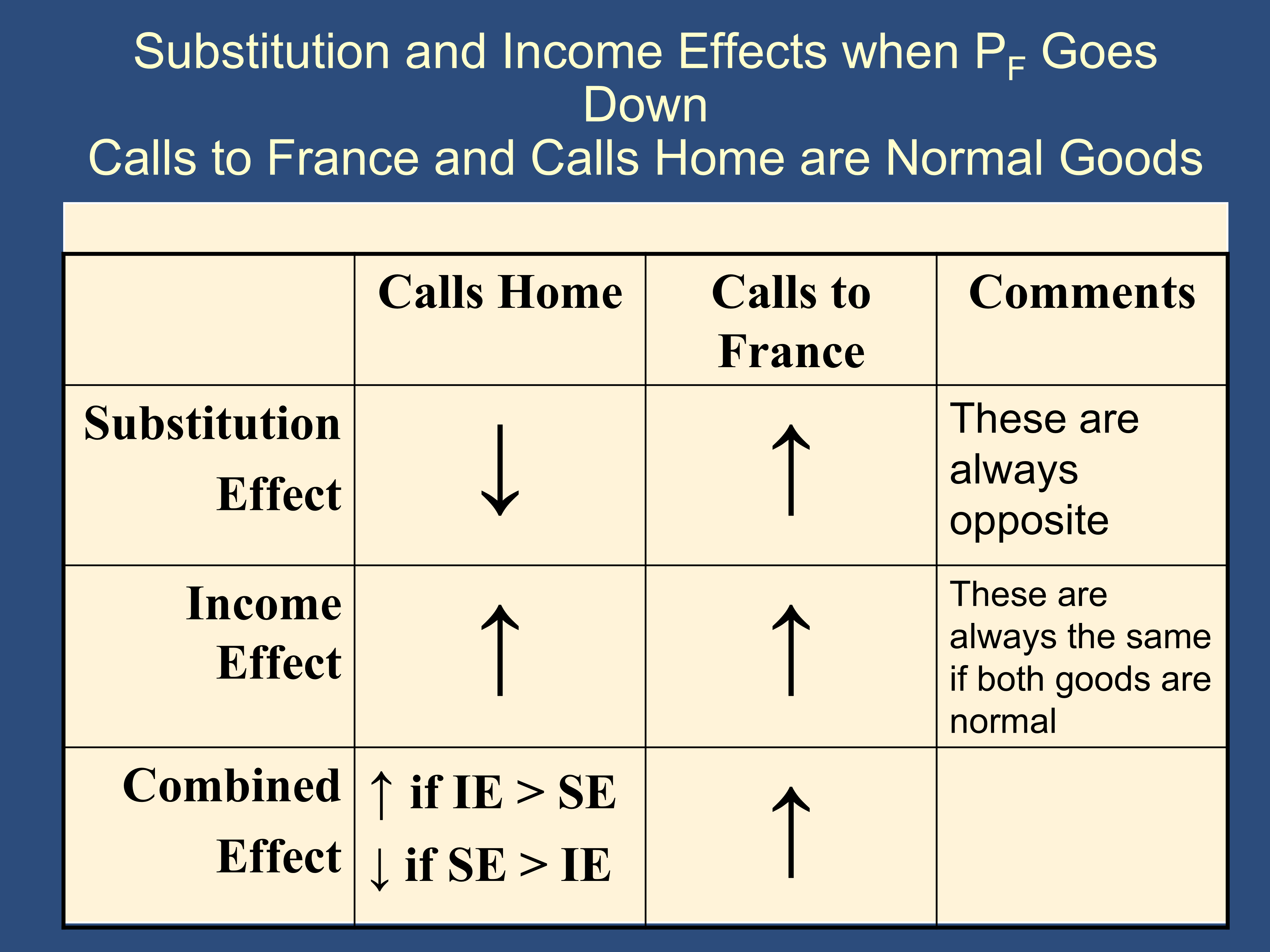
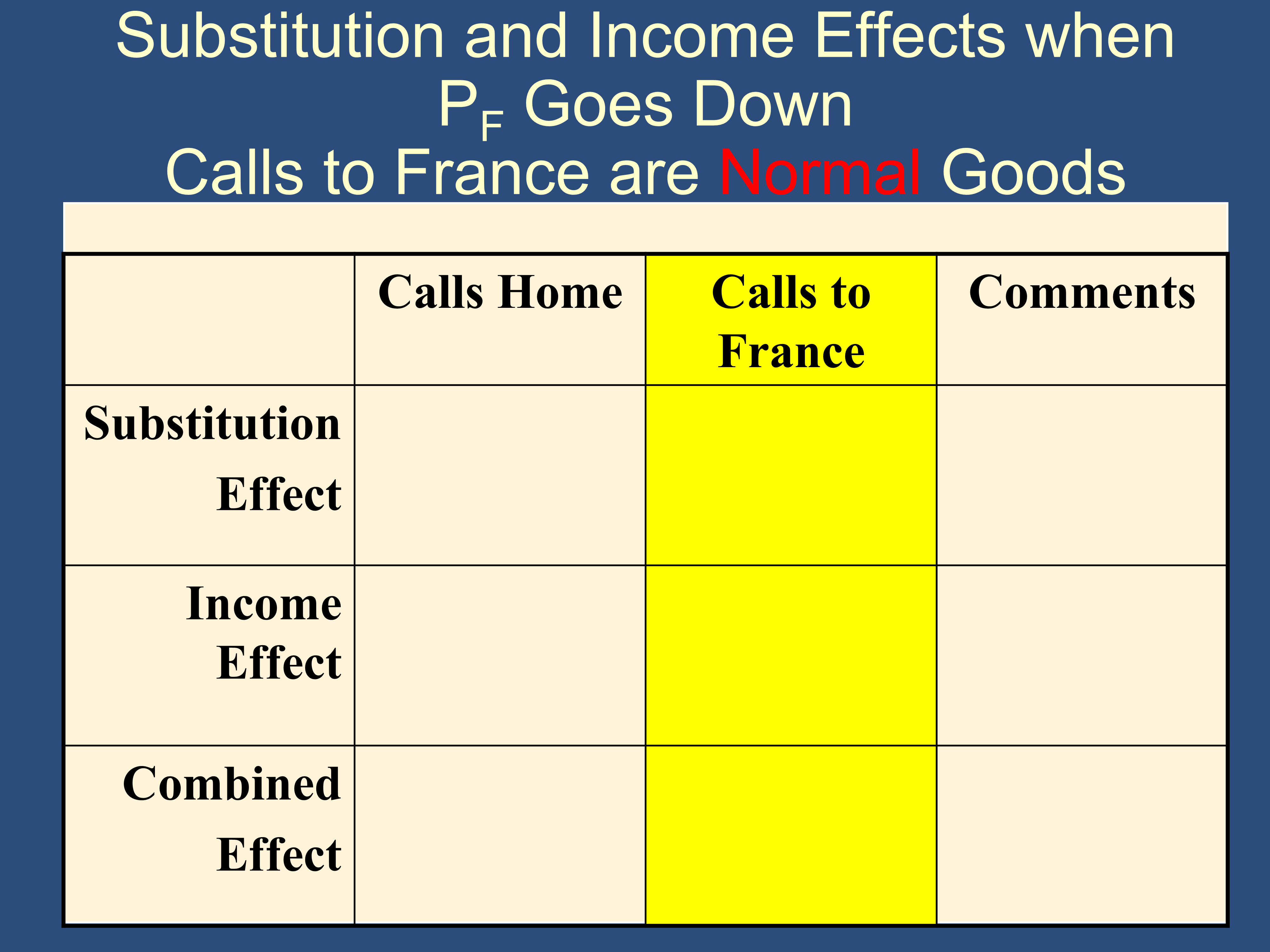
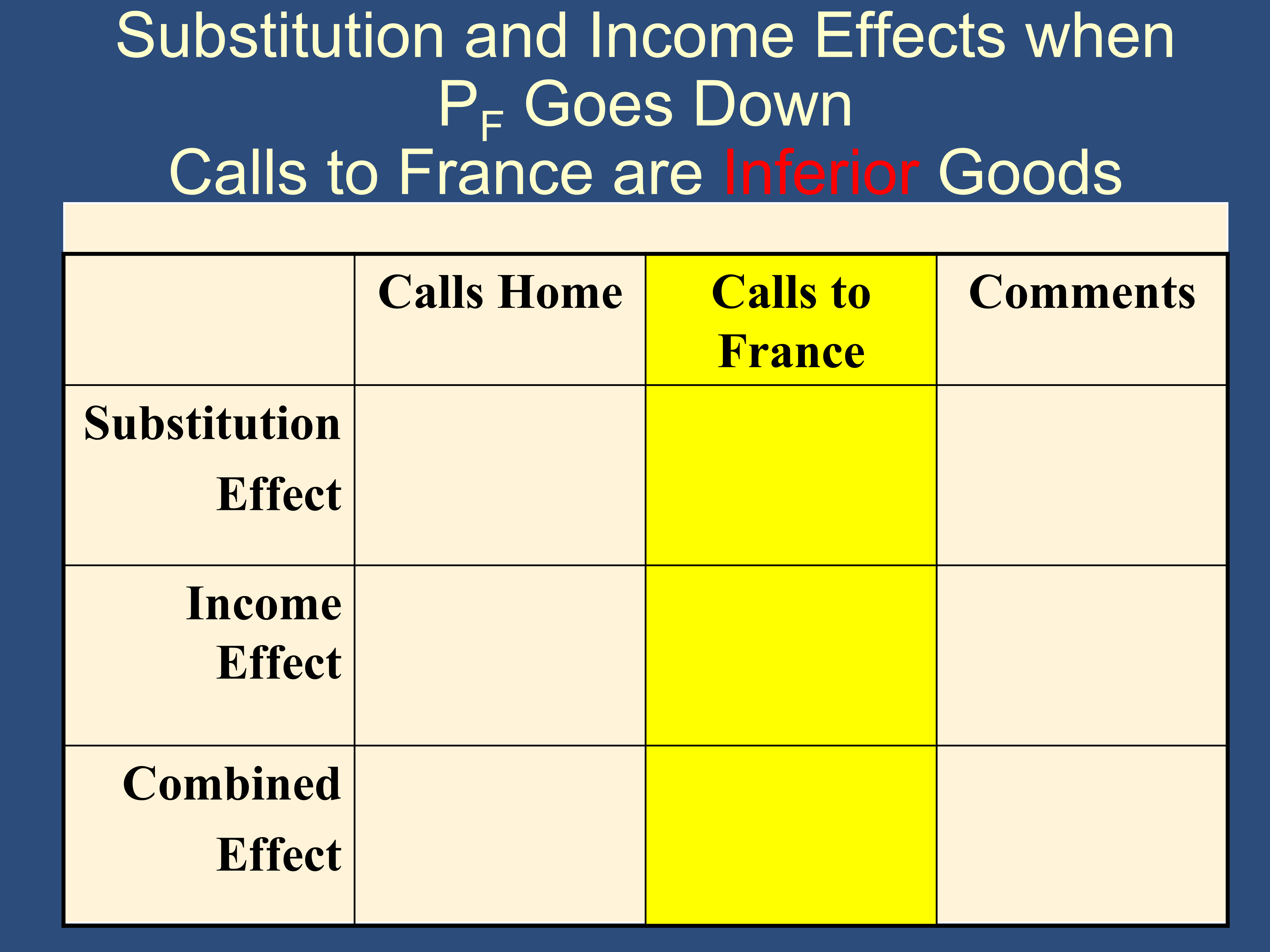
✏️ Fill both columns in the tables on the slides. Assume that calls Home are a normal good.
✔ Click here to view answer
Calls to France are Normal Goods and PF Goes Down. (Assuming Calls Home are Normal.)
| Calls Home | Calls to France | |
|---|---|---|
| Substitution Effect | ↓ | ↑ |
| Income Effect | ↑ | ↑ |
| Combined Effect | If SE>IE ↓ If SE<IE ↑ | ↑ |
Calls to France are Inferior Goods and PF Goes Down. (Assuming Calls Home are Normal.)
| Calls Home | Calls to France | |
|---|---|---|
| Substitution Effect | ↓ | ↑ |
| Income Effect | ↑ | ↓ |
| Combined Effect | If SE>IE ↓ If SE<IE ↑ | If SE>IE ↑ If SE<IE ↓ |
✅
Giffen Goods
Section titled “Giffen Goods”Normally, the demand curve slopes downward, because generally one of the two will be true:
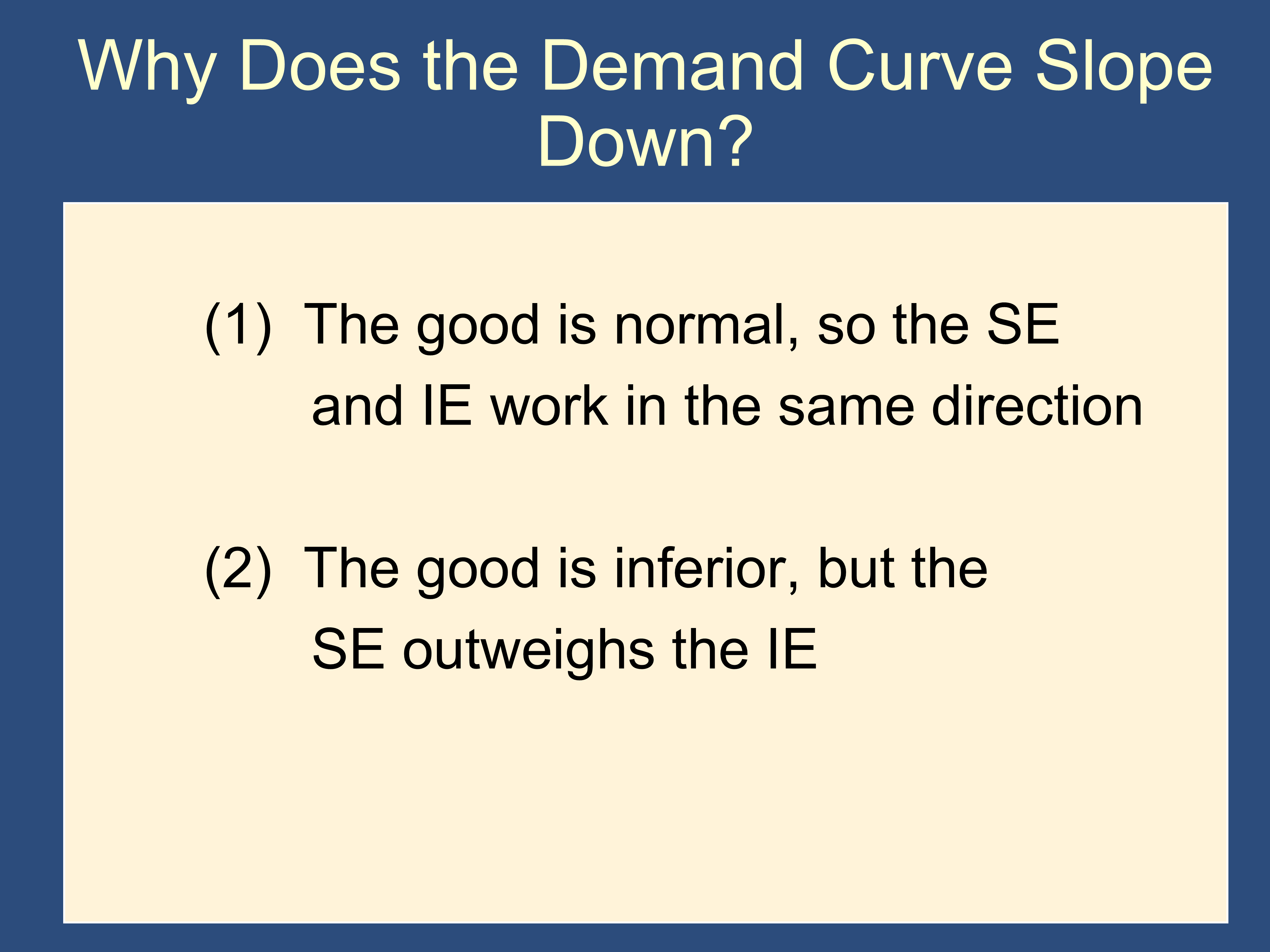
Giffen good = demand curve slopes upward
For a good to be Giffen, it must be a “super inferior good”:
- (1) It must be an inferior good: and
- (2) It is so inferior that Income Effect must outweigh SE
Note: All Giffen Goods are Inferior Goods BUT Not All Inferior Goods are Giffen Goods
So with Giffen, P↑ of the inferior goods, more quantity demanded
Substitution Effect:
- The price of the Giffen good rose, so the Giffen good is relatively more expensive, compared to before.
- SE: Buy less. SE↓
Income Effect: (Inferior)
- Poorer/less purchasing power.
- IE: When you feel poorer, you buy more of Inferior goods. IE: ↑
Combined Effect: When the price of a Giffen Good rises, you buy more. CE↑
If IE↑ and SE↓, then for the CE↑, it must be that IE↑>SE↓
🙋 What is the story behind a Giffen Good?
See answer
✔ Imagine it is 1848 in Ireland and there is a lot of poverty and subsistence farming. People get 70% of their calories from potatoes, and they’d rather have some meat and fresh vegetables.
Potatoes will be an inferior good.
If the price of potatoes rises,
SE: ↓
IE: you will feel poorer; your purchasing power will have declined significantly. Because potatoes are an inferior good, people will have to buy more potatoes. ↑ ✅
Feedback? Email munger.e1010@gmail.com 📧. Be sure to mention the page you are responding to.