✏ Determine TC when given MC and FC
✏️ Of the following two TC functions, you can solve the MC of one of them but not the other. Which one can you find the MC of? What is the MC?
✔ Click here to view answer
✔ We can only find the MC of the second one. You can not find the MC of the first one. Bruce knows this and would never ask you.
| q | TC | |
|---|---|---|
| 0 | 15 | |
| 1 | 22 | 7 |
| 2 | 29 | 7 |
| 3 | 36 | 7 |
| 4 | 43 | 7 |
With a TC like this, know that it is special and that you can immediately analyze it. ✅
✏️
What is FC, AFC, VC, AVC, MC?
✔ Click here to view answer
✔
MC = 32 ← the focus of this page.
With a linear functional form .
There is a lot of intuition behind this. Imagine you are the entrepreneur. The picture is that you pay 150,000 to get started, and every time you produce a new widget, it costs $32 (). Therefore, every widget costs you $32 (ie ).
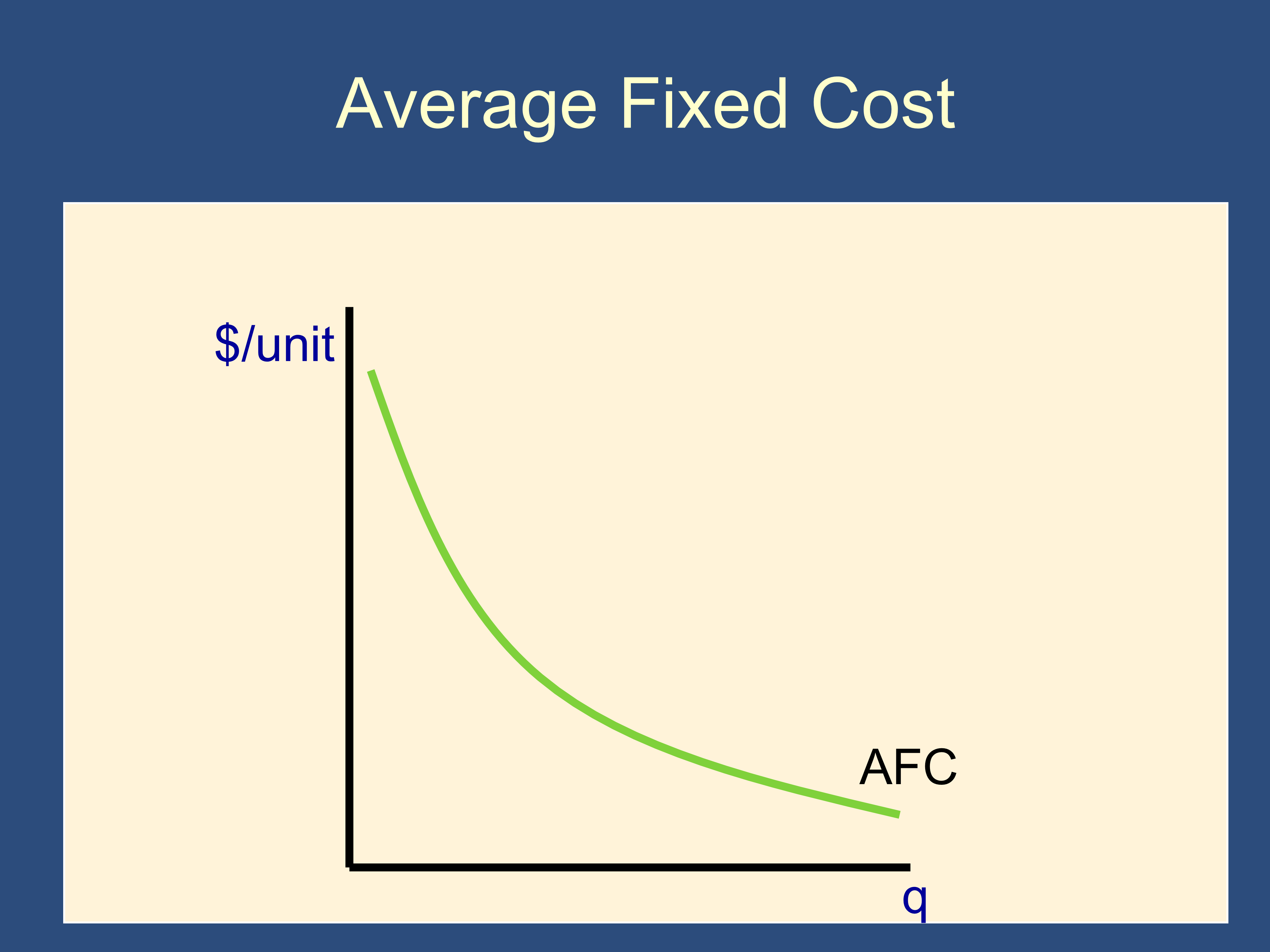
Let’s examine AFC.
| q | 1 | 2 | 3 | 4 | 5 | 10 | 100 | 10,000 | 1,000,000 |
|---|---|---|---|---|---|---|---|---|---|
| AFC | 150,000 | 75,000 | 50,000 | 37,500 | 30,000 | 15,000 | 1,500 | 15 | .15 |
Clearly, it is good to sell these things at scale, because you can spread your FC across millions of units.
Takeaway: FC always declines as q increases. Bruce demonstrates this on the following slide:
✅
✏️Suppose for a given product and given firm, marginal cost is always $2 and Fixed cost is always $20,000. What is the Total Cost function?
✔ Click here to view answer
✔ TC = ______←variable + ______←fixed.
This will apply broadly.
Feedback? Email munger.e1010@gmail.com 📧. Be sure to mention the page you are responding to.