🔎 Why are signals more costly for the low-quality producer?
🙋 Can you explain why a signal will be more costly for a low producer than a high one? Wouldn’t a college education cost the same for both?
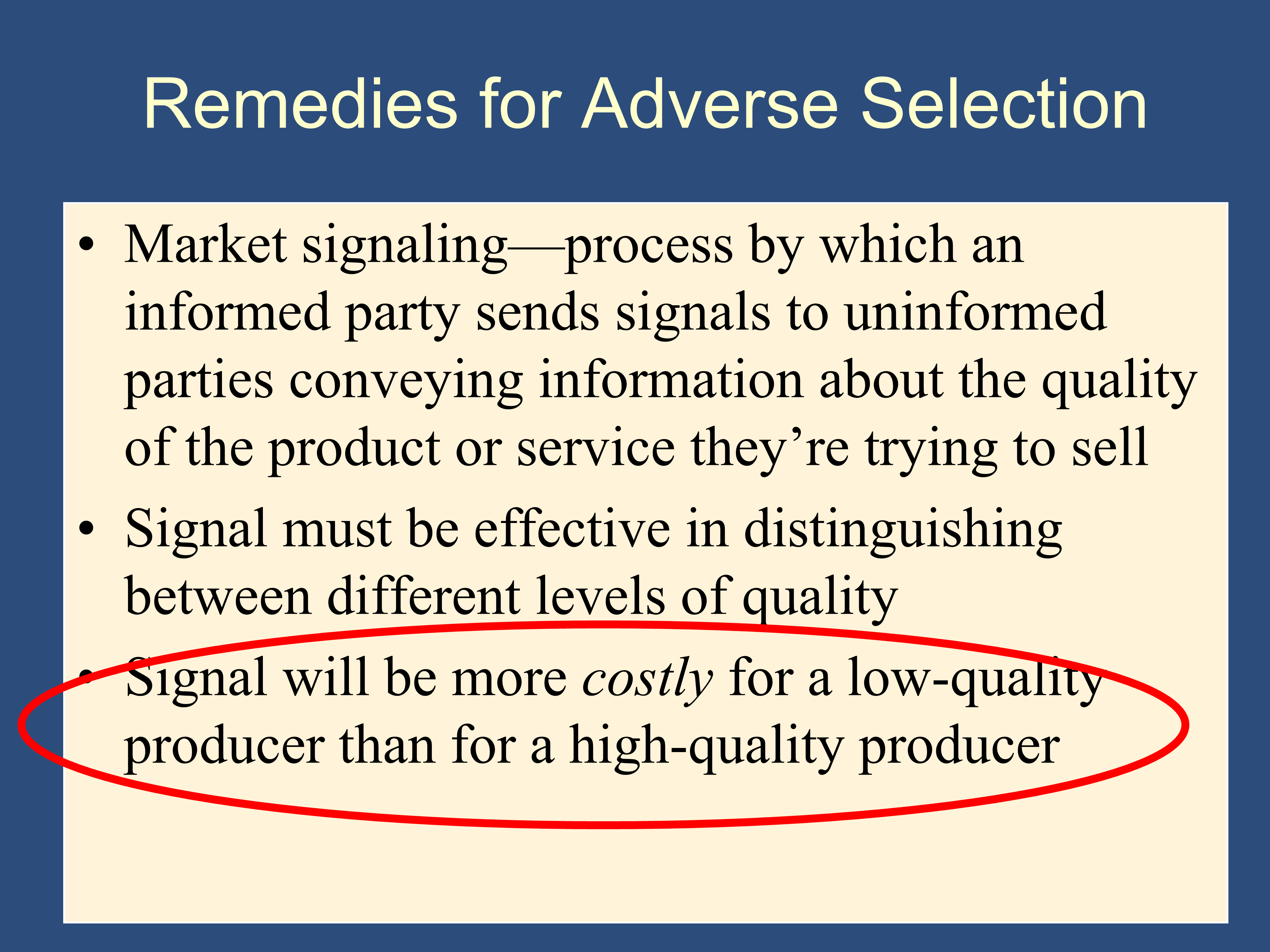
✔ This is a very important question. Let’s assume that, on average, a college education is harder to complete for workers with lower productivity (higher costs to send the signal). Such workers will have to invest more time and effort. Given that their costs are higher, a low productivity worker is less likely to attempt to complete a degree. This makes the presence of the degree a potentially powerful symbol, because people who choose to get the degree are more likely to be high productivity.
Education as a Signal
Section titled “Education as a Signal”For example, suppose that there are only two types of workers: more productive and less productive. Suppose that the total cost of a degree is $350,000 for the less productive workers and $250,000 for the more productive workers. Suppose also that the total benefits from having a degree are $300,000. The job of the employer is to find the high productivity workers.
Consider the following three questions:
- Will any less productive workers opt to get the degree? [No, because - ie .]
- Will any more productive workers opt to get the degree? [Yes, all of them, because - ie .]
- If an employer sees a worker with a degree, what do they know about the worker? [They know with 100% certainty that the worker is of the productive type, because no unproductive workers attempt the degree.]
Note: we could also rephrase this in terms of benefits. We could say, instead, that the cost of a degree is $300,000 for both high and low productivity workers. A high productivity worker will get benefits of $350,000 from the degree because the degree will allow them to get the job and they will keep it for a long time. However, a low productivity worker will only get benefits of $250,000 from the degree, because they will get the job, and won’t be able to keep the job for very long. Alternatively, they may find the job too hard for them to maintain work/life balance.
This illustrates how the crucial part of any signal is that “Signal will be more costly for a low-quality producer than for a high-quality producer.” It is specifically because the signal is costlier ($350K) for the low-productivity worker that the low-productivity work decides to not get the degree. It is specifically because the signal is less costly ($250K) for the higher-productivity worker that the high-productivity work decides to get the degree.
This example highlights how important your question is and why differing costs are key to identifying what economists consider to be signals. We can apply this example to other signals as well.
Car Warranties as a Signal
Section titled “Car Warranties as a Signal”For example, suppose that there are only two types of cars: unreliable and reliable. For simplicity, also suppose that there is only one possible type of warranty that can be offered, so that all cars either have a warranty or don’t have a warranty, and all warranties are the same. Suppose that the total cost of providing a manufacturer’s warranty is $14,000 for the unreliable cars and $10,000 for the reliable cars. Suppose that offering warranty means that the manufacturer can raise the price by (ie a car that would sell for $40K without a warranty will sell for $52,000 with a warranty). In other words, imagine that the signaling and monetary value of a warranty is exactly $12,000 to the buyer.
Consider the following three questions:
- Will any manufacturers of the unreliable cars offer warranties? [No. . . Therefore, . No unreliable cars will have warranties.]
- Will any manufacturers of reliable cars offer warranties? [Yes. . . Therefore, . All reliable cars will have warranties.]
- If a consumer sees a car with a warranty, what is the probability that it is a reliable car? [The probability is 100%, because no manufacturers of unreliable cars will find it worthwhile to offer a warranty.]
Once again this illustrates how the crucial part of any signal is that “Signal will be more costly for a low-quality producer than for a high-quality producer.” It is specifically because the signal is costlier ($14K) for the unreliable car that for the reliable car that the manufacturers will only supply a warranty with a reliable car. The manufacturers of the unreliable cars will decide to not offer a warranty. By doing so, they will be showing their cards to the consumer. As a result, the consumer will become informed and information will no longer be asymmetric. We have destroyed the information asymmetry.
Obviously, the assumption that there is only one type of warranty, is what we call in micro-theory, a “heroic assumption” (as in, it takes a heroic suspension of disbelief to believe the assumption). However, many, many micro-theorists have written many papers about signaling, and a key element is that the net cost of the signal leads the low-quality types to not attempt to send the signal. A signal comes down to a choice by the lower quality type, not to send the signal.
Signals Don’t Work if Costs are Identical
Section titled “Signals Don’t Work if Costs are Identical”Let’s reconsider the education example. Suppose now that the cost of an education is $250,000 for all employees, whether they are high productivity or low productivity. However, jobs with a college education still earn $350,000 more than jobs that don’t require that education.
Consider the following three questions:
- Will any less productive workers opt to get the degree? [. . Yes, all of them, because .]
- Will any more productive workers opt to get the degree? [. . Yes, all of them, because .]
- If an employer sees a worker with a degree, what do they know about the worker? [An education no longer contains any information about the quality of the worker, because all workers get educations.]
In a situation like this, the total benefits of getting an education would likely drop significantly, because a major component of the value of an education is in the signal it provides. Perhaps, the value might even drop below $250,000, in which case, the educational system may collapse.
All of this provides an important reason why you, as potential future graduates of the extension school, may find that it is in your interest to confirm that the extension school maintains its academic standards. Doing this will help preserve the signaling value of your degree.
Economists see this type of self-interest at work in various professional credentialing organizations. For example, MDs and lawyers have very strong incentives to keep entrance standards high in their professions. Because there is no central organization that owns the credential of a Master’s degree, any given educational institution may have incentives to make it easier and easier to get a Master’s degree. Essentially, the dynamic here is what is referred to as a “tragedy of the commons”. However, you’ll have to take another economics course to find out what that is.
Key components of signaling
Section titled “Key components of signaling”You can think of a signal as having five components.
- There are two types of informed agents: good and bad. There is also an uninformed party.
- There must be adverse selection: the uninformed party keeps on getting matched up with the “bad” type of agent.
- The signal must be more expensive for the “bad” type than for the “good” type.
- As a result, only the good type will choose to send the signal.
- Because only the good type sends the signal, the uninformed party will know that if someone chooses to send the signal, then they must be the good type. As a result, the uninformed party is no longer uninformed, and there is no longer any asymmetric information or adverse selection. Because the formerly uninformed party can use the signal to figure out who is good and who is bad, they can decide to only match up with the “good” type of agents. (ie if only the smart people get college degrees, employers can only hire people with college degrees and they don’t have to worry about hiring low-productivity workers.)
Feedback? Email munger.e1010@gmail.com 📧. Be sure to mention the page you are responding to.