🔎 Cost of Insurance Policies
The cost of providing an insurance policy is just the expected value of the payouts on the policy.
For example, suppose Torbjorn has a 10% chance of getting sick and needing $1000 of medical care. The cost of providing insurance to Torbjorn is the expected value of the payouts to him for his medical care.
For the insurance company, the payouts they must make to Torbjorn are like a lottery ticket.
| P | Outcomes | Outcomes, including premium |
|---|---|---|
| 10% | -$1000 | premium - $1000 |
| 90% | $0 | premium |
EVpayouts = 10% × $1000 + 90% × $0 = $100.00
An insurance company will also be interested in what I will call it’s base profit = premium - costs of insurance EVbase profit = 10% × (premium-$1000) + 90% × (premium)
An insurance company that deals with Torbjorn and many other customers can think of the direct costs of providing insurance to him as being $100.
If you provided insurance to 1M people, your payouts could be anything between 1M × $0=$0 and 1M × $1,000=$1B. But because you deal with so many other customers, the “law of averages” will kick in and your losses will be close to $100 × 1M=$100M.
Therefore, you can think of each customer as having an “expected payout” of $100. Think of this similarly to how you would think of costs for a manufacturer. A phone may “cost” $120 to produce, but be sold for more than that. A customer “costs” $100 on average to insure plus any administrative costs.
As long as you charge Torbjorn more than $100 (plus some additional premium to cover administrative costs), then you can stay in business.
The above example is for medical insurance, but we can also do disability insurance.
✏️ Suppose that Torbjorn makes $100K, but in his profession, he has a 5% chance of getting a disability which will cause his income to drop to $10K. How much must it cost to provide insurance to him that guarantees an income of $100K.
✔ Click here to view answer
✔ If Torbjorn is healthy, the insurance company doesn’t need to supplement his income.
If Torbjorn requires the payout, the insurance company will need to lift his income from $10K to $100K. This requires a payout of $90,000.
Insurance Company’s Ticket:
| Payout | Prob |
|---|---|
| $0 | 95% |
| $90K | 5% |
Expected Value of the Payout from the Insurance Company to Torbjorn:
“Expected Payout” = 95% × $0 + 5% × $90,000 = $4,500.00
means that an insurance company will think of a customer like Torbjorn as costing $4500 “on average.” ✅
✏️ what about the premium?
✔ Click here to view answer
We don’t know anything about premium at this point - right now, we’re just talking about the cost to the insurer. ✅
✏️ Imagine a simple model in which Torbjorn pays a one-time premium, and then has a 5% chance of qualifying for the payout. Suppose the premium is $5200. What is the expected profit for the insurance company, assuming that administrative costs are $0.
✔ Click here to view answer
Expected profit = Revenue - Expected costs
= $5200 - $4500 = $700
Another way to approach this question is to calculate the “Expected Value of the Profit”
| Payout | Prob | (Base) Profit |
|---|---|---|
| $0 | 95% | $5200-$0 = $5200 |
| $90K | 5% | $5200-$90,000= -$84800.00 |
Expected Value of the Profit = 95% × $5200 + 5% × (-84800) = $700.00
If you have a million customers, your profit will be something around $700M. ✅
✏️ Now suppose that the administrative costs are $900. What is the expected profit from Torbjorn?
✔ Click here to view answer
$5200 - $4500 - $900 = ($200.00)
The insurance company can expect a $200 loss. It may exit the market or investigate other options. ✅
Visualizing Insurance Costs
Section titled “Visualizing Insurance Costs”✏️ Suppose that Torbjorn makes $100K, but in his profession, he has a 5% chance of getting a disability which will cause his income to drop to $10K. How much must it cost to provide insurance to him that guarantees an income of $100K.
✔ Click here to view answer
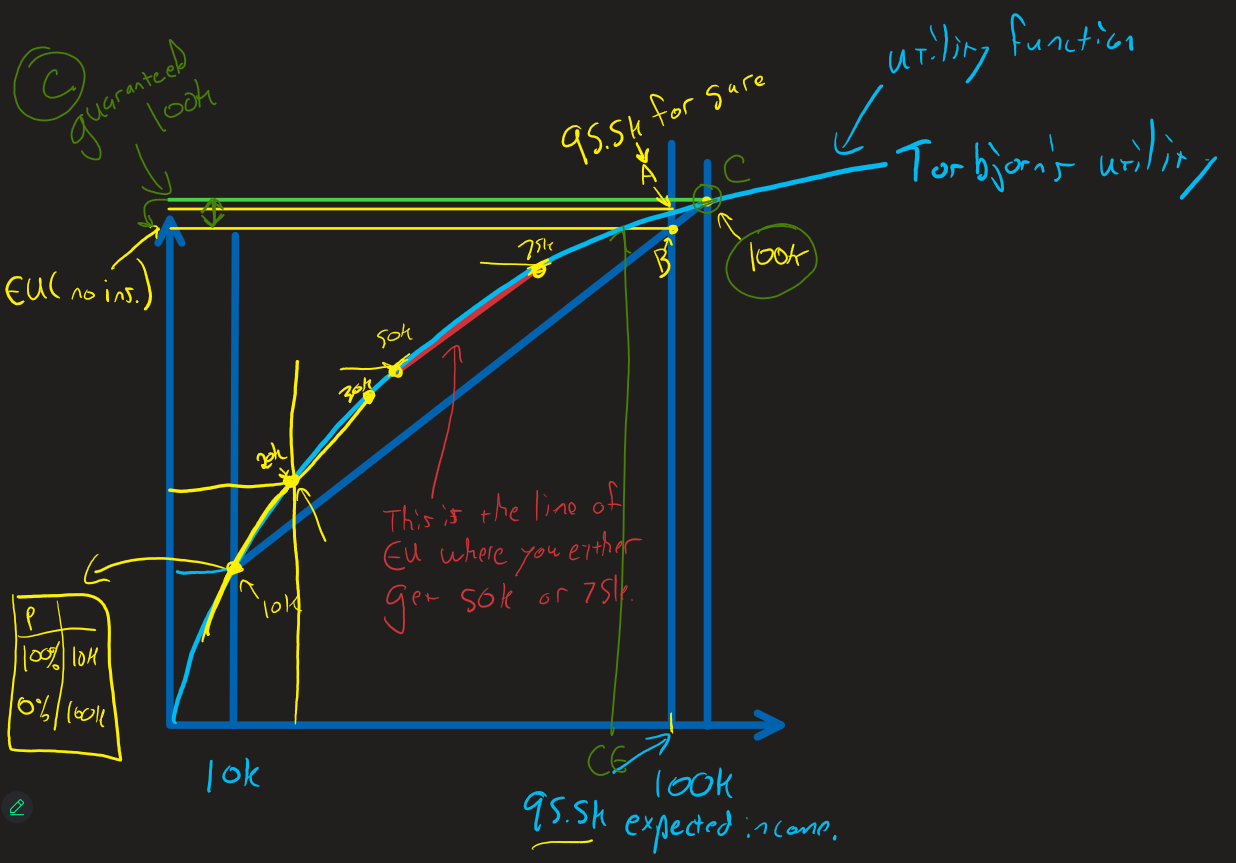
The curved line represents Utility when you know what you will receive. Point A is when he knows he will receive $95.5K.
The straight line represents EU from gambles where you either get 10K or 100K. Point B represents the EU of a 5% chance of 10K and a 95% chance of 100K.
EV of T’s income = 95% × 100,000 + 5% × $10,000 = $95,500.00
Torbjorn’s expected income is $95.5K
To compare point A and B above, we can return to the following text from yesterday:
Compare the curved line and the line of EU
- The curved line represents all of the “certain bets” where you know exactly what you will end up with.
- The straight line represents all bets where you get one of the two endpoints.
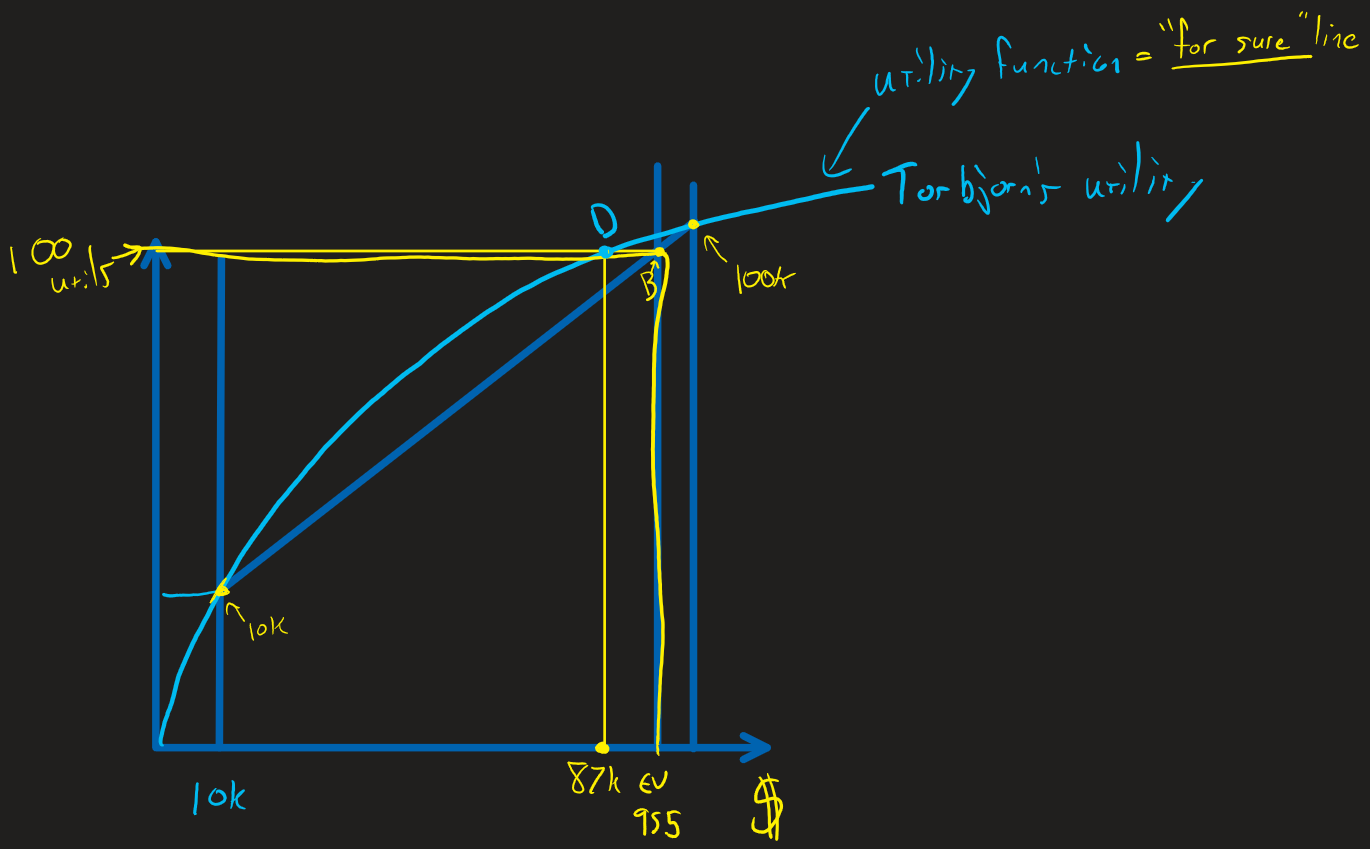
How does T compare
Point D: $87K for sure
vs.
Point B: no insurance (5%→$10K; 95%→$100K)
For both Point B and Point D, T gets 100 utils.
To calculate the exact point on the line of EU, you must calculate the EV and draw a line up.
Draw a line up to the line of EU to find the Expected Utility for facing this gamble. ✅
Feedback? Email munger.e1010@gmail.com 📧. Be sure to mention the page you are responding to.