👨🏫 Notes on E-1000 Lecture 6
Summary of Costs
Section titled “Summary of Costs”| Total | Fixed | Variable | Equation | |
|---|---|---|---|---|
| Total (all items) | TC | TFC=costs that do not vary with q | TVC=costs that do vary with q | TC = TFC + TVC |
| Average (per item) | AC = ATC = TC / q | AFC = TFC/q | AVC = TVC/q | AC = AFC + AVC |
| Marginal (additional item) | = 0 | =MC | MC = 0 + MVC |
Cost graphs
Section titled “Cost graphs”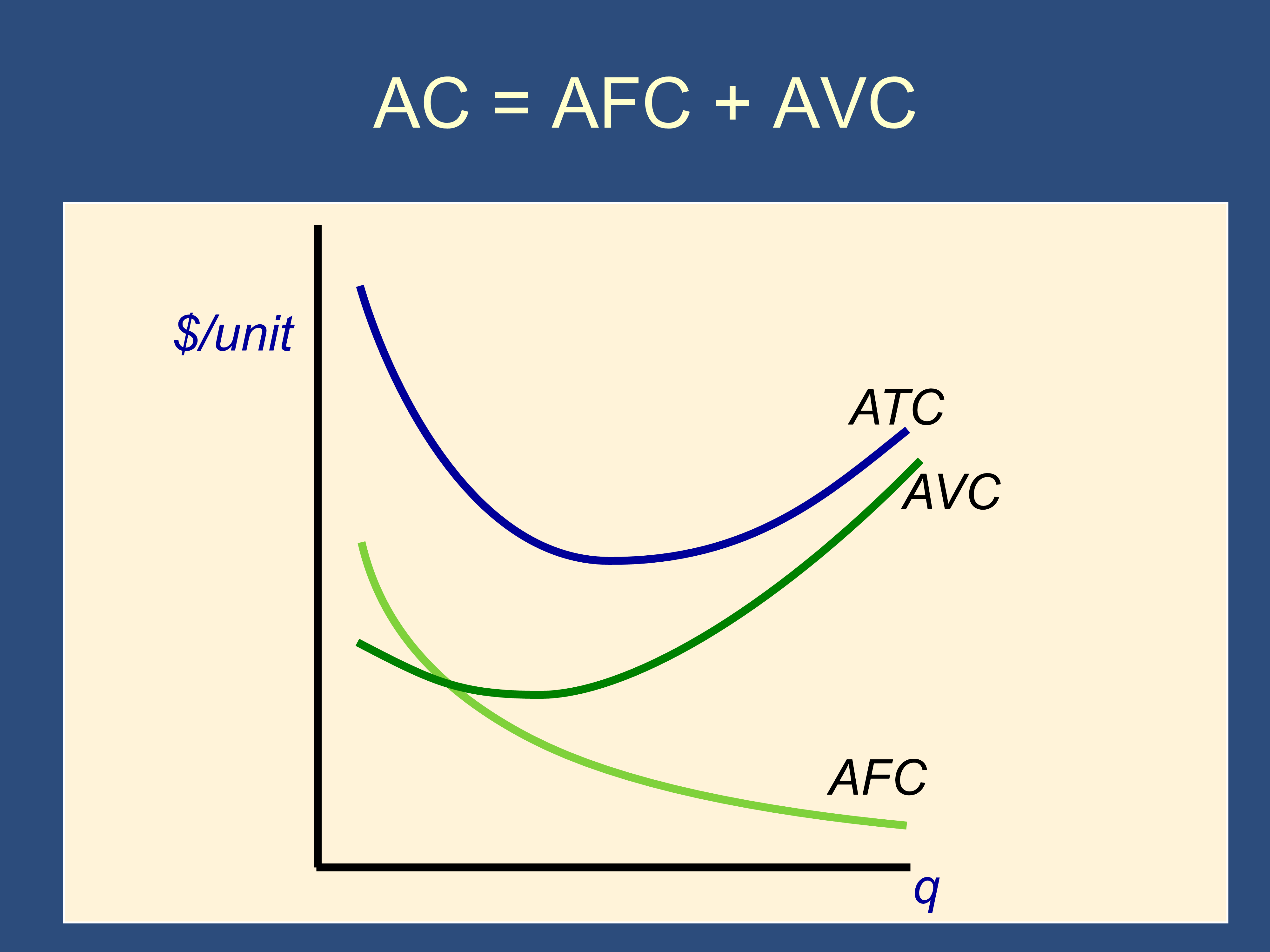
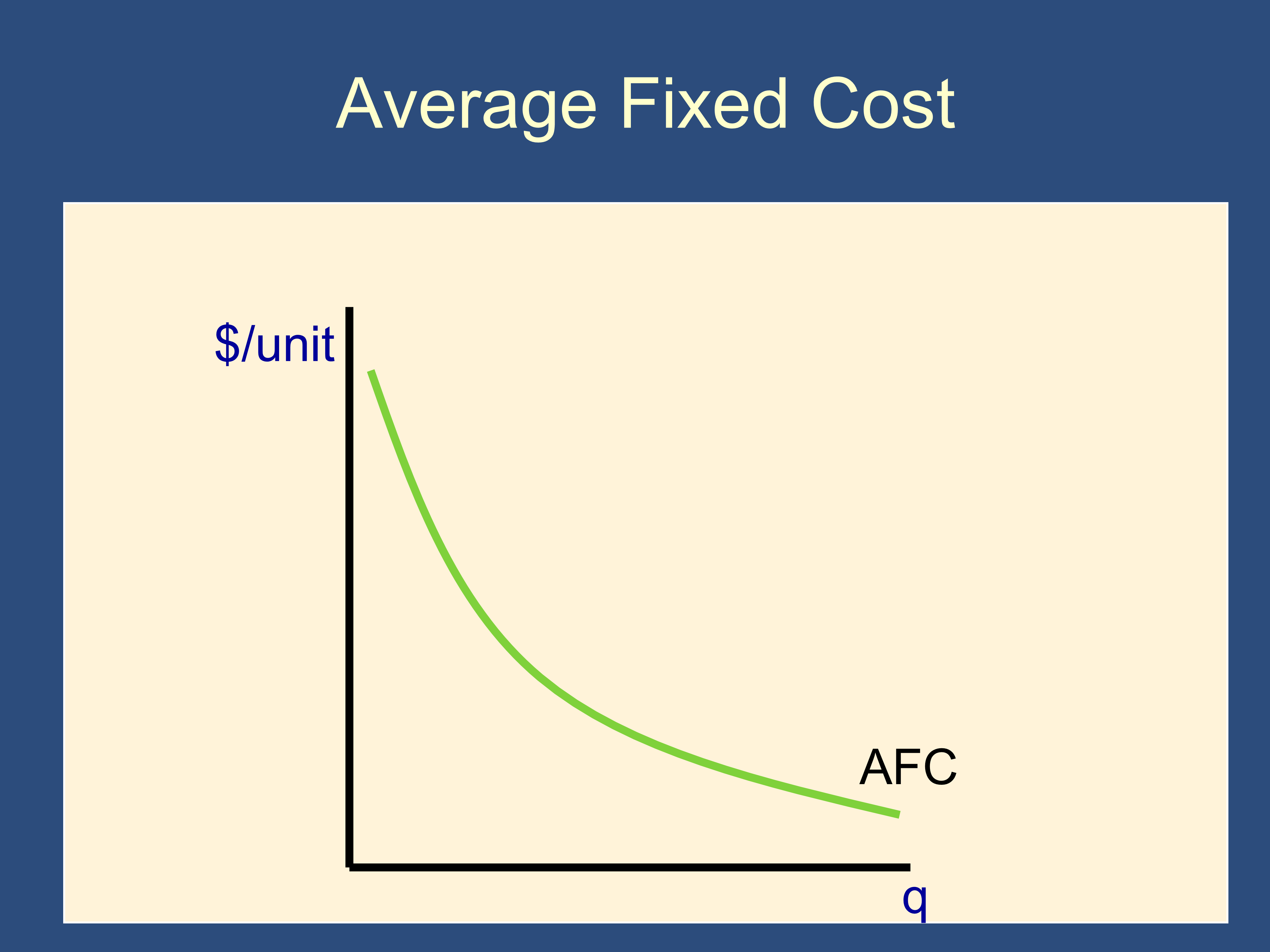
- AFC always slopes downward. It gets closer and closer to the X axis. .
- Advanced: Because , AFC is also the distance between AC and AVC.
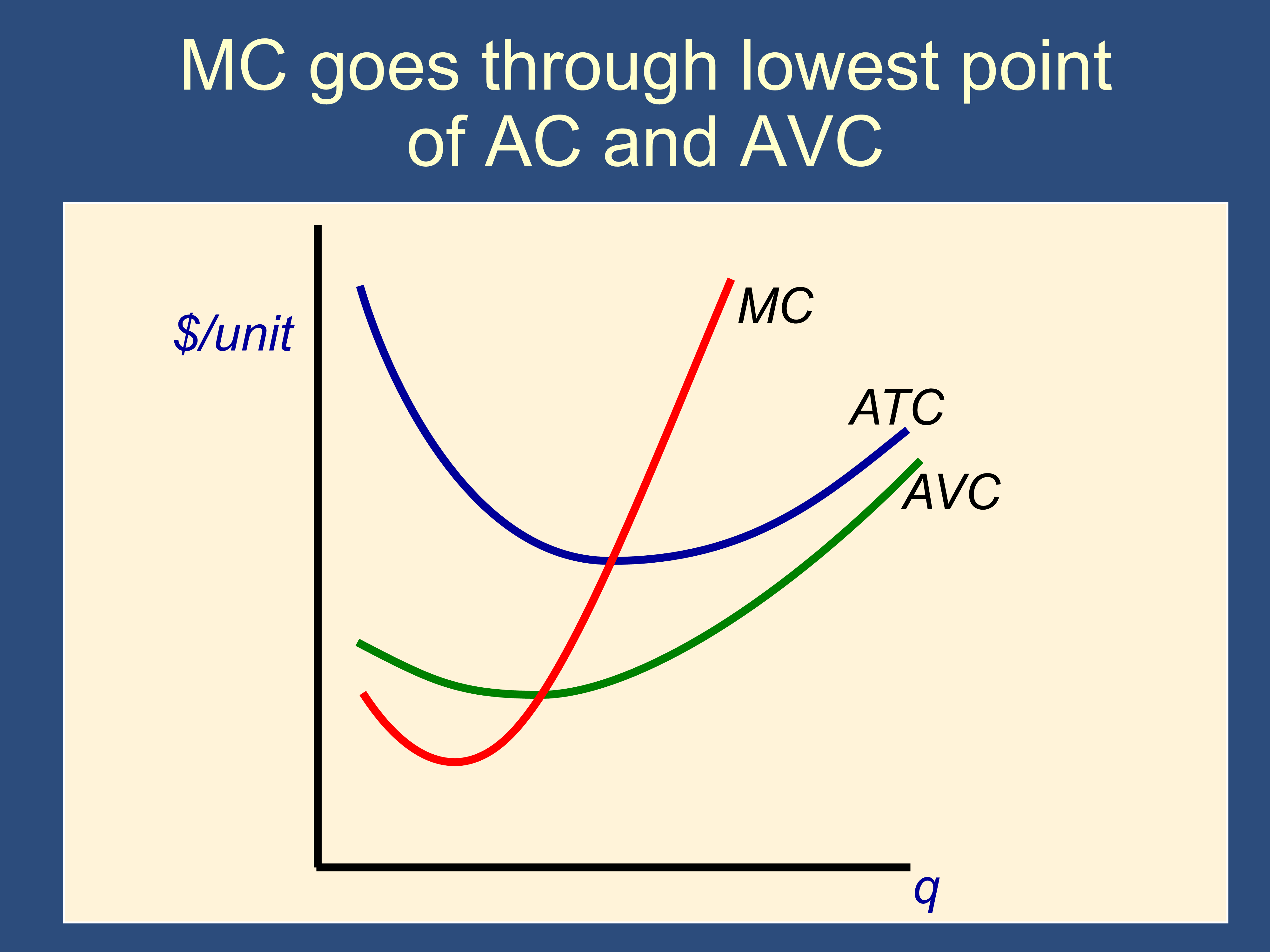
MC goes through the lowest points in AC and AVC. Advanced: When MC<AC, AC slopes down. Likewise, when MC>AC, AC slopes up. Advanced: When MC<AVC, AVC slopes down. Likewise, when MC>AVC, AVC slopes up.
✏️ Costs Fill-In-The Blanks Example
Section titled “✏️ Costs Fill-In-The Blanks Example”Fill in the empty cells in this diagram. The cells with a ❌ are not defined (ie there is no marginal cost or average costs for the zeroth unit) and you can skip the cells with a ➖.
| q | MC | AC | AVC | AFC | TC | FC | VC |
|---|---|---|---|---|---|---|---|
| 0 | ❌ | ❌ | ❌ | ❌ | 100 | ||
| 1 | 4 | 104 | 4 | 104 | 4 | ||
| 2 | 3 | 50 | 107 | ||||
| 3 | 2 | 36.33 | 3 | 33.33 | 109 | ➖ | 9 |
| 4 | 1 | ➖ | ➖ | ➖ | ➖ | 10 | |
| 5 | 2 | ➖ | ➖ | ➖ | 112 | ➖ | 12 |
| 6 | 3 | ➖ | ➖ | ➖ | 115 | ➖ | |
| 7 | 4 | ➖ | 19 | ||||
| 8 | 6 | ➖ | |||||
| 9 | 8 | ➖ | ➖ | ➖ | 133 | ➖ | 33 |
| 10 | 11 | ➖ | ➖ | ➖ | ➖ | 44 | |
| 11 | 15 | ➖ | ➖ | ➖ | 159 | ➖ | |
| 12 | 20 | ➖ | ➖ | ➖ | ➖ | 79 |
✔ Click here to view answer
Answers with hints:
| q | MC | AC | AVC | AFC | TC | FC | VC |
|---|---|---|---|---|---|---|---|
| 0 | ❌ | ❌ | ❌ | ❌ | 100 | TC=FC at 0 | Always 0 |
| 1 | 4 | 104 | 4 | 104 | 4 | ||
| 2 | 3 | TC/q = 53.5 | VC/q =AC-AFC =3.5 | 50 | 107 | 10 | TC-FC=7 |
| 3 | 2 | 36.33 | 3 | 33.33 | 109 | ➖ | 9 |
| 4 | 1 | ➖ | ➖ | ➖ | ➖ | 10 | |
| 5 | 2 | ➖ | ➖ | ➖ | 112 | ➖ | 12 |
| 6 | 3 | ➖ | ➖ | ➖ | 115 | ➖ | TC-FC= 15 |
| 7 | 4 | 119/7 | 19/7 | 100/7 | FC+VC=119 | ➖ | 19 |
| 8 | 6 | 125/8 | 25/8 | 100/8 | 119+6=125 | ➖ | 19+6=25 |
| 9 | 8 | ➖ | ➖ | ➖ | 133 | ➖ | 33 |
| 10 | 11 | ➖ | ➖ | ➖ | 133+11 | ➖ | 44 |
| 11 | 15 | ➖ | ➖ | ➖ | 159 | ➖ | 44 +15 |
| 12 | 20 | ➖ | ➖ | ➖ | 159+20 | ➖ | 79 |
Advanced: Two special cases
Section titled “Advanced: Two special cases”Bruce included two special cases in the slides. These sometimes help on homework or on the exams! I’m happy to explain them in section, but you can skip them if you like as they are advanced.
Identifying Fixed and Variable Cost from a formula
Variable cost is the part of the formula that varies.
If,
✏️ Suppose that . What are FC and VC?
✔ Click here to view answer
Clearly,
NOTE: you’ll never have to solve an equation like this!
When marginal cost is constant
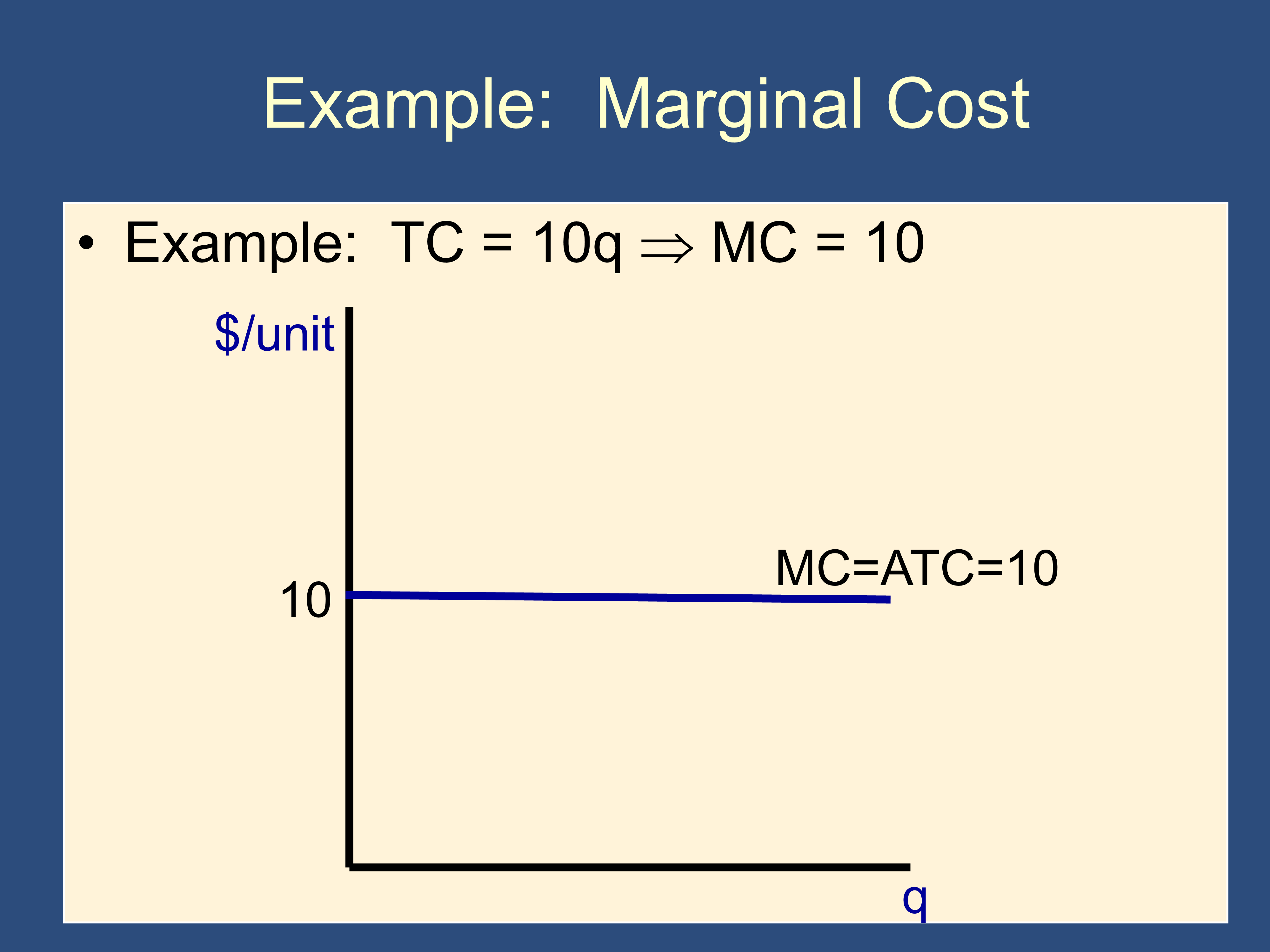
Suppose MC=10, then
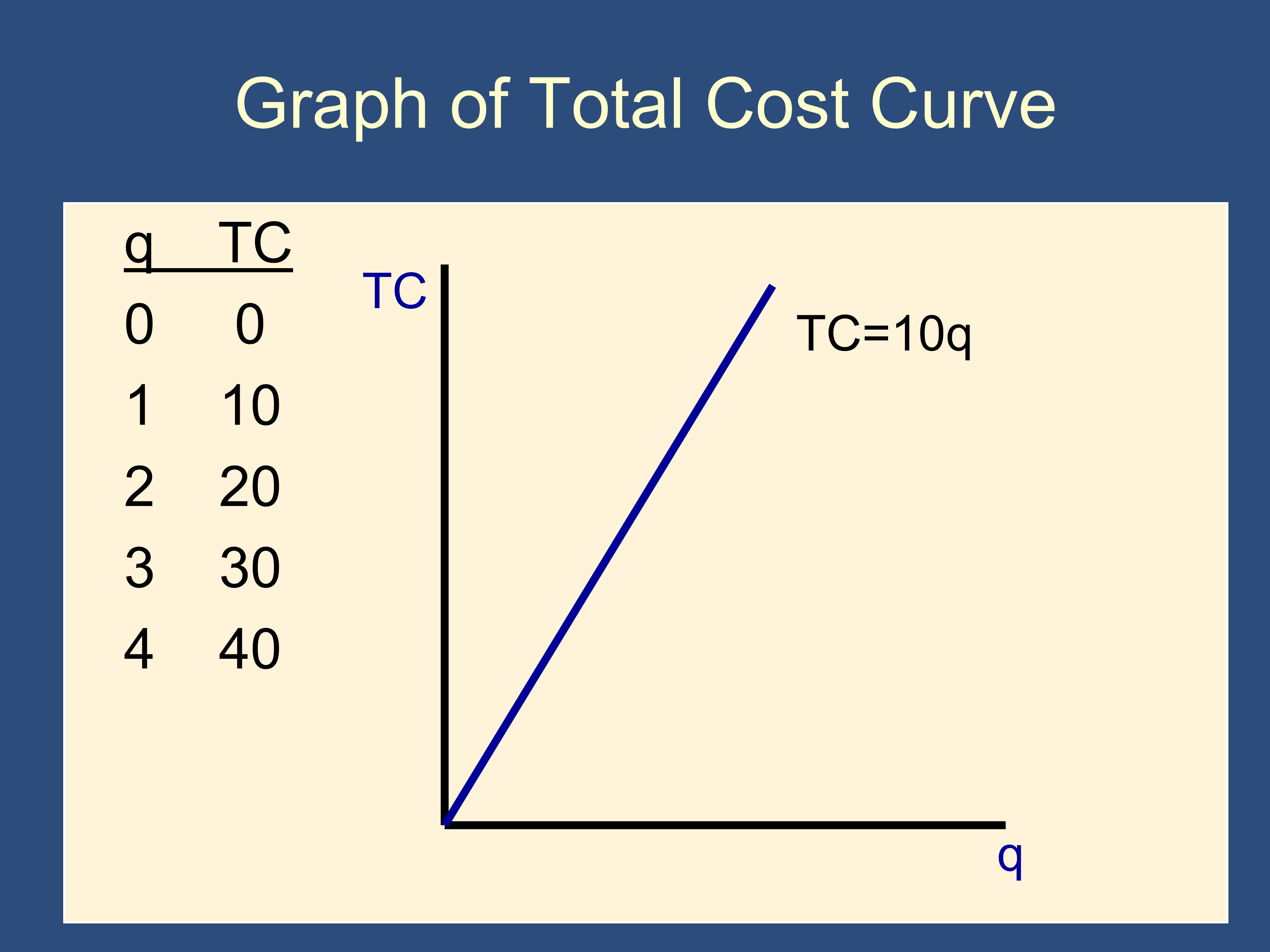
⇨ and (a straight line)
In general, if MC is constant, then
✏️ Suppose that and . What are TC and VC?
✔ Click here to view answer
Using the trick from the previous problem:
⇨ If , then
The following two slides illustrate this special case:
The following example illustrates the constant marginal cost special case from above.
What is FC, AFC, VC, AVC, MC?
FC = 150,000
AFC = 150,000/q
VC = 32q
MC = 32 (when MC is a constant number like this, TC will be a straight line, like above)
AVC = 32q/q=32
Intuition/how to think about TC in the above example: Imagine you are the entrepreneur. The picture is that you pay 150,000 to get started, and every time you produce a new widget, it costs $32 (MC=$32).
| q | 1 | 2 | 3 | 4 | 10 | 100 | 10,000 |
|---|---|---|---|---|---|---|---|
| TC | 150,032 | 150,064 | 150,096 | 150,128 | 150,320 | 153,200 | 182,000 |
Let’s examine AFC from this example:
| q | 1 | 2 | 3 | 4 | 5 | 10 | 100 | 10,000 | 1,000,000 |
|---|---|---|---|---|---|---|---|---|---|
| AFC | 150,000 | 75,000 | 50,000 | 37,500 | 30,000 | 15,000 | 1,500 | 15 | .15 |
Clearly, it is good to sell these things at large scale, because you can spread your FC across millions of units.
Takeaway: FC always declines as q increases. Bruce demonstrates this on the following slide:
Feedback? Email munger.e1010@gmail.com 📧. Be sure to mention the page you are responding to.