🔎 The IE/SE/CE arrow recipe
Pindyck and Rubinfeld: Sections 4.1 - 4.3
Substitution effect: (about relative prices)
Section titled “Substitution effect: (about relative prices)”When one price changes, suddenly one good becomes relatively more expensive and the other becomes relatively cheaper. Did this good get relatively more expensive or relatively cheaper?
For the good that is cheaper, you will substitute (buy) more, so put a ↑. For the good that is more expensive, you will substitute (i.e. buy) less, so put a ↓.
THAT’S IT.
One arrow goes up and one goes down because one good is relatively cheaper and the other good is relatively more expensive.
Income Effect: (about feeling richer or poorer)
Section titled “Income Effect: (about feeling richer or poorer)”1.) When a price changes, your purchasing power increases or decreases. Decide which. (If Price↓, purch. power increases. If Price↑, purch. power decreases)
2.) Review the following table
| Richer | Poorer | |
|---|---|---|
| Normal | Q↑ | Q↓ a |
| Inferior | Q↓ | Q↑ |
Advice: you won’t have time to review the notes, so understand the ideas behind the rules and you will remember them.
Combined Effect:
Section titled “Combined Effect:”. You just add them up.
↓ + ↓ = ↓
↑ + ↑ = ↑
If the two effects go in different directions, then “the stronger one wins”
Note:
If the price of the other good changes, then your good may become relatively more expensive or relatively cheaper.
1.) If the price of the other good drops, this good gets relatively more expensive.
For example, if you sell Fords and Chevies go on sale, then your Fords are relatively more expensive. The substitution effect will cause your sales to drop. 🙁
2.) If the price of the other good rises, this good gets relatively cheaper.
Practice
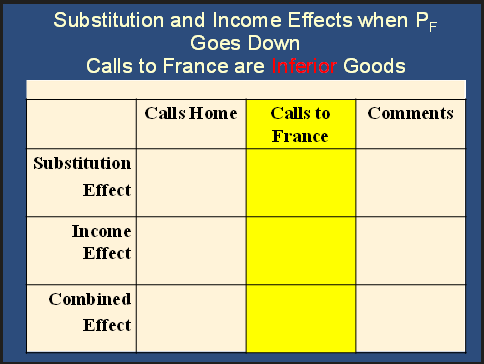
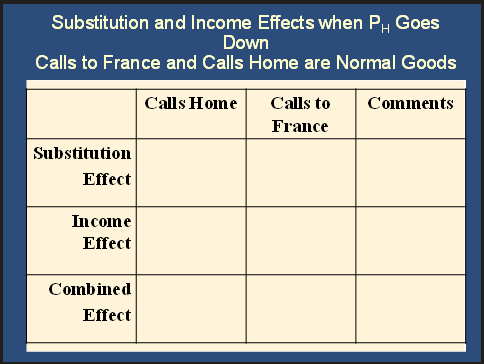
Section titled “Practice”| Calls Home | Calls to France | Comments | |
|---|---|---|---|
| Substitution Effect | |||
| Income Effect | |||
| Combined Effect |
Organic Farmers’ Market Heirloom Tomato Salad vs. 7-Eleven Nachos with Questionable Cheese Pump
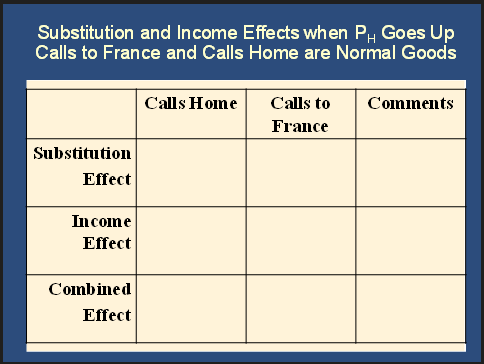
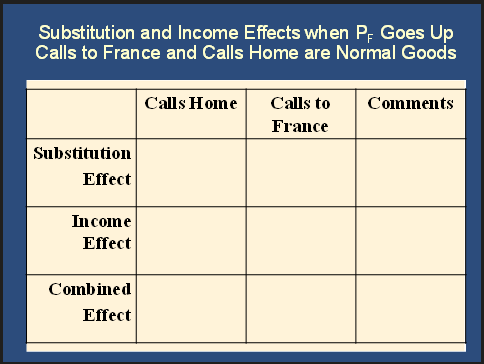
You can also use the following slides for practice.
Feedback? Email munger.e1010@gmail.com 📧. Be sure to mention the page you are responding to.